
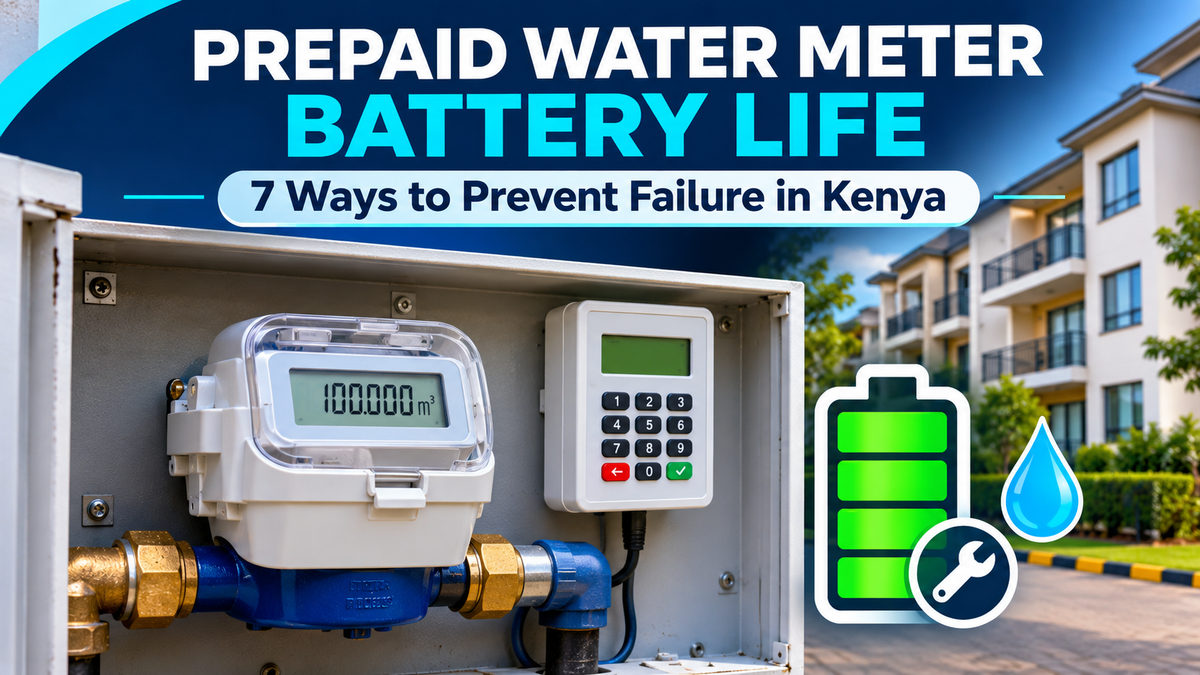
Prepaid water meter battery life is an important factor when choosing a water meter for apartments, rental properties, schools, institutions and community water projects in Kenya.
A prepaid water meter may offer secure token-based billing, M-Pesa integration and automatic water control. However, its long-term reliability also depends on the battery powering its electronic components and control valve.
What happens when the battery runs low? How long should a prepaid water meter battery last? Can poor maintenance cause unexpected water disconnections?
These are important questions for landlords and water-project operators planning installations that must remain reliable for many years.
This article explains seven practical ways to extend prepaid water meter battery life, understand warning signs and reduce the risk of unexpected meter failure.
How Long Does a Prepaid Water Meter Battery Last?
A prepaid water meter can be designed to operate for several years without battery replacement, but the expected lifespan depends on the specific meter model and operating conditions.
For example, the manufacturer of the Shanghong SH5112 STS prepaid water meter specifies a battery lifespan of at least six years under stated operating conditions.
Importantly, its technical specifications indicate that battery longevity depends on communication settings and how frequently the meter’s valve operates.
Therefore, a six-year battery specification should not be interpreted as an unconditional guarantee.
Property owners should always request the manufacturer’s battery specifications, warranty terms and maintenance recommendations before purchasing meters.
For more information on prepaid-meter applications, see Dotmobi STS Prepaid Water Meters in Kenya.
Why Prepaid Water Meter Battery Life Matters
Unlike an ordinary mechanical water meter, an electronic prepaid water meter may contain several power-consuming components:
- Electronic measurement or pulse-counting circuitry
- A prepaid credit-management module
- An internal control valve and actuator
- A display or communications interface
- Wireless communication components, where fitted
- Alarm and monitoring functions
The amount of electricity consumed depends on how these components operate.
A meter that communicates frequently, opens and closes its valve repeatedly or operates in challenging environmental conditions may consume battery capacity more quickly than one operating under favourable conditions.
This means battery longevity should be considered part of the total cost of owning a prepaid water-meter system.
1. Choose a Prepaid Water Meter With a Long-Life Battery
The first way to improve prepaid water meter battery life is to select a meter designed for low power consumption.
Modern prepaid meters commonly use batteries designed to provide long-term operation.
When assessing a meter, check:
- The battery technology and capacity
- The manufacturer’s expected service life
- Whether battery replacement is supported
- How the meter indicates low battery voltage
- Whether the battery compartment is sealed
- The manufacturer’s operating-temperature range
- Whether battery life has been calculated for normal valve and communication activity
The Shanghong SH5112 prepaid water-meter range uses low-power circuitry and provides an independently accessible battery compartment in its published product description.
These features can reduce maintenance complexity, provided that servicing follows the approved procedures.
A long battery life is beneficial, but battery replaceability and local technical support are equally important.
2. Reduce Unnecessary Valve Opening and Closing
A prepaid water meter often contains an electrically operated valve that controls water supply according to the available prepaid credit and configured operating rules.
Every valve operation requires energy.
If a meter frequently closes because credit has been exhausted and reopens after small purchases, battery demand may increase.
The manufacturer Shanghong explains that repeated valve operation can shorten battery lifespan.
Property managers can help reduce unnecessary operations by encouraging customers to maintain sufficient water credit and by ensuring that the vending system works reliably.
However, essential consumer protections, low-credit warnings and properly configured safety controls should not be disabled merely to conserve battery power.
The objective is efficient operation, not restricting legitimate access to water.
3. Protect Water Meters From Flooding, Heat and Physical Damage
The installation environment can influence battery performance and the reliability of the electronics.
Prepaid water meters are sometimes installed in underground chambers, outdoor cabinets, exposed pipework or shared utility spaces.
Poorly protected installations may be exposed to:
- Flooding
- Excessive heat
- Physical damage
- Corrosion
- Mud and sediment
- Water entering damaged enclosures
- Unauthorised interference
Even where a meter has a high ingress-protection rating, installers must follow the manufacturer’s specific requirements for mounting, connectors, cable seals and maintenance access.
A meter rated IP68, for example, should not automatically be assumed suitable for every possible duration or depth of immersion.
Dotmobi recommends planning the installation location carefully and ensuring the equipment remains accessible to authorised technicians.
See our article on prepaid water meter installation in Olkeri for an example of installation work in Kenya.
4. Monitor Low-Battery Alerts Before Water Supply Is Interrupted
One important feature to consider when selecting a prepaid water meter is how the device reports low battery voltage.
Depending on the model, the meter may provide a display warning, error code, customer-interface notification or remote alert.
Some meter designs may close their internal valve when the battery reaches a critical threshold. Others may behave differently.
Therefore, the response to low battery voltage must be confirmed for the exact installed meter model.
A low-battery warning should trigger a maintenance assessment rather than being ignored until the customer loses water supply.
Property managers should maintain records of:
- Meter serial number
- Installation date
- Battery type
- Battery replacement history
- Reported low-voltage warnings
- Date of last inspection
- Outstanding maintenance issues
A structured maintenance record can help identify devices that require attention before customers experience service disruption.
5. Avoid Excessive Communication and Poor Wireless Configuration
Not all prepaid water meters have the same communication architecture.
Some primarily use locally entered STS tokens, while others include additional communication modules for remote reading, alerts or management.
For connected meter configurations, communication activity may consume additional battery power.
Frequent reporting or repeated attempts to communicate under weak-signal conditions can affect energy consumption.
Where adjustable communication settings exist, the installer should choose a reporting schedule suitable for the application and approved by the supplier.
For example, a meter used mainly for prepaid credit management may not need the same reporting frequency as an industrial monitoring system requiring frequent operational updates.
The correct balance depends on the system’s intended functionality.
For customers considering separate keypads and communication arrangements, read our comparison of wireless CIU and integrated keypad prepaid water meters in Kenya.
6. Maintain the Valve and Water Installation Properly
Battery problems and mechanical valve problems can sometimes produce similar symptoms.
For example, a meter may stop supplying water because of:
- Exhausted prepaid credit
- A low-battery condition
- A valve fault
- Sediment interfering with valve movement
- A communication problem
- A token-loading problem
- A water-supply interruption
It is important not to assume that every closed valve means the battery has failed.
Correct installation and appropriate water-system maintenance can reduce avoidable valve problems.
A reliable installation should consider sediment, pipe sizing, permitted operating pressure and the manufacturer’s recommended installation conditions.
The World Bank’s research on prepaid water systems in Africa documented the importance of maintainability, replacement parts and operational reliability in prepaid-water installations.
For related guidance, see Dotmobi’s article on water meter accuracy and installation checks.
7. Establish a Preventive Maintenance and Battery Replacement Plan
The seventh and perhaps most important way to protect prepaid water meter battery life is to establish a structured maintenance programme.
Many property owners focus on the initial purchase and installation costs but overlook the long-term maintenance requirements.
For a development with 100 prepaid water meters, even a modest number of failures can create significant inconvenience if spare parts and servicing arrangements have not been planned.
A preventive maintenance programme should include:
- A complete register of installed meters
- Manufacturer and model details
- Installation and commissioning dates
- Battery specifications
- Low-battery warning procedures
- Approved battery replacement methods
- Availability of spare batteries and CIUs
- Records of service incidents
- A responsible person or service provider
- Periodic review of recurring faults
Battery replacement should be performed only as recommended by the manufacturer or an authorised technician.
Using an incorrect battery, opening a sealed compartment improperly or bypassing protective systems can damage the equipment, compromise seals or create safety problems.
Preventive maintenance is generally more effective than waiting for a meter to fail unexpectedly.
Prepaid Water Meter Battery Life: Warning Signs to Watch For
A property manager should investigate when customers report unusual meter behaviour.
| Warning sign | Possible explanation | Recommended action |
|---|---|---|
| Low-battery message | Battery voltage below warning threshold | Arrange a technical inspection |
| Display not functioning | Battery, display or electronics fault | Check approved diagnostics |
| Meter valve not opening | Credit, valve, battery or control fault | Verify status before repair |
| CIU cannot communicate | CIU power, pairing or communication issue | Check the CIU and meter separately |
| Frequent unexpected shutdown | Control, electrical or mechanical problem | Review event and maintenance records |
| Repeated token-entry problems | Token or communication fault | Verify token and meter status |
Important: These symptoms do not prove that the battery is defective. Diagnosis should follow the manufacturer’s approved procedures.
If a water token fails to load, see Prepaid Water Meter Token Failures: 9 Fixes.
What Happens When a Prepaid Water Meter Battery Dies?
The outcome depends on the meter design.
A depleted battery may prevent the meter from displaying information, communicating with a CIU or operating its valve correctly.
Some models are designed to close the valve under critical low-voltage conditions, while others follow different control strategies.
Customers should not attempt to bypass the meter, cut wiring or dismantle sealed equipment.
Instead, they should contact the installer or technical support team and provide the meter serial number, displayed fault code and description of the problem.
Before requesting battery replacement, confirm that the meter has sufficient credit and that the incoming water supply is available.
Is a Replaceable Battery Better Than a Sealed Battery?
A replaceable battery can simplify long-term servicing when the meter was designed for safe field replacement.
A sealed battery arrangement may offer other protection benefits, but battery replacement could require specialised servicing or replacement of an electronic module.
Neither arrangement is automatically superior.
When selecting prepaid meters, ask the supplier how battery replacement works, what it costs and whether the meter must be removed from the pipe.
For apartment buildings and water schemes with many meters, these questions can significantly affect operating expenditure.
Why Battery Performance Should Be Part of the Buying Decision
Imagine two prepaid water meters offered at different prices.
One is cheaper initially but has poorly documented battery life, limited spare parts and no clearly defined maintenance procedure.
The other is more expensive but includes documented battery specifications, suitable low-voltage warnings and local technical support.
The cheapest meter may not necessarily be the better long-term investment.
Buyers should evaluate the total cost of ownership, including installation, expected maintenance, battery replacement, downtime and technical support.
This is especially important when purchasing prepaid water meters for apartments, institutions and large residential developments.
Read our guide to prepaid water meters for apartments in Kenya for additional purchasing considerations.
Dotmobi STS Prepaid Water Meters in Kenya
Dotmobi LLP supplies and supports prepaid water-meter solutions for residential, institutional and commercial applications.
Our solutions can support secure STS token-based prepaid operation and M-Pesa-enabled credit purchasing for compatible meter configurations.
Potential applications include:
- Rental apartments
- Stand-alone houses
- Gated residential communities
- Hostels and schools
- Commercial premises
- Staff housing
- Community water projects
- Borehole distribution schemes
When planning an installation, Dotmobi can help customers assess meter configuration, installation conditions, customer-interface requirements and the appropriate management platform.
Customers should also consider the long-term servicing requirements of the selected equipment.
Explore our STS Prepaid Water Meters in Kenya product page.
Frequently Asked Questions About Prepaid Water Meter Battery Life
How long does a prepaid water meter battery last?
Battery life varies by model and use. Shanghong publishes a battery lifespan of at least six years for its SH5112 STS prepaid water-meter range under specified conditions. Actual service life depends on operating conditions.
Can a prepaid water meter work when the battery is low?
This depends on its design and remaining battery capacity. Some meters continue operating while showing a warning, while others may restrict certain functions or close the valve at a critical threshold.
Does frequent token purchasing reduce prepaid water meter battery life?
Entering a token is not necessarily a major source of battery consumption. However, frequent valve operations associated with credit exhaustion and reconnection can increase power demand.
Can the battery in a prepaid water meter be replaced?
Some models provide replaceable battery compartments, while others require specialised servicing. Always follow the approved procedure for the exact meter model.
Can a low battery stop water supply?
Yes, some prepaid water meters are configured to close the internal valve when battery voltage becomes critically low. The behaviour depends on the manufacturer and model.
Does a wireless CIU have a separate battery?
Some CIUs use replaceable batteries, while others use different power arrangements. The CIU power supply and the main meter battery must be assessed separately.
How can landlords avoid unexpected prepaid water meter failures?
Landlords should select suitable meters, maintain installation records, monitor warnings, keep approved spare parts available and arrange periodic technical checks.
Conclusion: Protect Prepaid Water Meter Battery Life Through Proper Maintenance
Prepaid water meter battery life should be considered from the moment a meter is selected until the end of its operating life.
Reliable prepaid water management requires more than secure tokens and convenient payment methods.
It also requires correct installation, suitable battery technology, efficient valve operation, dependable technical support and a preventive maintenance strategy.
For landlords and water-project operators in Kenya, investing in reliable equipment and maintenance planning can help reduce avoidable service interruptions and protect the value of the metering system.
Contact Dotmobi for Prepaid Water Meter Solutions
Planning prepaid water-meter installation for apartments, rental properties, institutions or community water projects?
Dotmobi LLP can assist with prepaid water-meter selection, compatible M-Pesa vending integration and implementation planning.
Visit our prepaid water-meter product page or contact Dotmobi to discuss your requirements.
A good prepaid water meter should not only collect payments reliably. It should also remain dependable throughout its service life.