Water meter accuracy matters whenever a reading determines how much a household, tenant or business pays. But can a meter register air instead of water when supply returns after an interruption? For certain mechanical meters, research shows that this can happen during pipe refilling.
That finding deserves attention wherever customers experience stop-start supply, empty pipelines or repeated interruptions. It also needs careful explanation. A high bill does not automatically mean that someone has been charged for air, and different meter designs do not behave identically.
Can a Water Meter Count Air?
This guide explains the issue and provides seven practical checks for customers, landlords, borehole operators and water-project managers in Kenya. The aim is to investigate unusual readings with evidence and protect fair billing.
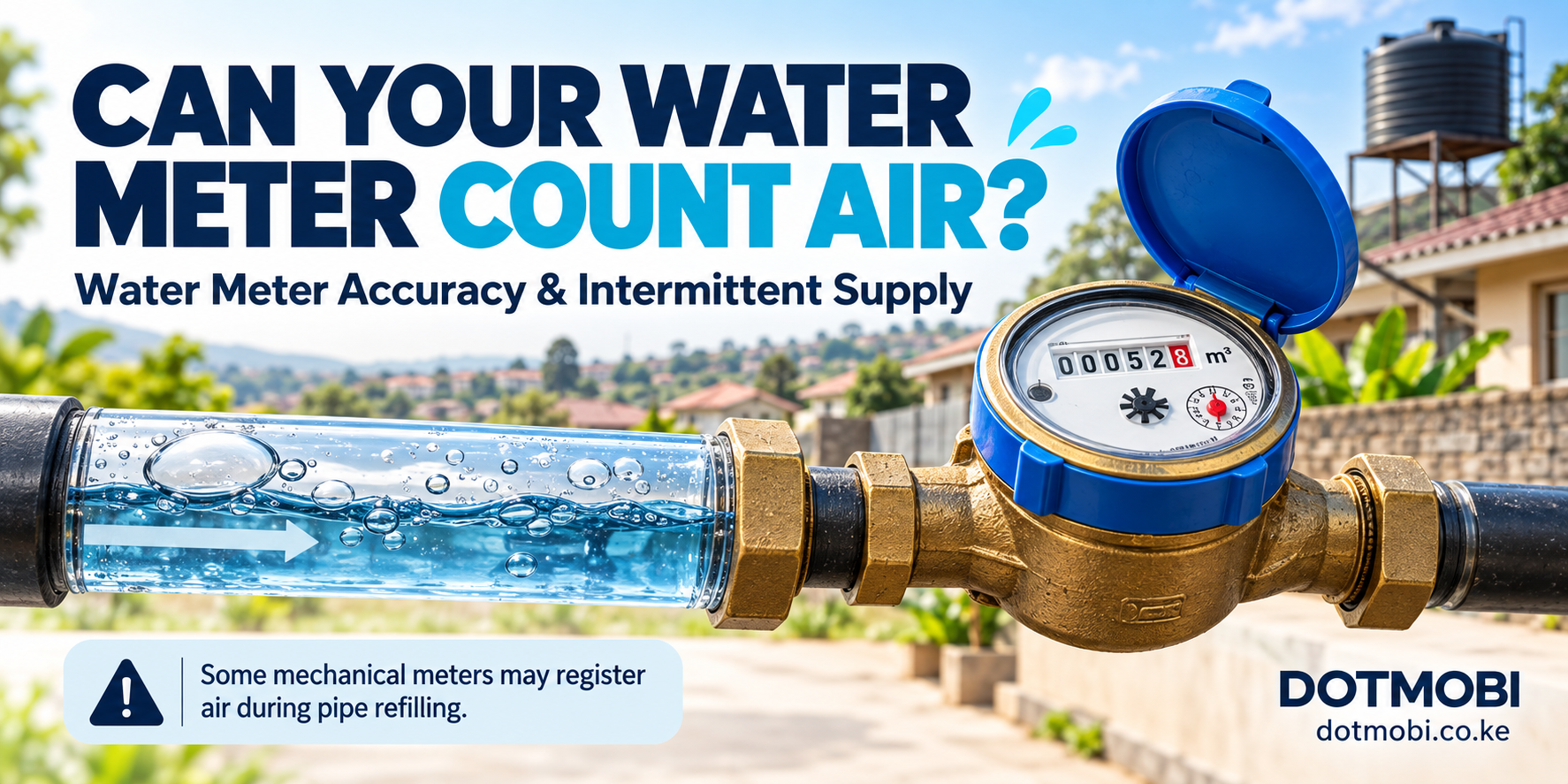
Yes, some mechanical water meters can register air passing through them during pipe refilling. Research on single-jet meters found that air discharged before the water reached the meter could produce measurement errors. This is evidence about the tested meters and conditions, rather than a universal rule for every installation.
The study, Accuracy of single-jet water meters during filling of the pipe network in intermittent water supply, examined this behaviour experimentally.
Imagine a supply pipe that has partly emptied during an interruption. When water returns, it pushes the air ahead of it. If some of that air exits through a customer connection, it may pass through the meter before a steady water flow arrives.
In an affected mechanical meter, movement associated with that airflow can advance the register. The reading then needs interpretation alongside the actual supply conditions.
Water meter accuracy therefore involves more than checking whether a display is working. The meter must be suitable for its application, installed correctly and assessed when operating conditions create doubts about its readings.
How Intermittent Supply Creates a Measurement Challenge
Intermittent supply means that piped water is available only at certain times or stops and starts. Whether a particular interruption introduces air depends on the network, pressure, drainage and plumbing arrangement.
An interruption alone does not prove that the customer’s meter has encountered air. Some pipes remain full. Others partly drain, allowing a refilling event when supply resumes.
A 2023 laboratory study of remedial measures examined air-related over-registration and meter reliability during refilling. It also tested air-release valves and an unmeasured-flow reducer, finding reductions in over-registration under the investigated conditions.
The practical implication is that the complete installation deserves attention: pipes, filling conditions, air-management arrangements and the meter itself. These findings do not provide a standard correction percentage for Kenyan bills.
Treat water meter accuracy as an investigation with several possible explanations. A tank filling after an outage, for example, can create real consumption even when nobody is using a tap inside the building.
Why Water Meter Accuracy Matters for Kenyan Properties
For landlords, an unexplained reading can become a tenant dispute. For a community water project, uncertainty can weaken confidence in collection records. For a household, it can make budgeting difficult.
The issue is relevant to Kenyan properties that experience supply interruptions, although the cited international experiments do not establish how common air-related billing errors are locally.
Several operating questions help frame the investigation. Does the incoming pipe remain full? Is there a storage tank? Does the meter serve one unit or several? Is a recent bill based on an actual reading or an estimate?
Improving water meter accuracy begins by understanding these details. Buying a newer meter without checking the underlying conditions can leave the original concern unresolved.
The following seven checks are recommended steps for collecting evidence and deciding what professional assessment is needed. They are not a substitute for an authorised meter test.
1. Check the Bill Before Questioning Water Meter Accuracy
Start with the account and the meter identification. Confirm that the serial number on the bill matches the installed meter. Then compare the opening and closing readings with available photographs or records.
Check the reading dates as well. A bill covering a longer period can show more consumption even where daily use has remained similar. An estimated bill followed by an actual reading may also require careful reconciliation.
Separate volume from money. Water consumption, tariffs, standing charges, sewerage charges and arrears are different parts of an account. A higher amount payable does not necessarily mean a higher measured volume.
Questions to ask include:
- Was the bill based on an actual reading or an estimate?
- Does the account use the correct meter serial number?
- Are the opening and closing readings consistent?
- Has the billing period or applicable tariff changed?
- Does the total include earlier unpaid charges?
A water meter accuracy enquiry is easier to follow when it includes a copy of the bill and the visible reading. This gives a clear starting point for discussing water meter accuracy with the provider.
2. Record What Happens When Water Supply Returns
If your concern relates to an interruption, timing is important. Record when supply stopped and when it returned, together with any observations made safely from accessible areas.
Where practical, photograph the meter before and after the event. Note whether the tank was refilling, fixtures were open, pumps were running or other users were drawing water.
A short video can help show the sequence, especially if there is sputtering at a tap. However, sputtering alone does not establish that the meter over-registered or quantify any error.
For a prepaid meter, distinguish the cumulative volume reading from the remaining credit. Record both if available, and note any token loaded during the observation period.
Useful information includes the date, time, meter serial number, reading, supply status and known water use. Do not remove a meter, interfere with its seal or open pressurised pipework to collect evidence.
Repeated observations of water meter accuracy are often more informative than one event. They help an assessor examine water meter accuracy in relation to supply interruptions rather than relying on memory.
3. Check for Genuine Consumption and Leaks
Before attributing a reading to air, account for water actually entering or leaving the property. Storage tanks, toilet cisterns, irrigation and shared connections can explain consumption that is not immediately visible.
A tank may continue filling after household taps have been closed. Similarly, a leaking toilet may use water without making an obvious noise. Ask whether all outlets and automatic filling arrangements have been considered.
The US Environmental Protection Agency’s home-maintenance guidance recommends comparing meter readings during a period when no water is being used. A changed reading can indicate a leak.
For a property with tanks or shared plumbing, the observation period must account for those arrangements. Otherwise, legitimate filling may be mistaken for a leak or a measurement problem.
Water meter accuracy should be considered alongside leak detection, rather than used as an alternative explanation before leaks have been assessed.
To separate leaks from water meter accuracy concerns, ask a plumber to inspect suspected leaks and unclear connections. Keep the findings with the meter records so the provider can review the complete picture.
4. Identify the Meter Type and Its Operating Limits
Find the manufacturer, model, serial number and available technical documentation. A blue cover or a digital display does not tell you enough about the measuring principle.
Water meter accuracy depends on the specific model and its operating conditions. Mechanical single-jet, multi-jet, volumetric and ultrasonic meters need to be assessed using their own specifications.
Ask the supplier for written information about installation orientation, flow range, pressure limits and any requirement for the meter to remain filled with water. Request guidance on intermittent supply if that describes your site.
The word “smart” also needs clarification. It may describe remote reading, communications or data processing. It does not explain every aspect of how the underlying meter measures volume.
Likewise, “prepaid” describes a payment and credit-control arrangement. A prepaid system still relies on the measurement produced by its meter.
For water meter accuracy, ask a precise question: what evidence shows that this particular model is suitable for the conditions at this particular property?
Avoid assuming that one successful installation proves suitability for all networks.
5. Request a Professional Installation and Air-Management Review
A competent installer or the water provider should review an affected installation before changes are made. The inspection should consider the meter arrangement, pipe routing, tanks and how the system behaves during supply restoration.
Where air is suspected, ask whether the network requires professionally designed air management. An air-release device must be selected and positioned for the application; a generic accessory is not automatically a solution.
The 2023 research supports investigating remedial measures, but does not establish that one device eliminates all air-related errors in every building.
For water meter accuracy, request an explanation of the proposed change, the conditions it addresses and how its performance will be checked afterwards.
Never fit a bypass or interfere with utility equipment as a response to a disputed bill. Arrange changes through the responsible provider or authorised installer and preserve records of the work.
Useful records include the inspection date, findings, photographs, parts installed and any post-installation observations. That documentation helps distinguish a verified improvement from an assumption that the problem has disappeared.
6. Request an Authorised Water Meter Accuracy Test
If doubts remain, ask the provider or an appropriate metrology service about the available testing procedure. Explain the concern clearly and supply the records already collected.
A water meter accuracy test should have a defined method, reference equipment and written results. Ask which flow conditions will be tested and how the meter’s performance will be evaluated.
If the concern specifically involves air during supply restoration, say so. A normal water-only test and an investigation of unusual field conditions answer different questions.
A meter might perform acceptably in a controlled test while an installation concern still requires assessment. Equally, an unexpected field reading does not establish that the meter itself is defective.
Request a report identifying the meter, the date, the test conditions and the conclusions. Ask the provider to explain its process for investigating the account and considering any adjustment.
Do not invent a deduction based on an overseas laboratory result. Any correction needs evidence relevant to the account and the provider’s applicable procedure.
7. Choose a Replacement Using Evidence
If replacement is recommended, select the model based on the site’s operating conditions and documented suitability. Price, appearance and a broad “smart meter” description are not enough.
Ask what the replacement is expected to improve. Is the problem measurement performance, installation suitability, communication failure, credit control or maintenance? These require different remedies.
A purchasing discussion should address water meter accuracy, approved application, installation requirements, support and the practical method for checking performance after commissioning.
Also ask about warranty terms, spare parts, battery or communications arrangements where applicable, and the records supplied at handover. An unsupported meter can create difficulties even if its initial reading appears satisfactory.
Have the old meter’s closing reading and the new meter’s starting reading recorded. Keep their serial numbers, replacement date and commissioning documentation together.
Finally, agree on a follow-up observation period. Comparing well-documented readings after the change gives a stronger basis for assessing the outcome than simply assuming a new device must be correct.
A Hypothetical Example of the Billing Impact
Consider a household whose genuine monthly consumption is 12 cubic metres. Suppose an investigation establishes an additional 0.5 cubic metres of registration that should not have been billed.
At a hypothetical volumetric charge of KES 100 per cubic metre, that difference would represent KES 50 for the month. Across 100 similarly affected accounts, the illustrative total would be KES 5,000.
These figures demonstrate the arithmetic only. They are not measured Kenyan losses, a claim about any provider, a typical error rate or an actual tariff.
Use the same principle when reviewing your own account: first establish the disputed volume, then apply the relevant billing arrangement. Do not start with an assumed percentage.
Water meter accuracy matters even when the amount for one account appears small. However, the proper response is still evidence-based investigation, rather than multiplying an unverified suspicion across an entire estate.
Does Prepaid Billing Prevent Air-Related Errors?
Prepaid metering can improve payment control, but it does not automatically establish water meter accuracy. The payment system and the measuring element perform different roles.
If an affected measuring element registers a volume incorrectly, a system using that registration could reflect it in a credit deduction. Whether this occurs depends on the meter and its configuration.
Similarly, remote monitoring can help retain and compare records, but a dashboard does not independently prove that the physical measurement is correct.
The appropriate approach combines suitable measurement hardware, correct installation, useful records and a clear investigation process.
Readers considering payment control can explore Dotmobi’s STS prepaid water meters in Kenya. A purchasing discussion should address the intended supply conditions as well as billing features.
For a practical deployment example, read about prepaid water meter installation in Olkeri. That installation article should not be treated as proof of air immunity.
A Simple Log for Investigating Water Meter Accuracy
Use a consistent log rather than scattered messages. One sheet can capture each observation and make it easier for an assessor to compare events.
| Item | What to record |
|---|---|
| Meter identity | Serial number, manufacturer and model |
| Observation | Date, time, cumulative reading and photograph |
| Supply | Interruption and restoration times |
| Property use | Open fixtures, tank filling, pumps and shared users |
| Prepaid records | Remaining credit, tokens loaded and transaction times |
| Follow-up | Inspection findings, reports and corrective work |
When investigating water meter accuracy, record facts separately from interpretations. “Reading increased from X to Y while the tank was filling” is more useful than “the meter stole water.”
For water meter accuracy investigations, uncertainty is also worth recording. If you do not know whether another tenant used water, say so. This avoids presenting an incomplete observation as a controlled test.
Keep the original photographs and reports. Clear records can support a fair discussion between customers, landlords, suppliers and technicians.
Questions to Ask Before Buying a Water Meter
A short written enquiry about water meter accuracy can prevent misunderstandings about what a meter is designed to do. Describe the application first: household, tenant supply, bulk supply, borehole or community scheme.
Explain whether supply is continuous or intermittent and whether the meter sits before or after a tank. Include known pressure or flow information if an installer has established it.
Then ask:
- Which exact model is recommended for this installation?
- What documentation supports its measurement performance?
- What conditions must be maintained for correct operation?
- How does the manufacturer address air or an empty measuring section?
- What does commissioning include?
- Who handles testing, faults and after-sales support?
Do not accept an unsupported statement that a model “cannot count air.” Ask for the relevant technical documentation or test evidence.
Good purchasing decisions connect water meter accuracy to the real installation. They also give the buyer a clear route for resolving problems after handover.
Frequently Asked Questions About Water Meter Accuracy
Can all water meters count air?
No universal claim is justified. Published experiments demonstrate air-related registration in particular mechanical meters under particular conditions. Other technologies and models require their own assessment.
Does a high bill prove that I have been charged for air?
No. Genuine consumption, leaks, tank filling, estimated readings, account errors and charges can all require investigation. Check the account and operating records before assigning a cause.
Is an ultrasonic meter automatically a complete solution?
Do not assume so. Ask for the exact model’s operating requirements, response to air or an empty measuring section, and suitability for the installation. Select equipment using documented evidence.
Can an air-release valve guarantee water meter accuracy?
No general guarantee should be made. A professionally selected arrangement may help address air-management conditions, but its suitability and performance need assessment for the actual system.
Should I remove the meter to test it myself?
Arrange testing through the provider or an appropriate authorised service. Keep seals intact and avoid working on pressurised equipment. Customer observations are useful evidence, but they are not formal calibration.
Does a prepaid meter eliminate measurement disputes?
Prepaid billing changes payment control. Water meter accuracy still depends on the measuring element, installation and operating conditions. Keep both volume and credit records when investigating a concern.
Discuss Your Water Meter Installation With Dotmobi
For Kenyan landlords, institutions and water projects considering prepaid metering, start with a clear description of the water system and the billing objective.
Explore Dotmobi’s prepaid water-meter solution and use the questions in this guide when discussing equipment selection and installation.
Ask about suitability for your supply conditions, commissioning records, credit management and after-sales support. Where an existing utility bill is disputed, involve the responsible provider in the investigation.
Protecting water meter accuracy starts with reliable measurement, a suitable installation and evidence that everyone can review.