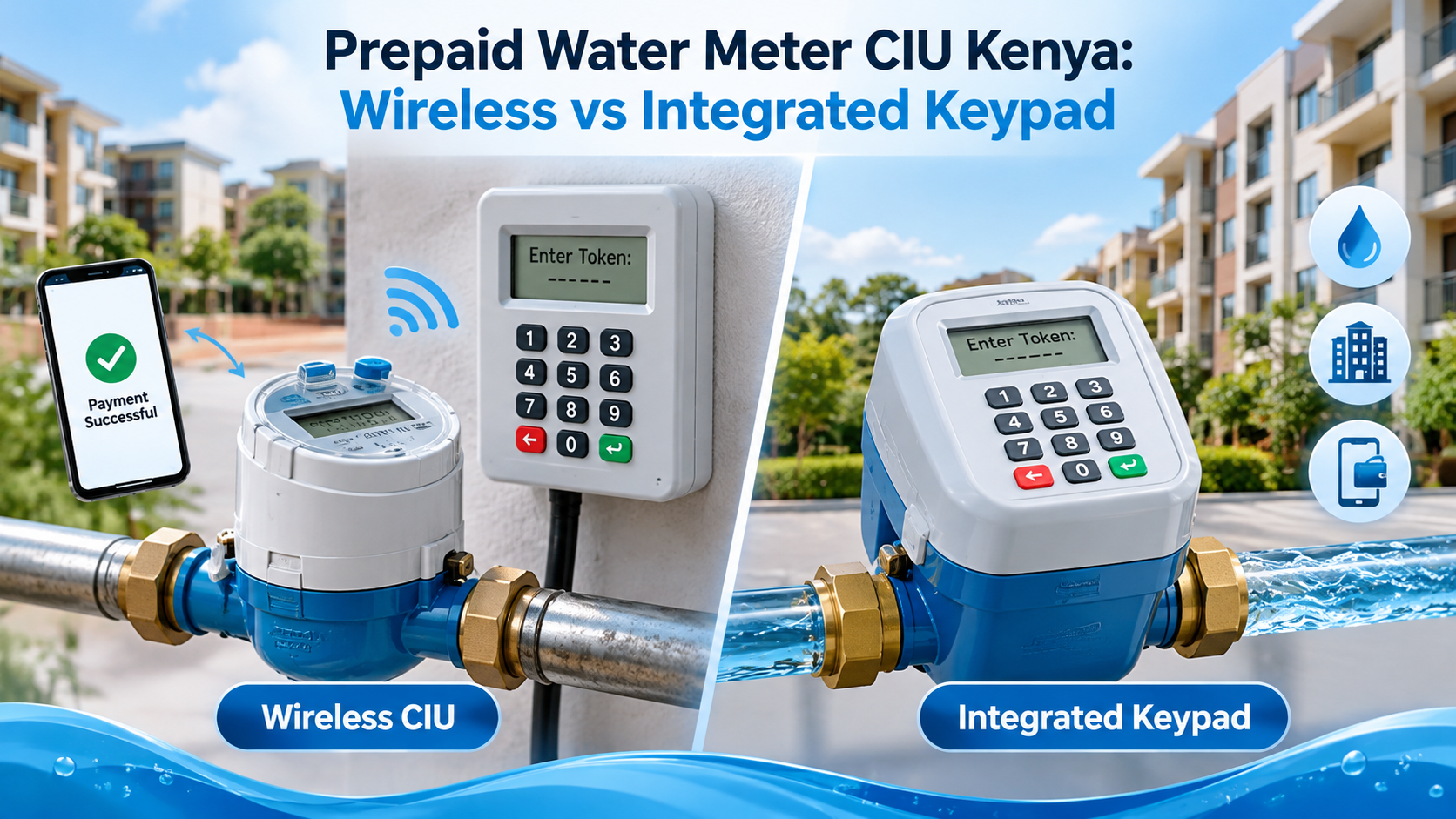
A wireless CIU prepaid water meter can make prepaid water management more convenient for apartments, rental properties and institutions where the physical meter is installed away from the customer.
When buying prepaid water meters in Kenya, one important decision is whether to choose a wireless CIU prepaid water meter or an integrated keypad prepaid water meter.
Both systems can allow consumers to buy water credit before consumption. Both can support token-based prepaid operation. Both can help landlords, property managers, institutions and water projects reduce the problems associated with collecting water charges after consumption.
However, the two configurations are not the same.
The right choice depends on where the water meter will be installed, how tenants will enter tokens, how accessible the meter is, the layout of the property and the level of convenience required.
This guide compares a wireless CIU prepaid water meter with an integrated keypad meter and explains where each configuration may work best in Kenya.
If you are new to prepaid water metering, first see Dotmobi’s STS Prepaid Water Meters in Kenya product page for an overview of prepaid billing, applications and benefits.
What Is a Wireless CIU Prepaid Water Meter?
CIU stands for Customer Interface Unit.
In a wireless CIU prepaid water meter system, the actual water meter and the customer keypad are separate devices.
The water meter is installed on the water pipe while the customer uses a separate CIU to interact with the meter.
Depending on the particular meter and system, the CIU can allow the customer to enter a prepaid token and view supported meter information without physically accessing the main water meter.
This can be particularly useful in apartment buildings where water meters are installed:
- Outside individual apartments
- Inside meter boxes
- In common service areas
- On lower floors
- In protected meter chambers
- In centralised meter locations
Instead of going to the physical meter whenever water credit needs to be loaded, the tenant can use the separate customer interface.
What Is an Integrated Keypad Prepaid Water Meter?
An integrated keypad prepaid water meter combines the water meter and customer keypad in one physical unit.
The user enters the prepaid token directly into the keypad installed on the meter.
There is therefore no separate CIU for normal token entry.
This configuration can be convenient where the meter is installed somewhere the customer can easily and safely access.
For example, an integrated keypad may be practical for a stand-alone house where the water meter is installed close to the house and remains easily accessible.
Wireless CIU Prepaid Water Meter vs Integrated Keypad
The difference is mainly about how the customer interacts with the meter.
A wireless CIU configuration separates the user interface from the physical water meter.
An integrated configuration places the user interface directly on the meter.
Neither configuration is automatically better for every project.
The installation environment should determine the correct choice.
1. Convenience for Entering Prepaid Water Tokens
Convenience is one of the strongest arguments for using a wireless CIU prepaid water meter.
Imagine a 40-unit apartment development where all 40 water meters are installed in secure meter cabinets on the ground floor.
If the meters have integrated keypads, tenants may need access to the meter area whenever they want to enter a token.
A wireless CIU can move the customer interface away from the physical meter.
This can make prepaid water management considerably more convenient where meters are centralised.
An integrated keypad remains practical when the meter is already located somewhere convenient for the consumer.
2. Protection of the Physical Water Meter
Separating the customer interface from the main water meter can also reduce the need for consumers to repeatedly handle or approach the actual meter.
For property owners, this allows meters to be installed in more controlled locations while customers interact with their CIUs.
Good installation design should make legitimate inspection and maintenance easy while reducing unnecessary access to the meter.
This can be particularly useful in apartments, hostels, staff quarters and institutions.
3. Installation Simplicity
An integrated keypad meter combines the meter and keypad into one unit.
Where access is easy, this can provide a straightforward installation.
A wireless CIU prepaid water meter introduces an additional component.
Before installing a wireless CIU prepaid water meter, confirm the communication range, building layout and meter location.
The installer should therefore confirm that the particular meter and CIU can communicate reliably under the intended installation conditions.
Building design, distance, walls and other physical structures may affect wireless communication depending on the communication technology used by the selected meter.
A site assessment should therefore be completed before large quantities of meters are purchased.
For an example of prepaid meters being incorporated into an existing property water system, see Dotmobi’s Prepaid Water Meter Installation in Olkeri.
4. Wireless CIU Prepaid Water Meter for Apartments
A wireless CIU prepaid water meter can be particularly useful in apartment developments where meters are grouped in a central service area away from individual tenants.
Modern developments frequently group utility meters together to simplify installation, maintenance and management.
This arrangement is convenient for property management but may place the meter far away from the tenant.
Separating the Customer Interface Unit from the actual meter can solve this problem.
The landlord can keep the meter in the designated service area while the tenant receives a convenient interface for loading prepaid credit.
This approach can be considered for:
- Apartment blocks
- Rental estates
- Hostels
- Staff accommodation
- Gated communities
- Multi-storey buildings
For a broader explanation of how prepaid metering is developing locally, read Prepaid Water Meters in Kenya: Why Adoption Is Accelerating.
5. Integrated Keypad Meters for Stand-Alone Properties
An integrated keypad prepaid water meter may be more appropriate where the physical meter is easily accessible.
Examples include:
- A stand-alone house with the meter near the entrance
- A rental unit with its own dedicated water supply
- A small commercial premises where the meter is inside a secure but accessible area
- A small water project where users can conveniently access the meter
In these applications, adding a separate CIU may not provide enough additional benefit to justify the extra component.
How Does an STS Prepaid Water Meter Work?
STS means Standard Transfer Specification.
The STS Association describes STS as a secure system used to transfer information between vending systems and payment meters.
A typical prepaid water transaction can work as follows:
- The customer purchases water credit.
- The vending system confirms the transaction.
- A secure prepaid token is generated.
- The customer enters the token using the supported meter interface or CIU.
- The meter validates the token.
- The purchased water credit is added to the meter.
- Water consumption reduces the available credit.
- When credit is depleted, the meter operates according to its configured prepaid controls.
The STS framework does not dictate the physical shape or size of a prepayment meter.
This is important because the choice between a separate CIU and an integrated keypad is a physical product-design decision, while STS concerns the secure prepaid transfer system.
Learn more from the official STS Association explanation of the Standard Transfer Specification.
Why STS Matters When Choosing a Prepaid Water Meter
A prepaid water solution is more than a water meter with a keypad.
The vending system, token security and meter must operate together.
Before purchasing meters in quantity, customers should therefore confirm:
- Meter model
- Relevant certification
- Vending-system compatibility
- Key-management requirements
- Firmware or system requirements
- Availability of technical support
The STS Association maintains a searchable database of certified products.
Before committing to a large project, buyers can check the official STS Certified Products database to confirm certification details for the exact product being considered.
How M-Pesa Can Make Prepaid Water More Practical
For prepaid water meters in Kenya, the purchasing process is just as important as the physical meter.
A customer should not have to visit the landlord or property manager every time water credit is required.
Dotmobi’s supported prepaid water-management platform can integrate water-credit purchasing with M-Pesa for compatible meters.
A typical customer journey can therefore become:
M-Pesa payment → payment confirmation → secure token generation → token entry → water credit loaded.
This can make prepaid water more practical for landlords managing many tenants and water projects serving many consumers.
Why the Water Meter Alone Is Not the Complete Solution
A property owner comparing prepaid meters should look beyond the hardware purchase price.
The complete solution may involve:
Meter hardware → Customer Interface Unit → vending platform → M-Pesa payment → token generation → customer records → transaction reports → technical support
A cheap meter can become expensive if:
- Its vending platform is unreliable
- Compatible replacement equipment cannot be obtained
- The CIU is difficult to replace
- Technical support is unavailable
- The meter cannot integrate with the intended payment platform
- Spare parts cannot be sourced
When purchasing a wireless CIU prepaid water meter, confirm that replacement CIUs, compatible meters and technical support will remain available.
When comparing prepaid water meters in Kenya, evaluate the whole system rather than only the meter.
Wireless CIU Prepaid Water Meter vs Integrated Keypad: Quick Comparison
| Feature | Wireless CIU | Integrated Keypad |
|---|---|---|
| Customer interface | Separate CIU | Built into meter |
| Token entry | Through separate keypad | Directly on meter |
| Need to reach main meter | Usually no | Usually yes |
| Central apartment installations | Excellent suitability | Depends on access |
| Stand-alone houses | Suitable | Often highly suitable |
| Additional customer device | Yes | No |
| Wireless communication check | Required | Normally unnecessary |
| Controlled meter location | Major advantage | Less convenient for token entry |
| Installation configuration | Meter + CIU | All-in-one device |
The following comparison shows where a wireless CIU prepaid water meter may have advantages over an integrated keypad design.
The best configuration therefore depends more on where and how the meter will be used than on the appearance of the meter itself.
Prepaid Water Meters Should Also Be Checked for Accuracy
Prepaid billing does not automatically guarantee accurate water measurement.
The prepaid platform controls how payment and credit are managed, while the measuring element determines how much water is recorded.
Correct meter selection, installation and measurement remain important.
Property owners should therefore consider:
- Pipe size
- Expected minimum and maximum flow
- Installation orientation
- Water quality
- Pressure conditions
- Intermittent supply
- Manufacturer requirements
- Applicable verification requirements
For a detailed explanation, read Water Meter Accuracy: 7 Essential Checks for Fair Billing.
Use a Bulk Water Meter to Identify Property-Level Water Loss
Individual prepaid water meters can tell you how much water individual consumers use.
But they cannot, by themselves, identify every loss occurring before water reaches those consumers.
Consider an apartment property where the main bulk meter records 100,000 litres entering the compound while all tenant meters together record only 88,000 litres.
The difference is:
100,000 litres – 88,000 litres = 12,000 litres
That 12,000-litre variance should be investigated.
Possible causes include:
- Underground leakage
- Overflowing tanks
- Illegal connections
- Unmetered outlets
- Bypasses
- Faulty meters
- Unauthorised water diversion
For larger properties, Dotmobi recommends considering bulk water meter integration with prepaid water meters so the total volume entering the property can be compared with the sum of individual consumption.
Kenya’s Water Losses Show Why Better Metering Matters
Water measurement is becoming increasingly important in Kenya.
Water losses can arise from a mixture of physical leakage and commercial losses such as meter inaccuracies, unauthorised consumption and billing problems.
Prepaid meters alone cannot solve physical water leakage.
However, accurate individual metering, prepaid revenue management, bulk metering, consumption comparison and monitoring can form part of a stronger water-management system.
For sector-level statistics, readers should refer directly to reports published by Kenya’s Water Services Regulatory Board, WASREB.
15 Questions to Ask Before Buying a Prepaid Water Meter
Do not start by asking only:
“How much is the meter?”
Also ask:
- Is the meter STS compatible?
- Is the exact meter model appropriately certified?
- Does it have an integrated keypad or separate CIU?
- Where will customers enter their tokens?
- Can customers purchase water using M-Pesa?
- How is the prepaid token generated?
- What happens when water credit becomes low or reaches zero?
- Can replacement CIUs be obtained?
- What battery life is expected?
- Who provides installation and technical support?
- Can the system support many properties or tenants?
- Can transaction reports be generated?
- Can it later integrate with other water-management systems?
- Is the meter suitable for the expected flow and pipe size?
- Are spare parts and replacement meters available locally?
These questions can make the difference between simply buying a meter and implementing a dependable prepaid-water-management system.
Dotmobi Prepaid Water Meter Solutions in Kenya
Dotmobi supplies STS prepaid water-meter solutions for residential, commercial and institutional applications.
Depending on the selected meter and project requirements, customers can consider different configurations, including separate customer-interface arrangements and integrated meter interfaces.
Applications include:
- Apartments
- Rental houses
- Hostels
- Gated communities
- Schools
- Commercial buildings
- Factories
- Staff housing
- Borehole schemes
- Community water projects
Dotmobi can also support M-Pesa-based prepaid water management, token generation and integration with wider monitoring solutions for compatible meters.
Explore the Dotmobi STS Prepaid Water Meter product page for product information, applications and quotation enquiries.
Frequently Asked Questions About Wireless CIU Prepaid Water Meters
What is a CIU in a prepaid water meter?
CIU means Customer Interface Unit. It provides an interface through which the customer can interact with a compatible prepaid meter, including entering prepaid tokens and viewing supported meter information.
Is a wireless CIU prepaid water meter better than an integrated keypad?
Not necessarily. A wireless CIU prepaid water meter is particularly useful when the actual meter is inconvenient for the customer to access. An integrated keypad can be simpler where the meter is easily accessible.
Can prepaid water meters use M-Pesa?
Yes, where the prepaid vending platform is properly integrated with M-Pesa. Dotmobi’s supported platform can use M-Pesa payment confirmation for water-credit and token processing with compatible meters.
Does an STS prepaid water meter require a separate CIU?
No. STS concerns secure prepaid token transfer and does not dictate the physical shape or size of the prepayment meter.
Is a wireless CIU prepaid water meter suitable for apartments?
Yes. A wireless CIU prepaid water meter can be particularly useful where apartment meters are installed together in common or controlled meter locations away from individual tenants.
Can prepaid water meters help reduce unpaid water bills?
Yes. Because water credit is purchased before consumption, prepaid metering can reduce the commercial risk associated with supplying water first and collecting payment later.
Should I use prepaid meters together with a bulk water meter?
For larger developments, this can be valuable. Comparing the main bulk-meter reading with the total consumption recorded by individual meters can help identify unexplained water losses.
Which Prepaid Water Meter Should You Choose?
A wireless CIU prepaid water meter is often the better choice where the physical meter needs to remain in a protected or centralised location while the customer requires convenient access to the prepaid interface.
Choose an integrated keypad prepaid water meter where the physical meter can be safely and conveniently accessed by the customer.
For apartment developments and larger installations, the decision should ideally be made after inspecting the property.
The correct system is not simply the meter with the lowest purchase price.
It is the meter + CIU + payment platform + token system + installation + technical support that must continue working conveniently and reliably after dozens, hundreds or thousands of water-credit transactions.
Talk to Dotmobi About Prepaid Water Meters in Kenya
If you are planning prepaid water metering for apartments, rental houses, a gated community, school, institution, borehole project or commercial property, Dotmobi can help assess the most appropriate configuration.
Our approach combines prepaid water metering with secure token management, M-Pesa payment capability and opportunities for broader water-monitoring integration.
Contact Dotmobi LLP for a prepaid water meter assessment or quotation.
Call: +254 722 761 322
Email: info@dotmobi.co.ke
Explore Dotmobi STS Prepaid Water Meters in Kenya to learn more.