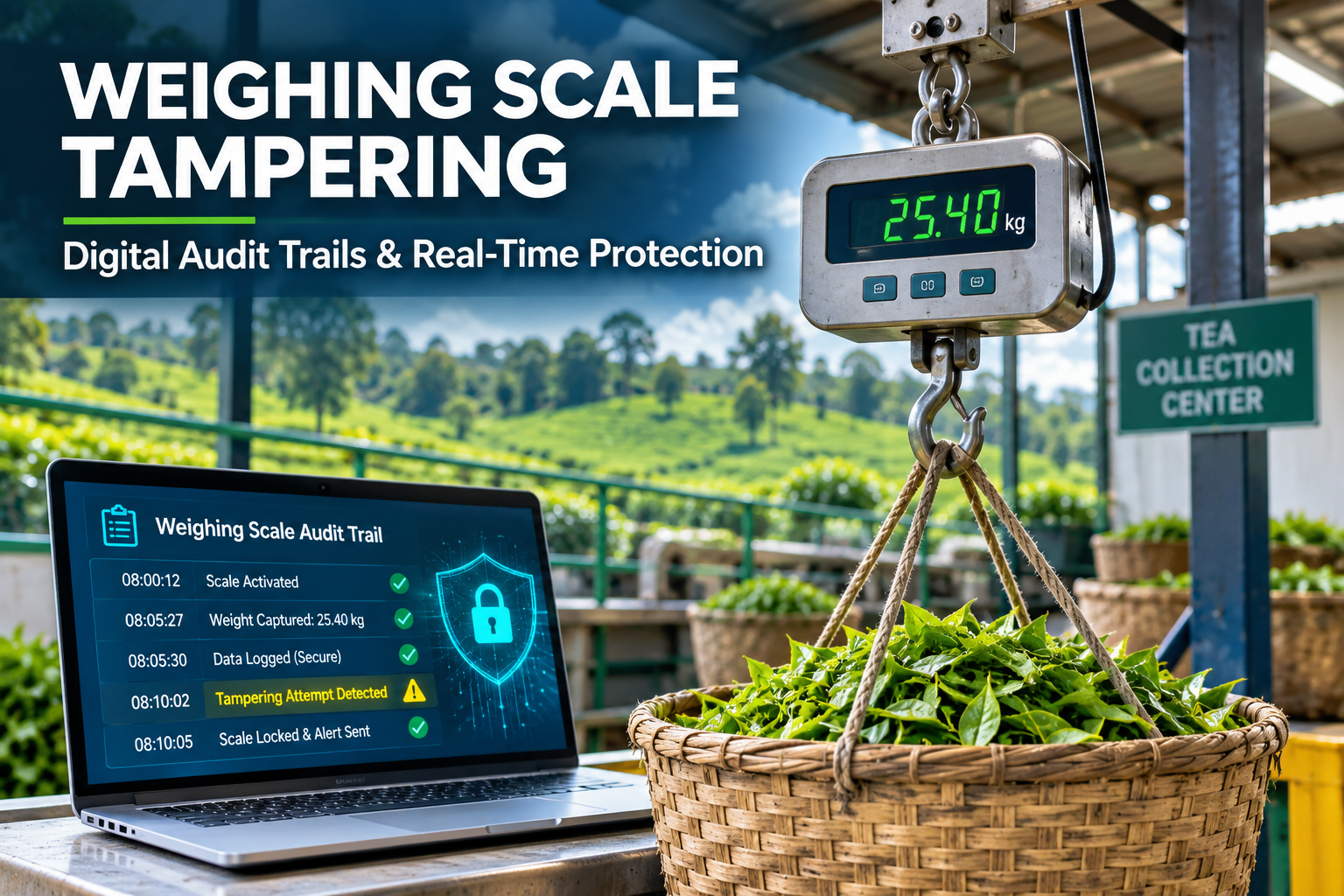
Weighing scale fraud is not always about visibly damaged equipment or broken calibration seals. In electronic weighing systems, inaccurate transactions can also arise when unstable readings, incorrect zero conditions, unauthorized instruments, or compromised data are accepted into official records.
For Kenyan farmers, tea factories, manufacturers, weighbridge operators, and commodity traders, the consequences can include financial losses, disputes, unreliable inventory records, and reduced confidence in commercial transactions.
Recent enforcement operations in Kenya have highlighted concerns about alleged manipulation of agricultural weighing equipment. International legal-metrology standards also demonstrate why preventing invalid weight capture is an essential part of trustworthy weighing.
The central question is simple: Should a weighing system allow a transaction to be completed when the measurement conditions are not valid?
Modern weighing automation can help ensure that critical requirements are satisfied before a weight is recorded.
Weighing Scale Fraud in Kenya: What Recent Events Reveal
During August 2026, enforcement officers investigated suspected manipulation of weighing equipment at tea buying centres in Bomet County.
According to reporting by The Star on August 12, 2026, the operation involved officials from the Tea Board of Kenya, the Department of Weights and Measures, and security agencies.
The investigations followed complaints from farmers about alleged discrepancies in their green-leaf measurements.
Further enforcement operations took place in September 2026 in the South Rift, with additional arrests reported following inspections of tea weighing equipment.
These allegations remain subject to the relevant legal processes and should not be treated as proof that every person investigated committed fraud.
The incidents highlight a wider concern: weighing accuracy must be protected during daily operations, not only during periodic inspections.
Although verification, stamping, and inspection are essential, additional technological controls can help protect transactions between inspections.
Sources:
- The Star — Factory clerks arrested over alleged tea leaf weighing fraud, August 12, 2026
- The Star — Five arrested as TBK intensifies South Rift tea weighing checks, September 17, 2026
What Does International Research Say About Stable Weight Capture?
The International Organization of Legal Metrology (OIML) provides internationally recognized technical requirements for measuring instruments.
Its Recommendation OIML R 76-1:2006, covering non-automatic weighing instruments, contains important requirements concerning stable equilibrium.
Section 4.4.2 addresses circumstances in which a weighing instrument may print, store, or process weighing results.
In particular, the Recommendation requires that weighing operations such as printing and data storage be inhibited when the instrument has not achieved the required stable equilibrium.
This is particularly important for electronic weighing systems where readings may fluctuate as loads move, settle, or experience external disturbances.
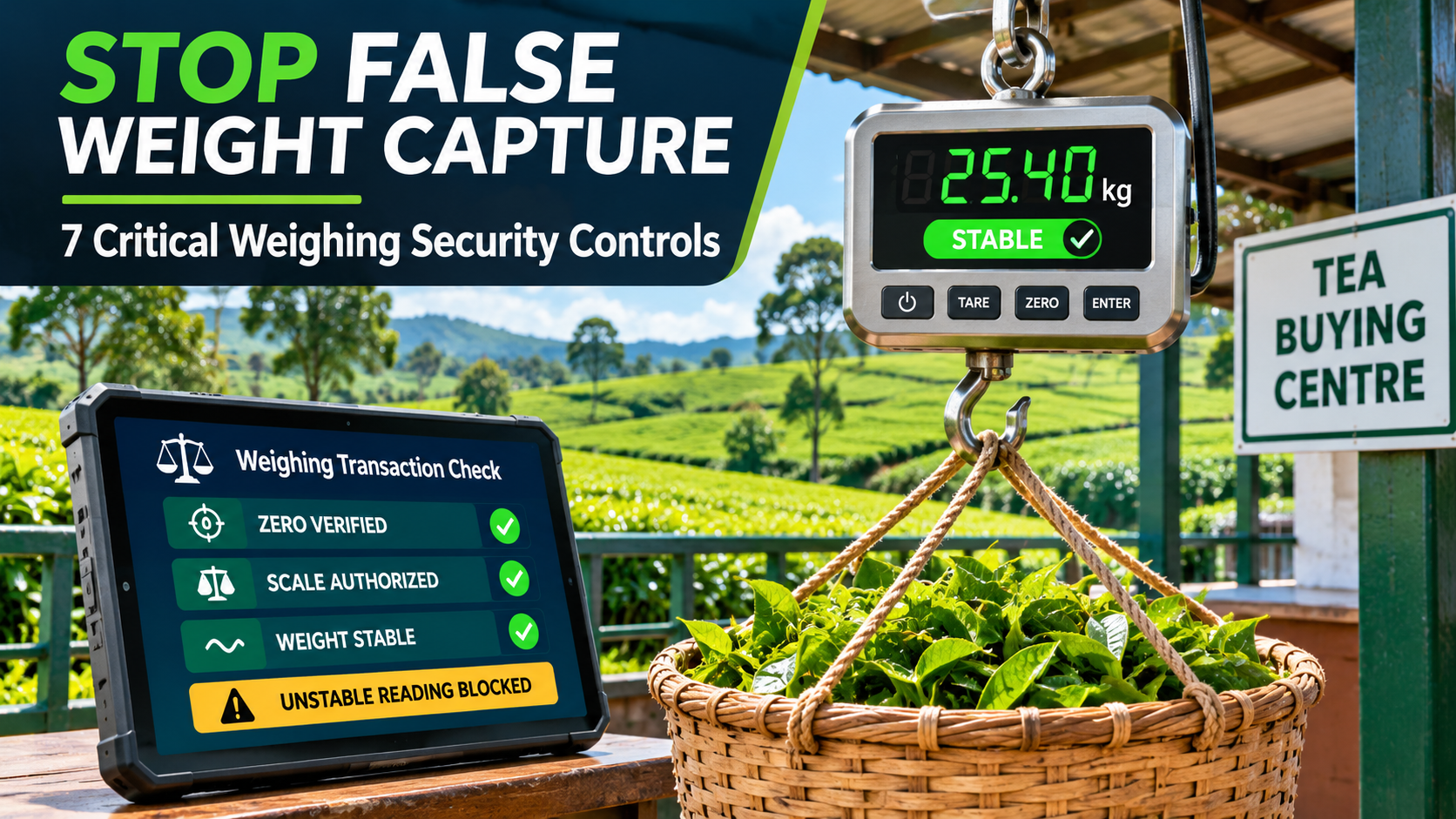
Consider a tea collection centre where a hanging scale is used to weigh a basket of fresh green leaf.
Immediately after the basket is lifted, the indicated weight may fluctuate before settling.
If a transaction is captured prematurely, the recorded result may not represent the final stable measurement.
A properly designed system should apply the required stability conditions before accepting the transaction.
An unstable reading is not necessarily evidence of tampering. However, accepting unreliable readings can create opportunities for errors or deliberate exploitation.
Research reference: OIML R 76 — Non-Automatic Weighing Instruments
7 Critical Controls That Help Prevent Weighing Scale Fraud
1. Stable Weight Verification Before Capture
A reliable electronic weighing system should verify that the reading satisfies the applicable stability criteria before accepting the measurement.
For example, a suspended basket of produce may move while being lifted.
During this movement, the displayed weight can fluctuate.
The weighing application should not accept the transaction until stable measurement conditions have been established.
Recommended control: Disable the transaction capture function until the required stable-weight condition is satisfied.
This helps protect against premature or unreliable recording.
2. Mandatory Zero Verification
An incorrect starting condition can affect the reliability of a subsequent weighing operation.
Before a new transaction begins, the system should check whether the scale is in an appropriate zero condition, according to its intended weighing procedure.
Where necessary, the equipment should undergo authorized zero-setting procedures.
Recommended control: Restrict the start of a new weighing transaction when the instrument fails the prescribed zero-condition check.
For operations involving tare weights, the system should apply the appropriate gross, net, and tare procedures rather than assuming every legitimate transaction must start at an unloaded zero.
3. Prevention of Suspicious Negative-Weight Transactions
Unexpected negative readings can indicate operational mistakes, incorrect tare conditions, equipment faults, or circumstances requiring investigation.
They do not automatically establish fraud.
Nevertheless, a weighing system should not allow unexplained negative-weight conditions to produce incorrect commercial records.
Recommended control: Flag or block questionable transactions according to configured rules, and permit recovery only when the applicable safe operating conditions are satisfied.
This reduces the risk of incorrect readings being entered into the transaction database.
4. Authorized Weighing Scale Identification
An electronic weighing environment may contain several instruments connected to mobile devices, computers, and transaction-management systems.
If the system cannot reliably identify the instrument supplying a measurement, unauthorized equipment substitution becomes an important security concern.
Recommended control: Authenticate the approved weighing instrument and validate its identity before accepting transaction data.
This can help strengthen traceability by linking the recorded measurement to the intended equipment.
5. Restricted Weighing Locations
Some weighing activities are authorized only at specific collection centres, factory stations, or other designated operational sites.
Mobile weighing solutions can incorporate location-based controls to support these procedures.
For example, a farmer’s tea delivery should be recorded at the approved collection point rather than at an unrelated location.
Recommended control: Where appropriate, restrict transaction recording to designated weighing locations through GPS and other available verification mechanisms.
GPS controls should be combined with appropriate equipment authentication and other safeguards because location information alone cannot establish measurement accuracy.
6. Protected Weight Transmission and Transaction Records
An accurate reading at the scale is useful only if the resulting weight remains trustworthy when transmitted, stored, and processed.
Weighing systems may exchange data with mobile applications, factory servers, printers, accounting systems, and payment platforms.
These communication paths require suitable security measures.
According to OIML D 31:2023, software-controlled measuring instruments should protect legally relevant software and measurement data from unauthorized alteration.
Recommended control: Apply secure communication, access controls, transaction integrity checks, and protected storage where appropriate.
A weighing transaction should remain traceable to the originating instrument and its recorded measurement.
Reference: OIML D 31:2023 — General Requirements for Software Controlled Measuring Instruments
7. Real-Time Monitoring and Automatic Transaction Blocking
Traditional supervision may identify irregularities only after transactions have been completed.
A prevention-oriented system can apply predetermined checks before accepting a weight.
Examples include:
- Refusing an unstable-weight capture.
- Preventing an unauthorized scale from submitting measurements.
- Blocking transactions that fail prescribed zero-condition checks.
- Flagging suspicious negative readings.
- Identifying repeated irregular events.
- Notifying responsible personnel when defined security conditions are violated.
These controls can help reduce the opportunity for invalid transactions to enter commercial records.
However, no single automated system can prevent every possible form of weighing fraud.
How Small Weight Discrepancies Can Create Significant Losses
The financial impact of inaccurate weighing depends on the size of each discrepancy, the number of transactions, and the payment rate.
Consider the following hypothetical example.
A buying centre processes 1,000 deliveries daily, and each delivery is recorded 0.5 kilograms below the actual quantity.
| Item | Illustrative value |
|---|---|
| Daily deliveries | 1,000 |
| Weight discrepancy per delivery | 0.5 kg |
| Total daily discrepancy | 500 kg |
| Illustrative price per kilogram | KES 25 |
| Daily financial difference | KES 12,500 |
| Difference over 26 working days | KES 325,000 |
This example is a mathematical illustration, not a finding from an actual investigation.
It demonstrates how relatively small discrepancies, if repeated across many transactions, can have substantial financial consequences.
Preventing inaccurate measurements at the point of capture is therefore an important financial and operational control.
Why Periodic Weighing Scale Verification Is Not Enough by Itself
Verification and inspection provide critical assurance that commercial weighing instruments meet applicable requirements when assessed.
However, a verified instrument can subsequently develop a fault, experience unauthorized interference, or be used incorrectly.
Continuous operational safeguards can complement official metrological controls by monitoring transactions as they occur.
An effective weighing security programme should therefore combine:
- Appropriate instrument verification and maintenance.
- Controlled access to calibration and configuration functions.
- Valid weighing procedures.
- Automated transaction checks.
- Secure records and accountability.
- Prompt investigation of identified irregularities.
Technology should complement, not replace, verification by the relevant authorities.
Dotmobi Weighing Scale Tampering Guard: Moving from Detection to Prevention
Dotmobi LLP has developed the Weighing Scale Tampering Guard (WSTG), supported by Kenyan Patent No. KE 1086.
The technology focuses on strengthening the security and integrity of electronic weighing operations.
Depending on the equipment and deployment configuration, Dotmobi’s integrated weighing solutions can support:
Stable-weight capture controls: Preventing transaction acceptance when readings fail defined stability conditions.
Zero-condition verification: Enforcing prescribed starting conditions before selected weighing activities.
Negative-weight protection: Restricting suspicious negative-weight transactions and supporting controlled recovery.
Authorized equipment identification: Helping ensure that measurements originate from approved weighing instruments.
Location-controlled weighing: Supporting operations restricted to designated collection points.
Tampering-event monitoring: Providing information about selected events that could indicate unauthorized interference.
Secure transaction integration: Supporting electronic weighing records and operational accountability.
These capabilities can help organizations build stronger controls around the weighing process.
The availability and scope of individual features depend on the deployment, connected instruments, and approved operational requirements.
Which Industries Need Stronger Weighing Security?
Tea Factories and Agricultural Buying Centres
Accurate weight capture helps ensure that farmers receive payment based on properly recorded deliveries.
Weighbridges and Transport Operations
Protected weighing transactions can support accountability in bulk transport, cargo handling, and industrial logistics.
Manufacturing and Industrial Processing
Factories can benefit from reliable weighing records when receiving raw materials, monitoring production, and dispatching finished products.
Grain, Coffee, and Agricultural Commodities
Collection centres and commodity buyers can strengthen confidence by ensuring that commercial weighing transactions meet defined operating conditions.
Retail and Commercial Weighing
Meat traders, cereal merchants, supermarkets, and other commercial operators can improve customer trust through verified equipment and disciplined weighing procedures.
Frequently Asked Questions About Weighing Scale Fraud
What is weighing scale fraud?
Weighing scale fraud involves deliberate manipulation or misrepresentation of weight measurements to obtain an unfair commercial advantage.
Can an electronic weighing scale record incorrect weights?
Yes. Incorrect results may arise from equipment faults, unsuitable operating conditions, unauthorized interference, or inappropriate transaction-processing procedures.
Why is stable weight verification important?
Stable weight verification helps ensure that measurements are accepted only after the instrument satisfies the applicable stability conditions.
Can software prevent weighing scale tampering?
Properly designed software and hardware controls can prevent certain invalid transactions and unauthorized operations. However, they cannot eliminate all fraud risks.
Is a verified weighing scale automatically protected against fraud?
No. Official verification is essential, but continuing operational controls are also important to detect faults, inappropriate use, and unauthorized interventions between inspections.
What is Dotmobi’s Weighing Scale Tampering Guard?
Dotmobi’s WSTG is a patented technology designed to strengthen protection against selected forms of unauthorized interference with electronic weighing systems.
Conclusion: Stop Questionable Weighing Transactions Before They Are Recorded
The integrity of a weighing transaction depends on more than whether the instrument displays a number.
The measurement must originate from the correct equipment, satisfy the applicable operating conditions, and be recorded without unauthorized interference.
International legal-metrology standards provide a strong foundation for improving weighing integrity.
For Kenyan businesses, the practical objective is to combine instrument verification with prevention-oriented operational controls.
The future of weighing security lies not only in detecting suspicious activity but also in preventing invalid transactions from being accepted.
Protect Your Weighing Operations with Dotmobi
Are unexplained weight discrepancies, unauthorized equipment adjustments, or questionable weighing transactions affecting your operations?
Dotmobi LLP provides weighing automation and anti-tampering solutions for agricultural, commercial, and industrial applications.
Contact Dotmobi to discuss the Weighing Scale Tampering Guard (WSTG) and secure weighing integration for your organization.
Website: https://dotmobi.co.ke/
Dotmobi LLP — Accurate Weights. Protected Transactions. Greater Accountability.