
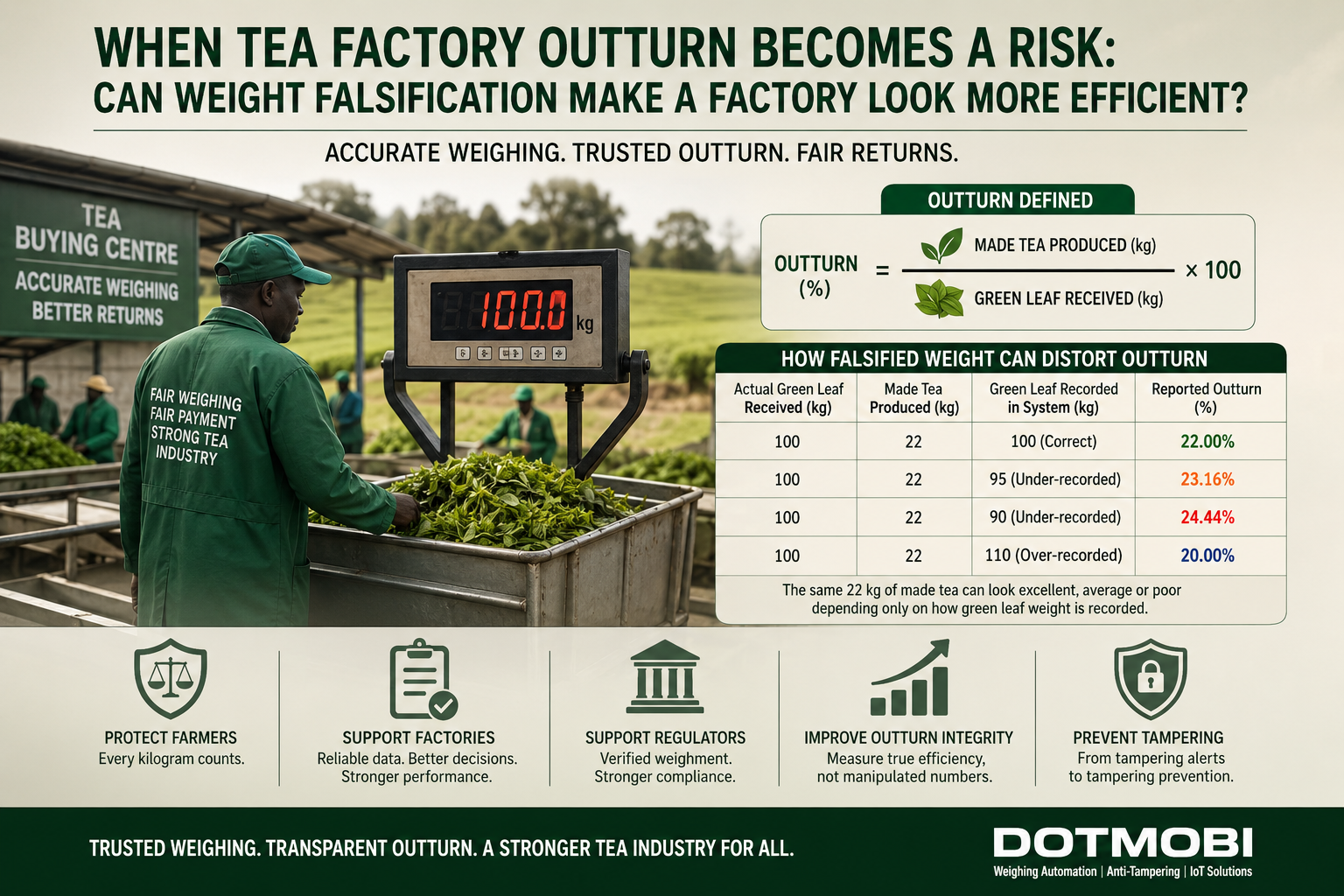
Tea factory outturn is an important measure of manufacturing performance. It shows how much made tea is produced from the green leaf delivered to a factory.
But there is an important question that Kenya’s tea industry should increasingly be asking:
What happens when the green-leaf weight used to calculate outturn cannot be fully trusted?
The answer matters to farmers, factory directors, regulators and management because manipulating the weight of green leaf can alter the apparent performance of a factory without changing its actual manufacturing efficiency.
Recent investigations into tea weighing practices in Kenya make this an issue that deserves serious attention.
What Is Tea Factory Outturn?
In simple terms:
Outturn (%) = Made Tea Produced ÷ Green Leaf Received × 100
The Tea Board of Kenya’s Green Leaf Quality Requirements states that conversion of green leaf to made tea varies according to weather conditions and should generally range between 20% and 24%.
But there is an important qualification in the same guidance: the weighing scales used for green leaf should be accurately calibrated and not manipulated.
That qualification is critical.
A factory’s reported outturn can only be reliable if both sides of the calculation — made tea and green leaf — are based on reliable measurements.
A Simple Example Shows the Risk
Suppose a tea factory actually receives:
100 kg of green leaf
and produces:
22 kg of made tea.
The genuine outturn is:
22 ÷ 100 × 100 = 22%
That is straightforward.
But suppose the factory physically receives 100 kg while, for whatever reason, only 90 kg enters the records used to calculate outturn.
The production remains 22 kg.
The reported calculation becomes:
22 ÷ 90 × 100 = 24.44%
The factory now appears to have improved from a 22% outturn to 24.44%, yet no manufacturing improvement has taken place.
The only thing that changed was the recorded green-leaf weight.
That is why weighing integrity should be treated as part of factory-performance integrity.
How Much Difference Can Weight Records Make?
Using the same example of 22 kg of made tea actually produced from 100 kg of green leaf:
| Reported Green Leaf | Calculated Outturn |
|---|---|
| 100 kg | 22.00% |
| 98 kg | 22.45% |
| 95 kg | 23.16% |
| 92 kg | 23.91% |
| 90 kg | 24.44% |
| 88 kg | 25.00% |
This illustrates why an impressive outturn figure should never automatically be interpreted as evidence of superior manufacturing performance.
It must first be supported by confidence in the underlying weighing data.
Kenya Has Already Recorded Cases of Under-Weighing
This concern is not theoretical.
In March 2023, Tea Board of Kenya officials inspecting tea buying centres in Kisii and Nyamira found weighing equipment that was recording less than the true weight.
At a tea buying centre in Nyamira, one machine was reportedly reading by almost two kilograms less than the correct weight. Several machines were confiscated for further investigation following concerns about faulty or interfered-with weighing equipment.
For an individual farmer, an under-reading scale means loss of payable green leaf.
For the wider factory system, persistent under-recording can also affect the integrity of production and outturn statistics.
August 2026: Bomet Crackdown Brings the Issue Back Into Focus
The weighing problem resurfaced prominently in August 2026.
On 11 August, a multi-agency operation involving the Tea Board of Kenya, the Weights and Measures Department and security officers inspected tea buying centres in Konoin, Bomet County.
Several factory clerks were arrested following complaints by farmers over alleged theft of green leaf and suspected manipulation of weighing equipment.
The investigations were intended to establish the extent of the alleged malpractice and whether other persons were involved.
It is important to emphasise that arrests and investigations are not, by themselves, proof of guilt.
However, the operation demonstrates that green-leaf weighing integrity remains a live regulatory and farmer-protection issue in Kenya’s tea industry.
Government Is Moving Toward Digital Green-Leaf Payments
The seriousness of the problem is further demonstrated by the Government’s August 2026 announcement of a proposed Digital Green Leaf Payment System.
The Government has said the system should ensure that tea delivered by farmers at buying centres is digitally captured and farmers are paid according to the quantity actually delivered.
According to the announcement, one objective is to reduce manipulation of weighing records.
This is a positive development.
But digitising a weight does not by itself guarantee that the weight is correct.
If an inaccurate or manipulated measurement enters a digital system, the system can simply preserve an inaccurate value more efficiently.
The integrity of the source weighing instrument therefore remains fundamental.
Parliament Has Also Raised Tea Weighing Concerns
The issue has reached the National Assembly.
During parliamentary debate on the tea sector in April 2026, legislators discussed reports concerning falsification of weighing scales at tea buying centres.
This places weighing integrity alongside broader questions surrounding factory governance, manufacturing efficiency, production costs and farmer returns.
It reinforces an important principle:
Tea-sector digitalisation must start with trustworthy measurement.
Weight Falsification Can Also Work in the Opposite Direction
Not every green-leaf falsification scheme involves reducing farmers’ recorded weights.
Kenyan court records show another form of malpractice: inflated or duplicated green-leaf weights.
In litigation involving a Kenyan tea factory, an audit identified green-leaf buying malpractices that included falsified weights, abnormal weight and data manipulation, double weights and inflated weights through duplication.
A related court case involving the same factory records evidence explaining how staff could falsely increase the green-leaf weight credited to particular farmer accounts.
This produces the opposite effect on outturn.
For example:
Actual green leaf: 100 kg
Made tea: 22 kg
True outturn: 22%
If the records instead showed 110 kg:
22 ÷ 110 × 100 = 20%
An unusually poor outturn could therefore, in some circumstances, be associated with overstated green-leaf records.
However, poor outturn should not automatically be treated as evidence of fraud.
Weather, surface moisture, leaf quality, plucking standards and factory manufacturing conditions can also significantly affect conversion.
The correct response is investigation and reconciliation, not assumption.
The Tea Industry Has Known About the Outturn Risk for Decades
The relationship between recorded green-leaf weight and reported outturn is not a new discovery.
Tea research literature going back decades warned against manipulating green-leaf deductions simply to obtain a more attractive factory outturn.
Historical tea manufacturing research specifically criticised arbitrary deductions from wet green leaf designed to produce a “flattering outturn.”
The principle remains relevant today:
You cannot improve genuine factory efficiency by changing the denominator.
True efficiency must come from better leaf quality, manufacturing control, reduced process losses, appropriate withering, fermentation, drying, energy efficiency and sound factory management.
Outturn Should Never Be Used as an Isolated KPI
This leads to a broader management concern.
Suppose factory managers are strongly rewarded or ranked according to outturn.
A manager producing a genuine 22% outturn could appear less efficient than another factory reporting 24%.
But if the underlying green-leaf measurements are not equally trustworthy, comparing the two factories becomes misleading.
This creates a perverse incentive — pressure to improve the number rather than improve the underlying process.
Tea factories should therefore evaluate outturn together with other controls such as:
- independently verifiable green-leaf weights;
- verified and calibrated weighing equipment;
- made-tea production records;
- factory weighbridge reconciliation;
- moisture and weather conditions;
- green-leaf quality;
- abnormal weight patterns;
- duplicate transactions;
- farmer production history; and
- secure audit trails.
A high outturn that cannot be reconciled to trustworthy source data should trigger questions rather than immediate celebration.
Calibration Alone Is Not Enough
Regular calibration and verification by Weights and Measures authorities remain essential.
In May 2026, the Ministry of Agriculture launched another tea weighing-machine inspection and calibration exercise in Bomet as part of efforts to improve accuracy, fairness and transparency.
But there is an important difference between accuracy at the time of verification and continuous protection against interference after verification.
A weighing scale can be correct when inspected and subsequently be subjected to unauthorised interference.
That is why the next stage of tea-sector protection should address what happens between official verification visits.
From Tampering Alerts to Tampering Prevention
Dotmobi believes Kenya’s tea industry should increasingly move from simply detecting suspicious events to preventing unauthorised weighing interference wherever technically possible.
The objective should be to create a trusted chain:
Farmer → Weighing Scale → Recorded Weight → Factory → Payment → Production Reconciliation
Every important stage should be capable of independent verification.
A modern protection framework should make unauthorised manipulation difficult, identify protected weighing equipment, preserve reliable transaction records and provide an audit trail when abnormalities occur.
The purpose is not to replace Weights and Measures verification.
Technology should strengthen regulatory verification by providing additional protection during the period between official inspections.
Protecting Outturn Also Protects Factory Management
Anti-tampering protection should not be viewed only as protection for farmers.
It also protects factory managers and directors.
Where a factory has genuinely achieved good manufacturing performance, reliable weighing records provide evidence supporting that achievement.
Instead of arguing about whether an unusually high or low outturn is genuine, management can reconcile trusted green-leaf data against production.
Good measurement protects everyone:
the farmer, the clerk, factory management, directors, regulators and the reputation of Kenya’s tea industry.
The Question Factories Should Ask
The important question should therefore no longer be simply:
“What outturn did the factory achieve?”
It should be:
“What outturn did the factory achieve, and can the green-leaf weight behind that number be independently trusted?”
Kenya already has increasingly sophisticated tea factories, digital farmer records, electronic weighing systems and plans for digital green-leaf payments.
The next logical step is ensuring that the measurement entering those systems is protected at source.
Because when every kilogram matters, trustworthy weighing is not merely a payment issue.
It is also a factory-performance, governance and accountability issue.
About Dotmobi
Dotmobi LLP develops technology solutions for weighing automation, weighing-scale anti-tampering protection, IoT monitoring and agricultural-sector automation.
Our approach is increasingly focused on moving from tampering alerts toward tampering prevention, while maintaining compatibility with statutory verification and inspection requirements.
For more information, visit the Dotmobi website or contact Dotmobi for a discussion on protecting weighing integrity in agricultural and industrial operations.