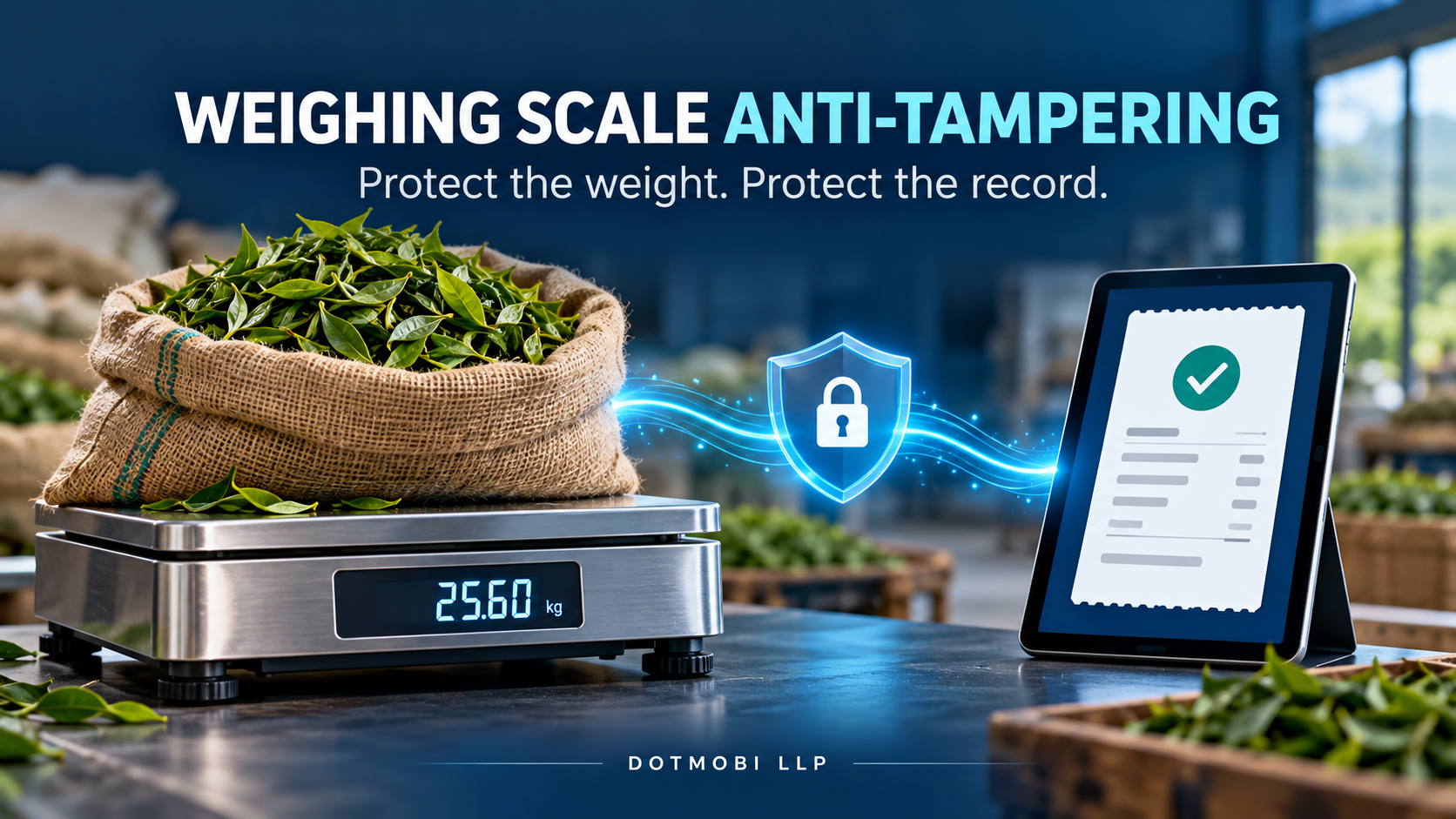
Weighing scale anti-tampering must protect more than the number displayed on a weighing instrument. Businesses also need confidence that the same weight reaches the receipt, database and payment calculation without unauthorized alteration.
A farmer may watch a correct reading appear on a scale. A customer may receive a printed ticket. A factory may later process the transaction through its accounting system. But do all three records describe the same weighing event?
This question matters for tea buying centres, grain traders, warehouses, retail businesses and weighbridge operators in Kenya.
Recent international research provides a useful warning: an accurate scale does not automatically guarantee an accurate digital transaction.
What 2026 Research Reveals About Connected Weighing
In the 2026 OIML Bulletin paper Designing trust in digital retail weighing systems, Daniel Šťastný of the Czech Metrology Institute writes:
“The weakness need not lie in the scale itself.”
The paper describes a 2026 retail inspection in which a 5 kg test weight was displayed correctly by the scale. However, the connected point-of-sale system processed a weight and price ten times the actual values. The reported cause was a replacement barcode scanner running different firmware.
This was a documented system error, not proof of deliberate fraud. It demonstrates why checks should follow the measurement through the connected transaction system.
Read the OIML technical paper.
NIST’s 2026 guidance reinforces the distinction:
“Performance tests assess the accuracy of the measurements”
NIST explains that software evaluation addresses vulnerabilities capable of enabling fraud or undetected corruption of measurement data. Its guidance identifies software identification, traceability, integrity, authenticity and robustness as key principles.
Read NIST’s software-controlled measuring instrument guidance.
The practical recommendations below apply these ideas to business operations. They are not claims that the cited international guidance automatically creates a new Kenyan legal requirement.
Why Weighing Scale Anti-Tampering Must Follow the Record
Consider this illustrative transaction:
- A scale displays 25.60 kg.
- The receipt shows 25.60 kg.
- The database stores 24.60 kg.
- Payment is calculated using the stored figure.
If nobody compares the records, the discrepancy may remain unnoticed.
At an assumed buying price of KES 30 per kilogram, that one-kilogram difference changes payment by KES 30. Across 1,000 similar transactions, the difference would be KES 30,000.
This is a hypothetical example, not a reported incident.
A mismatch alone does not establish criminal intent. It could arise from a software defect, incorrect configuration, an authorized correction handled poorly, or deliberate interference. Investigators need evidence to distinguish these possibilities.
Effective weighing scale anti-tampering therefore combines prevention, reliable records and a clear response when discrepancies appear.
7 Weighing Scale Anti-Tampering Checks for Businesses
1. Compare the Display, Receipt and Stored Record
During an authorized test, follow one transaction from the weighing instrument to the final business record.
Compare:
- Gross, tare and net weight where applicable.
- Units of measurement.
- Transaction identifier.
- Supplier, customer or vehicle identity.
- Receipt details.
- The weight used for payment.
Record the results and explain any legitimate differences.
For example, a receipt may display a rounded figure while the database retains additional decimal places. That behaviour should be documented and consistently applied.
The key question is whether the final transaction faithfully represents the original measurement.
2. Preserve the Original Weight When Corrections Are Needed
Businesses sometimes need to correct a supplier identity, cancel a duplicate transaction or resolve an administrative mistake.
A useful control is to preserve the original record and create a linked correction showing:
- What changed.
- The previous and revised values.
- Who made the correction.
- When it happened.
- Why it was necessary.
- Who approved it, where approval is required.
Avoid silent replacement of an original weight record.
Where a fresh measurement is necessary, link the new weighing event to the earlier transaction so that reviewers can understand the sequence.
3. Check Software and Device Changes Before Use
A replacement indicator, updated application or revised interface can affect how weighing information is handled.
Maintain an inventory of relevant devices, software versions and configurations.
After a change, repeat suitable transaction checks before relying on the system for commercial use. Include receipts, stored records and payment calculations.
Ask the supplier to explain whether the change affects the evaluated configuration or requires additional approval or verification.
Treating a component as an ordinary accessory should not excuse overlooking its influence on transaction data.
4. Separate Operator, Supervisor and Maintenance Permissions
Give each user the access needed for their role.
An operator may need to capture transactions. A supervisor may need to approve corrections. A technician may need controlled maintenance access.
One shared account makes it difficult to identify who performed a sensitive action.
Recommended controls include individual accounts, prompt removal of former staff access and restricted permission to change weighing parameters or payment settings.
Review access when staff responsibilities change.
Weighing scale anti-tampering becomes easier to investigate when actions can be attributed to specific authorized users.
5. Keep Protected Audit Trails and Review Them
An audit trail records relevant events over time.
Junichi Okamoto’s 2026 OIML paper, Checking audit trails for measuring instruments using runtime verification, explains how recorded event sequences can be checked against specified requirements. It discusses audit trails as evidence of interventions such as parameter changes and software updates.
Read the audit-trail research.
For business oversight, decide which events must be recorded and who reviews them. Useful examples may include corrections, cancellations, maintenance interventions and changes to sensitive settings.
Protect the logs against unauthorized alteration and retain them for a documented period appropriate to the operation.
A log provides little operational value if nobody examines it or follows up on significant events.
6. Test Offline Operation and Reconnection
Some weighing locations experience unreliable connectivity.
Ask what happens when the connection fails:
- Can transactions continue under controlled conditions?
- Are locally stored records protected?
- Is the original transaction time retained?
- Can reconnecting create duplicate records?
- Does the system identify failed uploads?
Run an authorized interruption-and-recovery test with the supplier.
Compare the local records with the central database after synchronization. Confirm that every transaction appears once and retains the correct measurement and identity.
Include this check in weighing scale anti-tampering acceptance testing.
7. Assign Responsibility for Alerts and Discrepancies
An alert should trigger a defined action.
Specify who receives it, who investigates it and when unresolved matters escalate.
A practical procedure should cover:
- Preserving the relevant records.
- Identifying potentially affected transactions.
- Arranging authorized technical checks.
- Recording findings and corrective action.
- Confirming that the issue has been resolved.
Where necessary, suspend the affected transaction process until its reliability is established.
An alert should support investigation. It should not automatically be treated as proof that an operator committed fraud.
Questions to Ask Before Buying an Anti-Tampering Solution
Request a demonstration using representative transactions rather than relying only on a feature list.
Ask the supplier:
- Can you demonstrate agreement between the scale, receipt and database?
- What can an operator change after weighing?
- Are original records preserved after corrections?
- How are device and software changes controlled?
- What happens during a network failure?
- Can authorized reviewers export transaction and audit records?
- Which events generate alerts, and what evidence accompanies them?
- What approval and verification documentation applies to this installation?
Agree on measurable acceptance criteria before deployment.
A convincing demonstration should show both ordinary operation and recovery from common problems.
Dotmobi’s Approach to Weighing Integrity
Dotmobi LLP works in weighing-scale anti-tampering and weighing automation.
For businesses assessing an existing installation or planning a new one, the starting point should be a review of the entire weighing workflow: measurement capture, transaction identity, records, integrations and responsibility for responding to alerts.
The controls required will depend on the equipment, software and operating environment. Confirm the supported features and integration scope for the proposed installation.
Discuss your weighing scale anti-tampering and automation needs with Dotmobi LLP.
Frequently Asked Questions
Can a scale display the correct weight while the payment record is wrong?
Yes. The OIML field example above demonstrates a correct scale indication becoming an incorrect connected sales transaction. Businesses should compare the measurement with the receipt, stored record and payment calculation.
Does a weighing discrepancy prove tampering?
No. A discrepancy can result from configuration errors, software faults, incorrect procedures or deliberate interference. Preserve evidence and investigate before assigning responsibility.
Does an audit trail replace physical verification?
No. Audit trails provide information about recorded events and changes. They complement appropriate instrument checks and the approval and verification requirements applicable to the installation.
What should a business check first?
Begin with one authorized test transaction. Compare its displayed weight, receipt, database entry and payment calculation. Then check how corrections and system changes are recorded.
Protect the Weight and the Record
A reliable weighing process should allow a business to explain how a measurement became a receipt and, ultimately, a payment.
Weighing scale anti-tampering should protect that connection. Accurate instruments, controlled changes, protected records and timely investigation help businesses build a weighing process they can defend.