
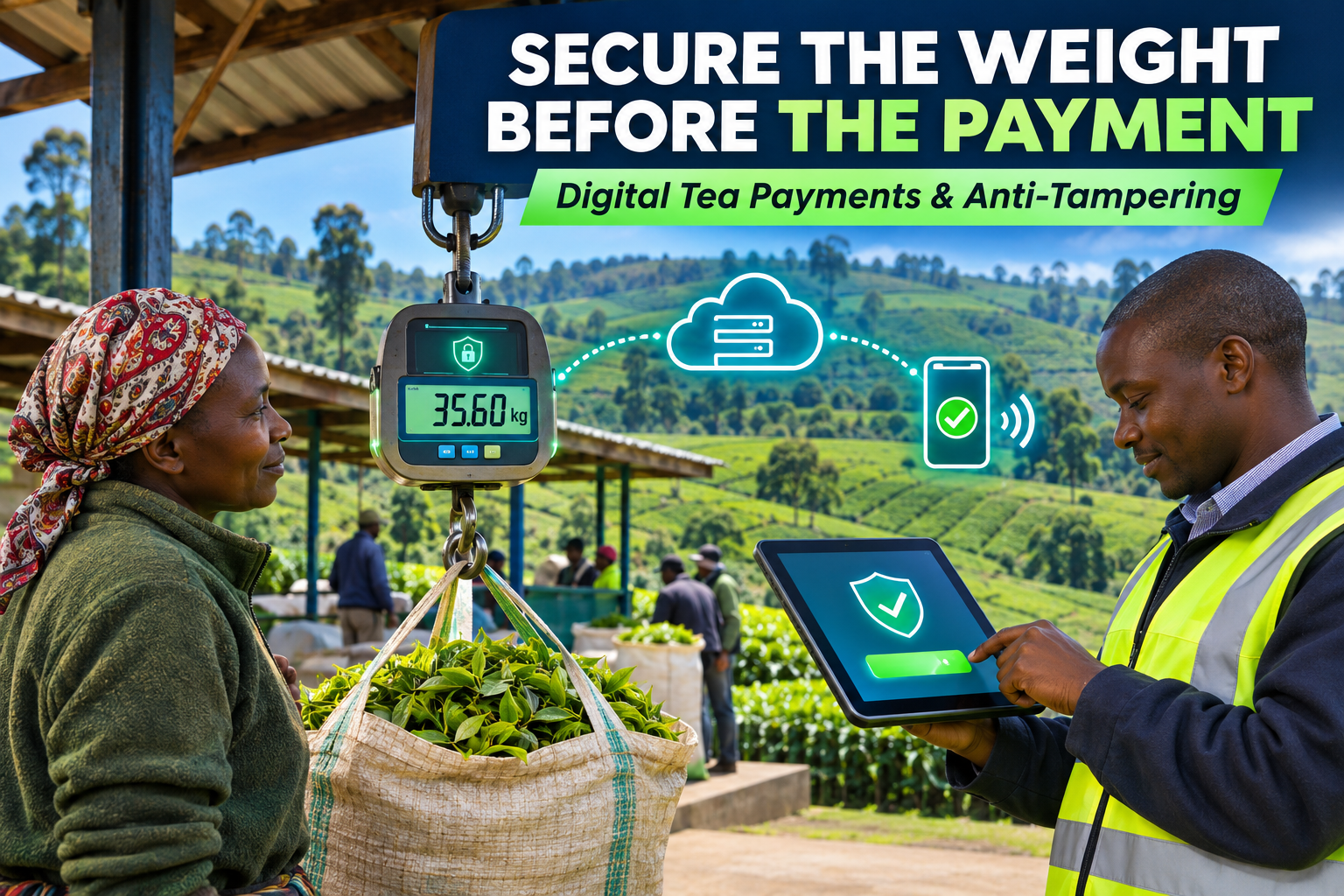
Digital tea payments in Kenya could transform how smallholder farmers receive payment for green leaf deliveries. However, an important question remains: what happens when the weighing scale records an incorrect or manipulated weight before the transaction enters the digital payment system?
Kenya’s efforts to modernise tea payments come at a time when regulators, farmers and technology providers are increasingly concerned about weighing scale tampering.
For farmers, the issue is straightforward. If the recorded weight is lower than the actual weight delivered, the farmer risks losing income even when the subsequent payment calculation is completely automated.
This makes accurate, secure and independently verifiable weighing a foundation for trustworthy digital payments.
1. Kenya’s 2026 Move Towards Digital Tea Payments
On 22 August 2026, the Kenya News Agency reported that the government had directed the Kenya Tea Development Agency (KTDA) to introduce an automated green-leaf payment system.
The announcement indicated that the proposed system would connect tea deliveries at buying centres to digital payment processing, with the objective of protecting farmers against exploitation and improving transparency.
The initiative followed concerns about weighing irregularities and payment practices affecting smallholder tea farmers.
Digital payment automation has several potential advantages:
- Faster processing of farmer delivery records.
- Reduced dependence on manual record entry.
- Improved traceability between weighing and payment.
- Better reconciliation of delivered quantities.
- More transparent records for farmers and factories.
- Reduced opportunities for unauthorised changes to payment information.
Digital tea payments in Kenya represent an important opportunity to improve accountability in the tea sector. However, the reliability of these payments depends on accurate and secure weighing at the point where farmers deliver their green leaf.
However, digitisation alone cannot establish whether the original weighing measurement was genuine.
An automated payment system is only as trustworthy as the weighing information it receives.
Source: Kenya News Agency – Government Move to Automate Tea Payments
2. Why Weighing Scale Tampering Remains a Serious Risk
In August 2026, Kenyan media reported investigations into alleged manipulation of tea weighing scales at buying centres in Bomet County.
According to the Daily Nation’s report of 14 August 2026, Tea Board of Kenya officials stated that some digital weighing machines had been found displaying weights approximately 1.7 kilograms below the actual weight of green leaf delivered.
Several employees faced charges following the investigations, although allegations against individual suspects should not be treated as established guilt.
These events demonstrate why weighing accuracy and transaction integrity remain important even as the tea industry adopts digital technology.
Consider a simple illustration.
A farmer delivers 30 kilograms of green leaf. If the weighing process improperly reduces the recorded weight by 1.5 kilograms, the payment system may receive only 28.5 kilograms.
The resulting shortfall is 5% of the actual delivery.
Even a perfectly functioning digital payment application could then calculate payment using the incorrect quantity.
This is the weakness that weighing scale anti-tampering technology is intended to address.
One of the greatest risks to digital tea payments in Kenya is the possibility of manipulated weighing records entering the payment system. Without effective anti-tampering controls, digital automation may process incorrect quantities rather than prevent the original measurement error.
Source: Daily Nation – Tea Factory Staff Arrested Over Manipulated Weighing Scales
3. Why Digital Tea Payments in Kenya Must Begin With a Trusted Weight
A modern digital tea payment system should not simply accept any weight transmitted by a connected device.
The weighing transaction should pass essential integrity checks before it becomes an authorised farmer delivery record.
These checks can include:
A. Confirming the Authorised Weighing Scale
The system should establish that the measurement originated from the correct, approved weighing instrument.
A substitute or unauthorised scale should not be allowed to generate legitimate farmer transactions.
B. Preventing Unstable Weight Capture
A weight should only be accepted after the weighing instrument has reached an appropriate stable condition.
This reduces the risk of capturing incorrect values while the load is moving or before the weighing measurement has settled.
C. Controlling the Approved Weighing Location
Where operationally appropriate, GPS-based controls can restrict weighing transactions to designated buying centres.
This helps prevent unauthorised weighing activities outside approved operating locations.
D. Preventing Invalid Weight Transactions
Digital controls should identify or reject invalid readings, including suspicious negative values and other measurements that fail defined transaction rules.
E. Maintaining Transaction Traceability
Each accepted record should be traceable to the appropriate scale, transaction time, authorised user and farmer identification.
These controls strengthen the integrity of the information that reaches the payment system.
For digital tea payments in Kenya to gain the confidence of farmers, each recorded delivery should originate from an authorised weighing scale, use a stable measurement and be securely linked to the correct farmer. These safeguards help ensure that payment calculations begin with trustworthy data.
4. What International Metrology Research Says About Digital Weighing Security
International legal metrology research increasingly recognises that electronic weighing security extends beyond the accuracy of the scale display.
The International Organization of Legal Metrology (OIML) publishes guidance on software-controlled measuring instruments, including OIML D 31.
The guidance addresses the protection of legally relevant software and measurement data, including software identification, integrity and traceability.
In 2026, the OIML Bulletin also published research discussing the risks arising when digital weighing systems exchange information with other connected devices and applications.
The underlying lesson is that every component involved in producing, transmitting or recording a weight-based transaction may introduce an integrity risk.
A system must therefore protect the measurement from the original weighing instrument through to its final recorded use.
This is directly relevant to tea buying centres where electronic weighing records may eventually determine farmer payments.
International technical guidance does not automatically become a mandatory Kenyan legal requirement. However, it provides useful principles for the design and evaluation of secure weighing systems.
The adoption of digital tea payments in Kenya creates a strong case for preventive weighing scale security. Dotmobi’s patented Weighing Scale Tampering Guard (WSTG) is designed to strengthen the integrity of electronic weighing transactions before they are accepted into digital records.
References:
- OIML D 31:2023 – General Requirements for Software-Controlled Measuring Instruments
- OIML – Designing Trust in Digital Retail Weighing Systems
- NIST – Software-Controlled Instruments in Legal Metrology
5. How Dotmobi WSTG Strengthens Weighing Scale Anti-Tampering
Dotmobi LLP, a Kenyan technology company, developed the patented Weighing Scale Tampering Guard (WSTG) to improve the integrity of electronic weighing operations.
The technology is protected by Kenyan Patent No. KE 1086.
Dotmobi’s first-generation solution introduced electronic monitoring and reporting of suspicious scale interference, helping management identify potential tampering events without depending entirely on periodic physical inspections.
Experience from extensive field deployments informed the development of an enhanced anti-tampering system.
The improved approach aims to move beyond detecting interference towards preventing invalid or unauthorised weighing transactions from entering operational records.
Depending on the approved system configuration, the enhanced controls include:
- Identification of authorised weighing scales.
- Restrictions on weighing at unauthorised locations.
- Validation of stable weight readings.
- Protection against invalid negative weight transactions.
- Monitoring of suspicious interference.
- Secure capture and traceability of weighing records.
- Integration with digital weighing and reporting systems.
The intention is to protect the original weight rather than simply investigate discrepancies after the records have already been processed.
Dotmobi’s anti-tampering technology complements statutory weighing verification and calibration. It does not replace the responsibilities of Kenya’s Weights and Measures authorities.
6. Why Prevention Is Better Than Detecting Fraud Afterwards
Traditional responses to weighing irregularities often depend on complaints, inspections and investigations.
These remain important safeguards, but they may occur after incorrect measurements have already affected farmers.
For example, a suspicious weighing discrepancy might only be discovered after a factory compares delivered quantities, investigates complaints or conducts a technical inspection.
By that stage, reconstructing individual transactions can become difficult.
A prevention-oriented system aims to intervene earlier.
It can be designed to stop transactions that fail defined security checks before the affected weight is accepted.
This approach reduces reliance on investigating losses after they have occurred.
For the tea industry, the distinction is important.
Detecting a manipulated weight may help explain a loss. Preventing that manipulated weight from being accepted can help avoid the loss in the first place.
No technological safeguard can eliminate every possible form of misconduct, but layered controls can significantly strengthen transaction security.
7. Building a Trusted Chain From Farmer to Payment
The long-term objective should be an integrated process in which each farmer delivery follows a controlled and traceable sequence:
Farmer identification → Authorised weighing scale → Stable and validated weight → Secure delivery record → Factory reconciliation → Digital payment
At each stage, the system should be able to establish that the relevant information has not been improperly altered.
This approach would support several important objectives:
- Farmers receive payment based on reliably captured quantities.
- Factories maintain more trustworthy delivery information.
- Managers can identify irregularities sooner.
- Investigators have better electronic evidence.
- Digital payment systems process validated source records.
- The tea sector gains stronger confidence in electronic weighing.
A trustworthy payment ecosystem therefore needs both payment automation and secure measurement capture.
8. Lessons for Other Agricultural and Commercial Weighing Operations
The challenge extends beyond Kenya’s tea industry.
Any business that pays, charges or accounts for goods based on weight can face similar risks.
Examples include:
- Coffee collection centres.
- Dairy collection facilities.
- Grain buying centres.
- Meat processing businesses.
- Agricultural produce markets.
- Warehouses and logistics operations.
- Industrial weighbridges.
Where financial transactions depend on weight, organisations should consider how weighing equipment is identified, protected and connected to their digital systems.
Accurate measurement, transaction security and accountability should be designed together.
9. The Future of Digital Tea Payments in Kenya
Kenya’s move towards automated tea payments offers an opportunity to improve transparency throughout the agricultural value chain.
However, the success of such systems should not be measured only by how quickly payments are processed or how effectively records are digitised.
It should also depend on the integrity of the information entering those systems.
A digital platform that processes inaccurate weight data can reproduce the consequences of the original error at greater speed.
The stronger approach is to combine:
- Official weighing verification and calibration.
- Electronic scale anti-tampering protection.
- Authorised scale and location controls.
- Secure and validated weight capture.
- Digital transaction traceability.
- Reliable factory reconciliation.
- Transparent farmer payment processing.
This would move the sector closer to an end-to-end framework for protecting farmer income and preserving confidence in commercial weighing.
10. Protect Your Weighing Operations With Dotmobi
Dotmobi LLP develops innovative weighing scale anti-tampering and automation solutions for agricultural and commercial applications.
Our patented Weighing Scale Tampering Guard (WSTG) is designed to help organisations strengthen the security of electronic weighing operations through monitoring, transaction validation and enhanced protection against interference.
Whether your organisation operates tea collection centres, agricultural weighing stations, industrial scales or weighbridges, protecting the accuracy and integrity of the original measurement is essential.
Do not secure the payment process while leaving the weighing process vulnerable.
Learn more about Dotmobi’s Weighing Scale Tampering Guard.
Contact Dotmobi LLP through www.dotmobi.co.ke to discuss weighing scale anti-tampering protection, system integration and a technical demonstration.
Frequently Asked Questions
Can digital tea payments prevent weighing scale tampering?
Not by themselves. Digital payments can improve transaction processing and traceability, but they need reliable weight data from properly protected weighing instruments.
What is weighing scale anti-tampering technology?
It refers to security measures that help detect, record or prevent unauthorised interference with weighing instruments and associated weighing transactions.
Why is a stable weight reading important?
A stable reading helps ensure a transaction is captured only after the scale’s measurement has settled sufficiently for valid recording.
What is Dotmobi WSTG?
The Weighing Scale Tampering Guard is Dotmobi’s patented technology for strengthening the protection and monitoring of electronic weighing operations.
Can anti-tampering systems replace official verification?
No. Anti-tampering technology complements statutory weighing verification and calibration rather than replacing them.