Imagine a twelve-unit apartment block where every household receives water from one main connection.
Some tenants have large families. Others live alone. One household washes two vehicles every weekend, while another tenant is away for most of the month.
However, when the monthly water bill arrives, the caretaker divides it equally among all twelve units.
For several months, the arrangement appears manageable. Then one tenant raises a simple question:
“Why am I paying the same water bill as a family that uses four times more water than I do?”
That question begins a disagreement that soon involves the caretaker, landlord and nearly every tenant in the building.
The real problem is not necessarily the price of water. It is the absence of a fair and transparent way of measuring what each household consumes.
This is one of the challenges that prepaid water meters in Kenya are designed to solve.
Shared Water Bills Can Create Unnecessary Conflict
Many rental properties, hostels, institutions and commercial buildings still depend on shared water bills.
The landlord receives one bill and then attempts to distribute the cost among the users. The amount may be divided equally, estimated according to the number of occupants or included in the monthly rent.
These methods can create several problems:
- Careful users subsidise heavy users.
- Tenants dispute estimated charges.
- Landlords spend time following up unpaid water bills.
- Water arrears accumulate.
- Leaking taps and pipes may remain unattended.
- Users have little incentive to control consumption.
- Water payments become mixed with rent disputes.
The landlord may install a larger tank, change the caretaker or introduce new billing rules, but the underlying problem remains: individual consumption is not being measured and paid for transparently.
How Prepaid Water Meters Work
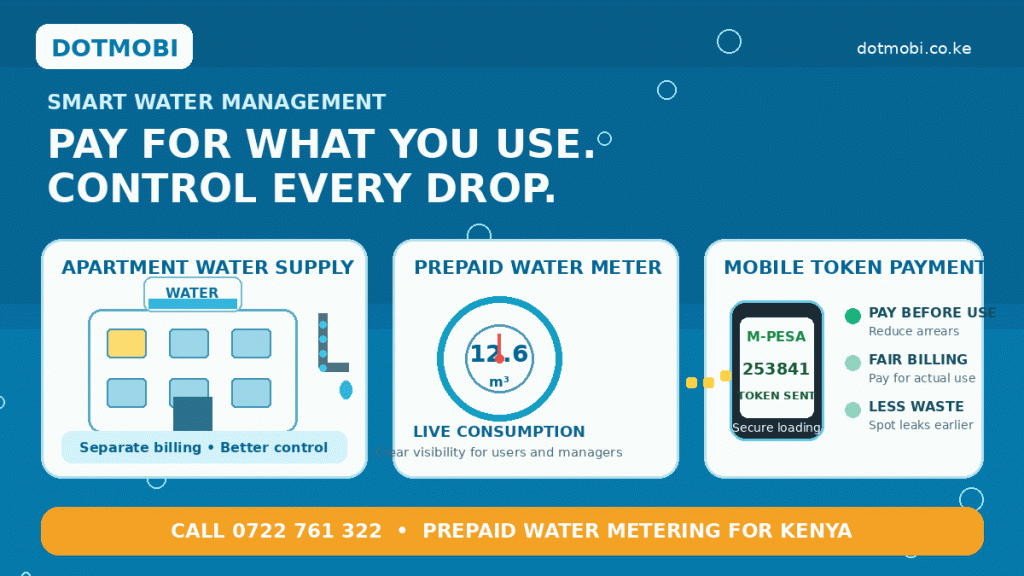
A prepaid water meter allows a consumer to purchase water credit before using the water.
The purchased credit is loaded into the metering system using a secure token or customer interface unit. As water is consumed, the available credit is gradually deducted according to the volume passing through the meter.
When the balance becomes low, the user can purchase additional credit. Depending on the installation and system configuration, payment and token issuance can be integrated with mobile payment services such as M-Pesa.
The arrangement is similar to prepaid electricity: pay, load credit, monitor the balance and consume according to the available amount.
Fair Billing for Every Household
Returning to the twelve-unit apartment, imagine that every unit is fitted with its own prepaid water meter.
The tenant living alone pays only for the water used in that unit.
The larger family purchases water according to its actual needs.
The household washing vehicles every weekend carries the cost of that additional consumption.
The landlord no longer has to calculate individual bills manually or defend estimates that tenants consider unfair.
Each user becomes responsible for their own consumption.
This creates a clearer relationship between water usage and payment.
Better Revenue Collection for Landlords
One of the greatest benefits of prepaid water metering is that consumption is paid for in advance.
Under a post-paid arrangement, a landlord or water supplier delivers water first and attempts to collect payment later. By the time the bill becomes overdue, the water has already been consumed.
Prepaid metering changes that sequence.
Users purchase credit before consumption, helping landlords and water-project operators:
- Reduce water-payment arrears.
- Improve cash flow.
- Lower collection costs.
- Separate water charges from rent.
- Reduce disconnection disputes.
- Improve accountability.
- Plan maintenance using collected revenue.
For apartment owners managing several properties, this can significantly reduce the administrative burden of monthly water billing.
Prepaid Water Meters Encourage Responsible Consumption
People normally pay closer attention to a resource when they can see how quickly they are consuming it.
A running toilet, leaking tap or damaged pipe becomes easier to notice when the available water balance reduces unexpectedly.
Consumers may also become more deliberate about:
- Repairing leaks.
- Closing taps properly.
- Reusing water where appropriate.
- Avoiding unnecessary washing.
- Budgeting for household consumption.
- Monitoring unusual increases in usage.
The prepaid meter therefore does more than collect revenue. It can also encourage better water-management habits.
Where Prepaid Water Meters Can Be Used
Prepaid water meters are suitable for many Kenyan environments, including:
Apartments and Rental Houses
Each tenant can pay for actual consumption instead of sharing an estimated water bill.
Gated Communities
Individual houses can manage their water credit while the property manager maintains oversight of the water-distribution system.
Borehole and Community Water Projects
Prepaid collection can provide more reliable revenue for electricity, pumping, treatment, repairs and system maintenance.
Schools and Colleges
Different departments, staff houses, hostels or facilities can be monitored separately.
Commercial Buildings
Shops, restaurants, salons, offices and other occupants can pay according to their actual water consumption.
Factories and Staff Housing
Management can improve accountability across production areas, accommodation units and common facilities.
Water Vending Points
Water can be distributed using a structured pay-before-use model.
Why Consider Dotmobi STS Prepaid Water Meters?
Dotmobi STS prepaid water meters are designed to help property owners, institutions, water projects and commercial users manage water consumption more effectively.
The solution supports secure token-based credit loading and can be incorporated into a wider utility-management environment.
Dotmobi also provides a locally developed platform that can support easier token issuance following mobile payment, depending on the agreed project configuration.
This combination of prepaid metering, mobile payment and digital management helps organisations move away from handwritten records, unclear calculations and repeated collection follow-ups.
Frequently Asked Questions
Can prepaid water meters be installed in existing apartments?
Yes. However, the property’s plumbing arrangement should first be assessed to determine whether each unit has, or can be provided with, an independent water-supply line.
What happens when the water credit is exhausted?
Depending on the meter configuration, the internal valve can restrict supply until the customer purchases and loads additional credit.
Can tenants buy water credit through M-Pesa?
Mobile-payment integration can be provided depending on the selected platform and project configuration.
Are prepaid water meters suitable only for landlords?
No. They can also be used by schools, factories, hospitals, hostels, borehole projects, gated communities and commercial facilities.
Do prepaid water meters reduce water wastage?
They can encourage users to monitor consumption more closely and identify leaks or unusual usage earlier.
Move From Shared Bills to Measured Consumption
Water billing should not depend on estimates, arguments or the caretaker’s notebook.
Every litre supplied has a cost. Every user should understand what they consume and what they are paying for.
Dotmobi prepaid water meters help landlords, institutions and water suppliers move from uncertain billing to measurable, prepaid consumption.
To discuss prepaid water metering for an apartment, institution, commercial building or community water project, contact Dotmobi LLP.
Call: 0722 761 322
Email: info@dotmobi.co.ke
Website: dotmobi.co.ke