
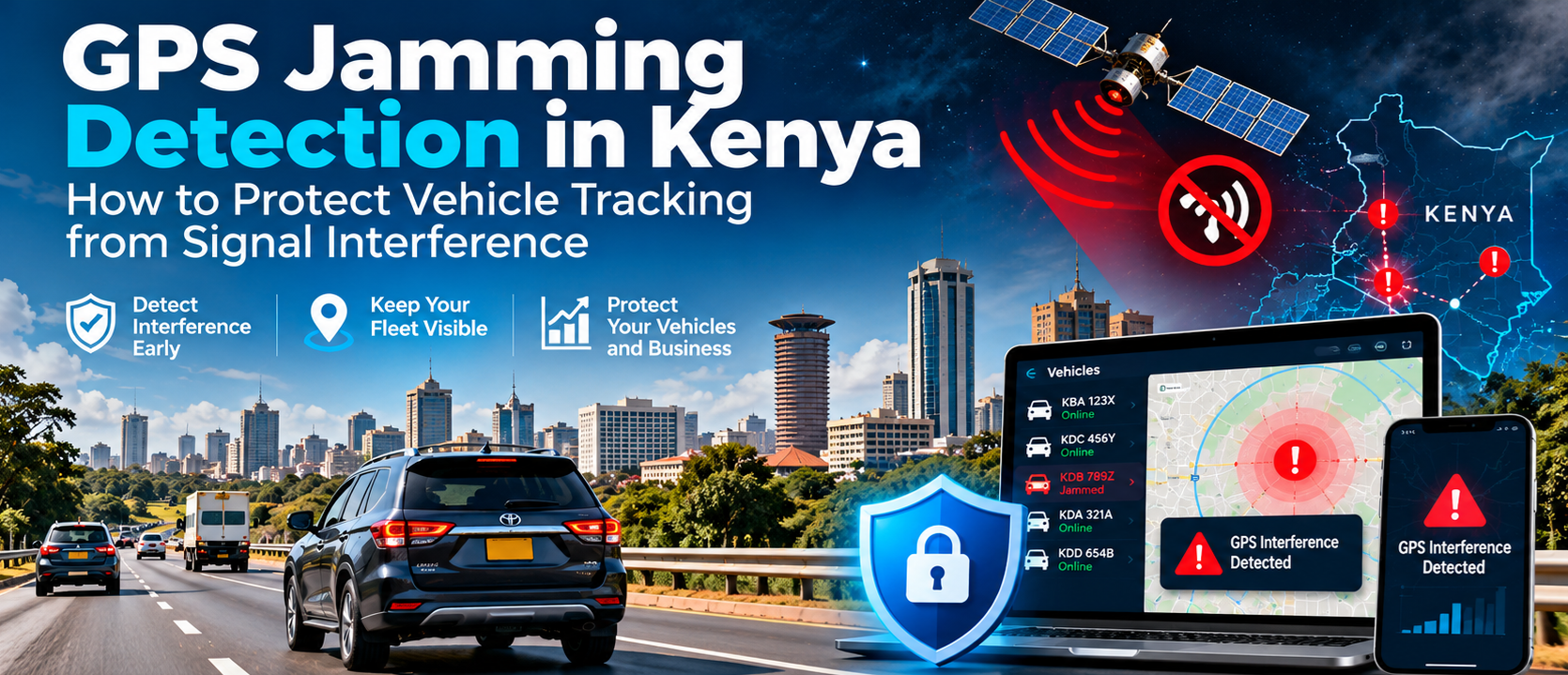
GPS jamming detection in Kenya is becoming increasingly important as vehicle owners, logistics companies and fleet operators depend more heavily on GPS tracking for security, route monitoring and operational control.
Vehicle tracking allows motorists and businesses to know where their vehicles are, review routes, monitor driver activity and respond quickly when something goes wrong.
However, installing a GPS tracker does not automatically make a vehicle impossible to hide.
One growing security concern is GPS and communication signal interference.
A device designed to interfere with satellite or mobile communication signals can potentially prevent a conventional vehicle tracker from determining its position or transmitting that position to a monitoring platform.
This is why vehicle owners should no longer ask only:
“Does my vehicle have a GPS tracker?”
They should also ask:
“What happens if somebody deliberately interferes with the tracking signal?”
What Is GPS Jamming?
GPS tracking devices normally calculate their position using signals transmitted by Global Navigation Satellite Systems, commonly referred to as GNSS.
GPS is one of these satellite navigation systems.
A vehicle tracker then normally sends its location and other information to a tracking platform through a mobile communications network.
A jammer is a radio-frequency transmitting device designed to introduce interference into one or more of these communication channels.
Depending on the type of interference, a vehicle tracker may experience:
- loss of satellite positioning;
- loss of cellular communication;
- delayed tracking updates;
- an apparently stationary vehicle;
- disappearance from live tracking;
- prolonged periods without communication; or
- unexplained gaps in journey history.
The important point is that GPS signal loss and mobile-network loss are not necessarily the same thing.
A more advanced vehicle-tracking platform should therefore monitor more than just the vehicle’s coordinates.
Why GPS Jamming Detection in Kenya Matters
GPS jamming detection in Kenya matters because modern vehicle security increasingly depends on continuous communication between the vehicle and the tracking platform.
A basic tracker experiencing signal loss may simply show:
Last seen: 10 minutes ago
A more sophisticated system may instead evaluate several events together and generate a warning such as:
Possible GPS or GSM Interference Detected
That additional information can help a vehicle owner or fleet controller decide whether the loss of communication is normal or potentially suspicious.
For commercial fleets, this can be particularly important where vehicles transport valuable goods, operate long-distance routes or require continuous visibility.
Is GPS Jamming Legal in Kenya?
Kenya regulates radio-frequency spectrum through the Communications Authority of Kenya.
The Kenya Information and Communications Act addresses deliberate interference with radio communication and provides penalties relating to unlawful interference with communications.
Vehicle owners should understand that the practical issue is not only whether interference is lawful.
The operational question is:
Can your tracking system recognise interference when it occurs?
When publishing this article, link:
Communications Authority of Kenya
to the official CA website.
Also link:
Kenya Information and Communications Act
to the relevant page on Kenya Law.
These two external links will also help satisfy Rank Math’s external-link recommendations.
How GPS Jamming Can Affect a Normal Vehicle Tracker
A conventional GPS vehicle tracker usually depends on two major communication stages.
1. Satellite Positioning
The tracker receives satellite-navigation signals and calculates the vehicle’s location.
If those signals become unavailable or unreliable, the tracker may temporarily lose its position.
2. Communication to the Tracking Server
The device sends location and telemetry information through a cellular network to the tracking server.
If mobile communication is disrupted, the tracker may still know where it is internally but may not be able to send that information to the monitoring platform.
This distinction is important.
A vehicle disappearing from a tracking platform does not automatically prove jamming.
Other possible causes include:
- poor cellular coverage;
- underground parking;
- enclosed buildings;
- tunnels;
- disconnected power;
- damaged tracking equipment;
- antenna faults;
- SIM-card or network problems;
- tracker removal; or
- server connectivity problems.
A properly designed anti-jamming tracking platform should therefore evaluate several indicators before classifying an event as suspicious.
How GPS Jamming Detection in Kenya Works
Modern anti-jamming tracking systems can combine multiple indicators to identify possible interference.
Sudden Loss of GNSS Signals
A tracking device can monitor satellite availability and signal quality.
A sudden reduction in usable satellite signals may indicate possible interference, especially if the vehicle is in an open environment where GPS reception would normally be expected.
Cellular Network Interference
Some tracking systems can also monitor abnormal cellular-network behaviour.
If a moving vehicle simultaneously loses satellite positioning and mobile communication, the combination may justify a higher-priority alert.
Vehicle Movement Without Valid GPS
Modern trackers may also use:
- accelerometers;
- ignition signals;
- motion sensors; and
- vehicle-power information.
Consider this sequence:
- Vehicle ignition turns on.
- Motion is detected.
- GPS disappears.
- Cellular communication becomes abnormal.
- Vehicle movement continues.
That combination may be more suspicious than an ordinary communications outage.
Power Disconnection Detection
An attacker may attempt to disable a tracker by disconnecting vehicle power.
A tracking unit with an internal backup battery can detect loss of external power and generate a tamper or power-disconnection alert.
Communication Recovery Analysis
When network communication returns, the tracker can send stored information to the monitoring platform.
This allows fleet controllers to review what happened during the period when communication was unavailable.
GPS Jamming Detection vs Ordinary Vehicle Tracking
| Feature | Basic GPS Tracker | Advanced Anti-Jamming Tracking |
|---|---|---|
| Live vehicle location | Yes | Yes |
| Route history | Yes | Yes |
| Geofence alerts | Usually | Yes |
| Ignition monitoring | Usually | Yes |
| Power-disconnection alert | Depends on device | Recommended |
| GPS interference monitoring | Often limited | Yes |
| GSM interference monitoring | Often limited | Yes |
| Backup battery | Depends on device | Recommended |
| Motion detection | Depends on device | Recommended |
| Jammer alerts | Usually limited | Yes |
| Event correlation | Limited | More advanced |
The best tracking solution depends on the security requirements of the vehicle.
A personal vehicle used mainly in an urban area may have different requirements from a long-distance truck transporting valuable cargo.
Seven Ways to Protect Vehicle Tracking from Signal Interference
1. Install a Tracker with Jamming Detection
When purchasing a vehicle tracker, ask specifically whether it can detect abnormal GPS/GNSS or GSM signal behaviour.
Do not assume every GPS tracker has anti-jamming capability.
2. Use Multiple Security Indicators
Vehicle location should not be the only security signal.
Combine GPS information with:
- ignition status;
- motion detection;
- geofencing;
- power monitoring;
- backup battery status;
- driver identification; and
- communication-status monitoring.
This helps the platform understand what is happening even when GPS information becomes unavailable.
3. Configure Immediate Offline Alerts
A tracking device that unexpectedly stops communicating should not remain unnoticed for hours.
Fleet operators can configure alerts when communication is lost while:
- the vehicle is moving;
- ignition is on;
- the vehicle has recently left a geofence; or
- the outage occurs outside normal working hours.
4. Use Backup Power
A tracker with internal backup power can continue operating after external vehicle power is disconnected.
It may also generate an immediate power-loss warning.
5. Protect the Installation
Tracking equipment should be installed professionally and discreetly.
The tracker, wiring and antennas should not be easily visible.
A poorly concealed tracker provides an attacker with an obvious target.
6. Use More Than One Security Layer
For higher-risk vehicles and commercial fleets, GPS tracking should form part of a broader security strategy.
Additional security measures may include:
- vehicle alarms;
- driver identification;
- geofence alerts;
- panic buttons;
- immobilisation controls;
- secondary tracking devices;
- video telematics; and
- fleet-control procedures.
The objective is simple:
Defeating one security layer should not automatically defeat the entire vehicle-security system.
7. Review Tracking Data for Abnormal Patterns
Fleet tracking is not only about watching a vehicle move on a map.
Historical information can reveal suspicious patterns such as:
- repeated GPS losses at the same location;
- unexplained communication gaps;
- unusual nighttime movement;
- ignition activity without matching route information;
- unexpected route deviations;
- repeated tracker power interruptions; or
- recurring signal problems affecting a particular vehicle.
Repeated abnormalities should be investigated.
Why Fleet Operators Should Pay Particular Attention
For a business operating many vehicles, tracking forms part of operational control.
Loss of tracking can affect:
- cargo security;
- route accountability;
- delivery verification;
- driver supervision;
- customer communication;
- vehicle recovery;
- fuel monitoring; and
- insurance investigations.
For example, imagine a delivery truck travelling from Nairobi suddenly disappearing from the tracking platform for 45 minutes.
A conventional system might simply record a communication gap.
A more advanced tracking system could examine:
- the last known location;
- vehicle speed;
- ignition condition;
- satellite signal condition;
- mobile-network condition;
- motion sensor information;
- power status; and
- the time the interruption occurred.
This information can help determine whether the event was an ordinary communication outage or something that deserves further investigation.
For commercial operators, GPS jamming detection in Kenya can therefore become an important part of fleet-risk management.
Anti-Jamming Does Not Mean Impossible to Jam
This is an important distinction.
No responsible tracking provider should imply that a vehicle becomes completely immune to radio-frequency interference simply because an anti-jamming tracking device has been installed.
Anti-jamming technology is mainly about:
- detection;
- resilience;
- event recording; and
- response.
The objective is to make interference observable.
Instead of allowing the tracker to disappear silently, the security platform should recognise abnormal conditions and respond according to the configured security rules.
Depending on the system, this may include:
- generating an alert;
- recording the event;
- storing tracking information locally;
- notifying a fleet controller;
- using another communications method; or
- triggering a predetermined security response.
Any remote immobilisation feature should be configured with safety as the first priority.
What Should You Ask Your Vehicle Tracking Provider?
Before buying a tracking system in Kenya, ask the provider these questions.
Does the Tracker Detect GPS or GNSS Interference?
Simple GPS-loss detection is not necessarily the same as jammer detection.
Does It Detect Cellular-Network Interference?
An attacker may interfere with mobile communication rather than satellite positioning.
What Happens When Communication Is Lost?
Ask whether the tracker stores data internally and sends it when communication returns.
Does the Tracker Have Backup Power?
Internal backup power can help the device detect and report external power disconnection.
Can I Receive Immediate Alerts?
Find out whether alerts are available through:
- mobile applications;
- web dashboards;
- SMS;
- email; or
- other notification channels.
Can the System Distinguish Network Loss from Suspicious Interference?
No detection system is perfect.
However, combining several security indicators can improve event classification.
Does the Platform Keep Historical Records?
Historical event records are important for fleet reviews, investigations and auditing.
The Future of Vehicle Tracking: Intelligent Anomaly Detection
The next generation of vehicle tracking will not simply answer:
Where is the vehicle?
More advanced platforms will increasingly ask:
Is this vehicle behaving normally?
This requires analysing several types of information together.
For example:
Normal Event
Poor cellular coverage → communication disappears temporarily → connection returns → route continues normally.
Potentially Suspicious Event
Vehicle leaves an authorised area → GPS suddenly disappears → cellular communication becomes abnormal → vehicle power is disconnected → motion continues.
Both situations technically involve a tracker going offline.
However, they represent very different security risks.
This is where event correlation and anomaly detection can improve modern vehicle security.
Dotmobi’s Approach to Smarter Vehicle Tracking
At Dotmobi LLP, we believe modern tracking should provide more than a map showing vehicle locations.
Effective vehicle tracking solutions in Kenya should help vehicle owners and businesses identify abnormal events early and provide useful information for decision-making.
Depending on the customer’s requirements, a modern tracking solution can include:
- real-time GPS tracking;
- route history;
- geofencing;
- ignition monitoring;
- speed monitoring;
- vehicle movement monitoring;
- power-disconnection alerts;
- communication-loss alerts;
- fleet reports; and
- security-event monitoring.
For higher-risk vehicles and commercial fleets, GPS jamming detection in Kenya can be incorporated as part of a layered vehicle-security strategy.
Conclusion
GPS jamming detection in Kenya is becoming an important consideration for motorists and businesses that depend heavily on vehicle tracking.
GPS tracking remains one of the most useful tools for vehicle security and fleet management.
However, the security question is changing.
It is no longer enough to ask:
Can I track my vehicle?
Vehicle owners should also ask:
Can my tracking system recognise when somebody is trying to stop me from tracking it?
By combining jammer detection, backup power, motion sensing, geofencing, communication monitoring and intelligent alerts, vehicle owners can make tracking systems much harder to defeat silently.
For businesses managing valuable vehicles, cargo or field operations, this additional visibility can help distinguish an ordinary network outage from a potentially serious security event.
Need a Vehicle Tracking Solution in Kenya?
Dotmobi LLP provides vehicle tracking and monitoring solutions for private motorists, businesses and commercial fleets.
We can help you evaluate the tracking features needed for your vehicle type, fleet size and security requirements.
Visit: https://dotmobi.co.ke/
Frequently Asked Questions
What is GPS jamming?
GPS jamming involves radio-frequency interference that can disrupt a receiver’s ability to obtain reliable satellite-navigation signals.
Can a GPS jammer disable a vehicle tracker?
It may interfere with satellite positioning, mobile communication or both. The effect depends on the tracker, installation, communications architecture and nature of the interference.
Can vehicle trackers detect jammers?
Some advanced tracking devices can monitor abnormal GPS and cellular signal behaviour and generate warnings indicating possible interference.
Is GPS jamming illegal in Kenya?
Kenya regulates radio-frequency communications through the Communications Authority of Kenya, and deliberate interference with authorised radio communications is prohibited under Kenyan communications law.
How can GPS jamming detection in Kenya improve vehicle security?
GPS jamming detection in Kenya can help identify suspicious signal loss and combine it with information such as vehicle motion, ignition status, power loss and network communication behaviour.
How can I protect my vehicle from GPS interference?
Use a tracking system with interference monitoring, backup power, secure installation, motion sensing, power-disconnection alerts and multiple layers of vehicle security.
Does anti-jamming mean the tracker cannot be jammed?
No. Anti-jamming technology should generally be understood as technology designed to detect, resist or respond to interference rather than providing a guarantee that interference is impossible.
Is anti-jamming tracking useful for commercial fleets?
Yes. It can be particularly useful for fleets carrying valuable cargo, operating long-distance routes or requiring continuous operational visibility.