
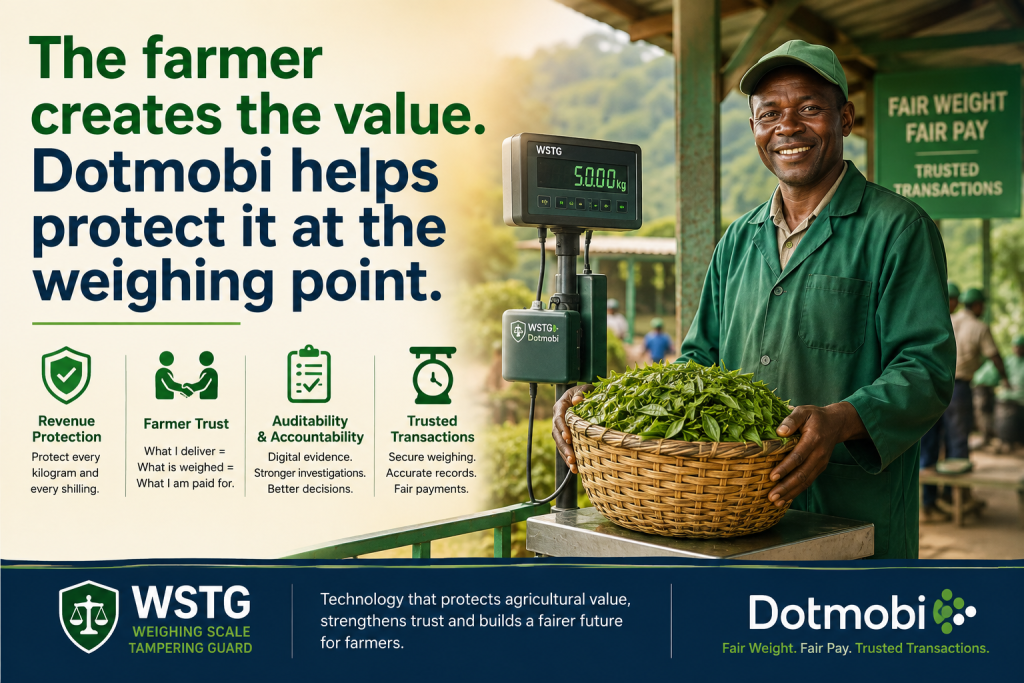
A farmer can spend months preparing land, tending crops, paying for inputs and labour, and finally harvesting produce.
Yet after all that work, one of the most important moments may take only a few seconds:
The weighing of the produce.
At that point, kilograms are converted into money.
If 50 kilograms are delivered, the farmer expects 50 kilograms to be recorded. If the weighing process is manipulated and records less than the actual quantity delivered, part of the value the farmer has worked to create can disappear immediately.
This is what we call:
The Hidden Leak at the Weighing Point
The Problem Is Not Just About a Weighing Scale
Weighing integrity is fundamentally about value, trust and accountability.
Where agricultural produce is bought according to weight, the weighing transaction determines what the supplier or farmer is eventually credited or paid.
This affects many agricultural value chains, including:
- Tea
- Coffee
- Cocoa
- Dairy
- Grain
- Horticulture
- Other commodities purchased by weight
When weighing integrity is compromised, the effects go beyond an inaccurate number on a display.
They can result in:
- Farmer underpayment;
- Loss of trust;
- Farmer-management disputes;
- Revenue and value leakage;
- Difficult investigations;
- Weak transaction traceability; and
- Increased governance and compliance risks.
How Material Can the Loss Be?
A publicly reported Kenyan case illustrates the potential scale of the problem.
In May 2023, Kenya News Agency reported that preliminary examinations of weighing scales at tea buying centres in Githunguri, Kiambu County, found that farmers were losing at least 1.4 kilograms for every 10 kilograms delivered. (Kenya News)
That represents approximately:
14% of the weight-linked value of an affected transaction.
This does not mean that all tea farmers or all agricultural weighing points experience a 14% loss.
It does, however, demonstrate how economically significant weighing manipulation can become when it occurs.
Consider the principle.
If an affected farmer should legitimately receive KES 10,000 based on weight, a 14% distortion would represent KES 1,400 in value.
If the legitimate value were KES 100,000, the same percentage would represent KES 14,000.
Now multiply small discrepancies across repeated deliveries, hundreds of farmers and multiple buying centres.
The cumulative impact can become substantial.
Why Traditional Controls May Not Be Enough
Physical inspection, verification and stamping of weighing equipment remain important parts of protecting trade measurements.
The challenge is that agricultural organisations can operate large networks of geographically dispersed buying centres.
An inspection can confirm the condition of equipment at a particular point in time.
But management also needs confidence in what happens:
after the inspector leaves, during actual transactions, and across many remote locations.
This is where technology can strengthen traditional controls.
The question is shifting from:
“Was this scale inspected?”
towards:
“Can we trust this particular weighing transaction?”
Protecting the Transaction, Not Just the Equipment
At Dotmobi, our focus is not agricultural production.
We are not trying to tell farmers how to grow their crops or increase their yields.
Our responsibility begins when the farmer has already done the hard work.
The crop has been produced.
It has been harvested.
It has reached the buying point.
Our goal is simple:
Protect the value the farmer has already created.
The Weighing Scale Tampering Guard (WSTG) is designed as a technology layer around agricultural weighing transactions, supporting stronger transaction integrity, monitoring and digital traceability.
Rather than treating weighing security simply as an equipment problem, WSTG approaches it as a transaction-trust problem.
Three Outcomes Matter Most
1. Revenue and Value Protection
Every legitimate kilogram has an economic value.
Protecting the integrity of the weighing process helps reduce exposure to value leakage caused by manipulation.
For the farmer, this means protecting the connection between the produce delivered and the amount recorded.
For the agricultural organisation, it means strengthening controls around one of the most commercially important points in the supply chain.
2. Farmer Trust
Trust cannot depend entirely on asking a farmer to believe that the weighing process was correct.
Modern agricultural systems should increasingly be capable of creating digital evidence around transactions.
The desired relationship should be:
What I delivered = What was weighed = What was recorded = What I am paid for.
When farmers have greater confidence in this process, the relationship between producers, cooperatives and agricultural enterprises can become stronger.
3. Auditability and Accountability
When a disputed weighing transaction occurs, management needs reliable information.
Digital transaction records can strengthen the ability to:
- Review transactions;
- Identify anomalies;
- Investigate complaints;
- Reconcile records;
- Monitor remote operations; and
- Support compliance processes.
The objective is to move from relying mainly on retrospective explanations toward having stronger transaction evidence.
Kenya Has Already Recognised the Importance of Anti-Tampering Technology
The need for stronger weighing integrity is not theoretical.
In October 2024, KBC reported the completion of anti-tampering gadget installations on green-leaf weighing scales across KTDA-managed factories. The report linked the initiative to concerns over tampered scales and the need to improve transparency and fairness for smallholder tea farmers. (KBC)
This signals an important shift in agricultural weighing:
Technology is increasingly becoming part of the trust infrastructure around agricultural transactions.
The next opportunity is to continue strengthening these systems so that technology does more than identify problems—it should increasingly help organisations prevent invalid transactions and create better evidence for management and farmers.
From Devices to Trust Infrastructure
Anti-tampering technology should not ultimately be judged simply by the number of devices installed.
The more meaningful questions are:
- How many weighing transactions are protected?
- How many kilograms of produce pass through protected systems?
- How many abnormal or manipulation attempts are identified?
- How many invalid transactions are prevented?
- Are farmer disputes declining?
- Can management investigate incidents more effectively?
- How much economic value is being protected?
These are the impact indicators that should increasingly define the success of digital weighing protection.
Our Field Experience
Dotmobi’s WSTG journey has moved through practical deployment and continued product improvement.
The existing footprint has included approximately 70 factories, 800+ deployed devices and an agricultural ecosystem reaching more than 600,000 farmers.
That experience has provided something that cannot be developed entirely inside a laboratory:
Understanding how weighing manipulation behaves in the real world.
Field experience has helped inform the continued strengthening of the WSTG approach, with emphasis moving progressively from simply detecting suspicious events toward stronger transaction protection and reduced dependence on human intervention.
The Bigger Opportunity
The challenge of weighing integrity extends beyond tea.
The underlying business problem exists wherever:
Produce is aggregated → weighed → valued → paid for.
That creates potential application across multiple agricultural commodities and African markets.
A cocoa farmer in Ghana, a coffee farmer in Kenya, a grain supplier in Uganda or a dairy farmer delivering milk through a cooperative may operate in very different value chains.
But they share one fundamental requirement:
The measurement used to determine payment must be trustworthy.
Digital Agriculture Needs Trusted Data
Agriculture is becoming increasingly digitised.
Transactions are moving to mobile devices.
Payments are becoming digital.
Management information is moving to cloud platforms.
Traceability requirements are expanding.
But digitalisation alone cannot guarantee fairness.
If inaccurate or manipulated information enters the digital system at the beginning of the transaction, technology may simply preserve an unreliable record.
The foundation therefore has to be:
Trusted data at the point of capture.
And in weight-based agricultural trade, that begins at the weighing point.
The Dotmobi Vision
Our vision is to help build an agricultural ecosystem in which farmers, cooperatives, factories, regulators and agricultural enterprises can have greater confidence in the integrity of weighing transactions.
We believe that protecting agricultural value requires bringing together:
Revenue Protection + Farmer Trust + Secure Data + Traceability + Auditability + Technology
Because after a farmer has spent months creating value, that value should not be lost in the few seconds it takes to weigh the produce.
Dotmobi WSTG — Fair Weight. Fair Pay. Trusted Transactions.