
Protecting Trust at the Weighing Point
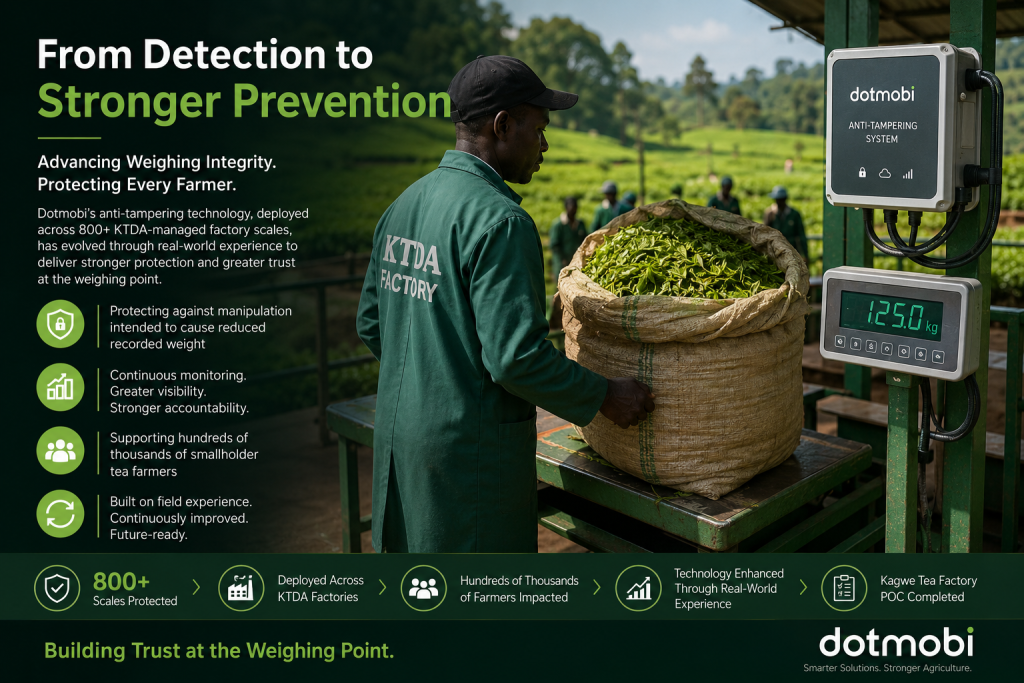
For smallholder tea farmers, every kilogram matters.
The weight recorded when green leaf is delivered ultimately contributes to the farmer’s earnings. This makes the integrity of weighing equipment one of the most important control points in the tea value chain.
For many years, concerns over manipulation of tea weighing scales have been raised by farmers, regulators, government officials and other stakeholders in Kenya’s tea industry.
Publicly reported investigations before 2024 included complaints of weighing discrepancies, regulatory inspections, confiscation of problematic weighing equipment and cases where farmers were found to be receiving lower recorded weights than expected.
These concerns created a clear need for technology capable of strengthening confidence in the weighing process.
KTDA’s Move Towards Technology-Based Protection
KTDA responded by strengthening its electronic weighing environment through anti-tampering technology.
By October 2024, KTDA publicly announced completion of anti-tampering installations on green-leaf weighing scales across its managed-factory network.
The deployment represented an important change in the way weighing integrity could be managed.
Instead of relying primarily on periodic inspections or waiting for farmers to report suspected discrepancies, technology introduced continuous monitoring and quicker identification of suspicious interference.
For Dotmobi, the deployment also provided something equally important: extensive real-world operating experience.
More than 800 weighing scales were protected, exposing the technology to different field environments, operators, factory conditions and practical challenges.
Real-World Deployment Produced Important Lessons
No security technology remains effective by standing still.
Once controls are introduced, persons seeking to interfere with a system may change their methods.
Public reports after the 2024 rollout continued to record concerns over weighing manipulation in parts of the tea sector.
These included allegations of attempts to interfere with weighing processes in ways intended to cause reduced recorded weight.
Rather than viewing continued manipulation attempts simply as a setback, Dotmobi treated the field experience as valuable engineering intelligence.
Every real-world incident helped the company better understand the operational risks surrounding green-leaf weighing and informed continuous improvement of the technology.
From First-Generation Protection to an Enhanced System
Using lessons accumulated from deployment, Dotmobi embarked on a programme to further strengthen and harden its anti-tampering technology.
The enhanced system has been designed around a simple objective:
increase the ability of the technology to protect weighing transactions while reducing dependence on human intervention.
For intellectual-property protection reasons, the detailed architecture and operating mechanisms of the enhanced technology are not being publicly disclosed.
What can be stated publicly is that the enhanced platform has been developed in response to manipulation techniques and operational risks identified through extensive field experience.
The objective is to provide stronger protection against attempts to interfere with legitimate weighing transactions, including manipulation intended to cause reduced recorded weight.
Kagwe Tea Factory Proof of Concept
The evolution of the technology culminated in a Proof of Concept involving the enhanced system at Kagwe Tea Factory.
The Kagwe POC represents an important stage in Dotmobi’s journey.
It moves the technology beyond the original large-scale deployment and applies lessons learned from real operating environments to a strengthened generation of the solution.
The development journey can therefore be summarised as:
Industry problem identified → technology deployed at scale → field behaviour observed → technology strengthened → enhanced system subjected to Proof of Concept.
Dotmobi now looks forward to the anticipated KTDA procurement process that could facilitate further evaluation, piloting and, subject to successful procurement and approval, wider deployment of the enhanced solution.
A Technology That Learns From the Field
The strongest aspect of the Dotmobi story is not simply the development of an anti-tampering device.
It is the experience accumulated from protecting a large agricultural weighing network.
Dotmobi has been able to observe:
- the practical challenges surrounding field weighing;
- how manipulation risks change after controls are introduced;
- the importance of reducing dependence on manual intervention;
- the need for continuous monitoring and accountability; and
- the importance of continually strengthening technology as threats evolve.
This experience is difficult to reproduce in a laboratory.
It has allowed Dotmobi to develop technology based on actual operational challenges rather than assumptions.
Proven at Scale
The KTDA engagement has provided Dotmobi with an important commercial and technical proof point.
800+ weighing scales protected
Large-scale deployment across the KTDA managed-factory network
Hundreds of thousands of smallholder farmers potentially benefiting from stronger weighing integrity
Real-world field validation
Continuous technology improvement
Enhanced system progressed to Kagwe Tea Factory POC
These milestones demonstrate that Dotmobi is developing technology for a proven and economically important problem.
From Detection Towards Stronger Prevention
The first generation of anti-tampering technology focused heavily on increasing visibility and identifying suspicious interference.
Field experience demonstrated the importance of going further.
Dotmobi’s enhanced technology is therefore focused on stronger intervention capabilities and reducing the extent to which protection depends entirely on a person identifying a problem and subsequently taking action.
The detailed mechanisms remain confidential.
This progression represents an important step in the maturity of the product:
from detecting risks towards preventing more manipulation from affecting legitimate weighing transactions.
Supporting Farmer Trust Through Technology
The ultimate purpose of weighing-security technology is not the device itself.
It is trust.
A farmer delivering green leaf should have confidence that the recorded weight represents the legitimate transaction.
A factory should have greater visibility over its weighing operations.
Management should have stronger tools for identifying suspicious activity.
And the wider tea industry should have increasingly auditable systems capable of supporting transparency and accountability.
This is the challenge Dotmobi continues to address.
The Next Chapter
The original KTDA deployment demonstrated that anti-tampering technology could operate at significant scale.
Continued field experience demonstrated that weighing-security threats continue to evolve.
Dotmobi responded by evolving with them.
The result is a strengthened generation of the technology, informed by large-scale operational experience and progressed through a Proof of Concept at Kagwe Tea Factory.
As Dotmobi prepares for the next potential KTDA procurement and pilot opportunity, the company’s proposition has evolved beyond a simple anti-tampering device.
It is becoming a broader weighing-integrity and transaction-protection platform, developed from years of experience protecting real agricultural weighing operations.
Dotmobi — Building Trust at the Weighing Point.