The warehouse scale looked properly maintained.
Its enclosure was closed, the verification seal appeared intact and the display returned to zero before each weighing transaction.
From the outside, there was no obvious reason to suspect a problem.
Yet, at the end of every month, the warehouse accountant reported a stock variance.
The quantities recorded as received did not agree with the quantities later issued for production. Suppliers insisted that they had delivered the correct amounts. Warehouse staff said every consignment had been weighed.
The scale technician checked the equipment and found it operating normally during the inspection.
For several months, the business treated the differences as ordinary handling losses.
But the unexplained shortage continued.
The real question was no longer whether the scale worked correctly during an inspection.
The question was whether anyone interfered with the weighing process when management and technicians were not present.
This is the visibility gap that a weighing scale anti-tampering device is designed to address.
A Scale Can Work Correctly During Inspection and Still Be Vulnerable
Traditional scale protection measures remain important.
Commercial weighing instruments should be properly verified, sealed, serviced and used according to applicable requirements. However, a physical inspection only shows the condition of the scale at the time it is examined.
It may not reveal what happened:
- During a night shift
- Between scheduled inspections
- Before the technician arrived
- After a supervisor left the weighing point
- When an unauthorised person accessed the scale
- When another scale was substituted
- When scale settings or components were interfered with
A scale can therefore appear normal during an inspection while the business still lacks continuous oversight of its weighing environment.
Why Small Weight Manipulations Create Large Losses
Commercial weighing determines important financial and operational records.
Weight may be used to calculate:
- Supplier payments
- Farmer payments
- Goods received
- Stock balances
- Production quantities
- Customer invoices
- Transport loads
- Raw-material usage
- Warehouse accountability
A small unexplained difference on one transaction may appear insignificant.
However, when the same difference is repeated across hundreds or thousands of transactions, the total financial impact can become substantial.
The business may experience declining stock, unexplained production variances and supplier disputes without immediately identifying weighing manipulation as the cause.
What Is the Dotmobi Weighing Scale Tampering Guard?
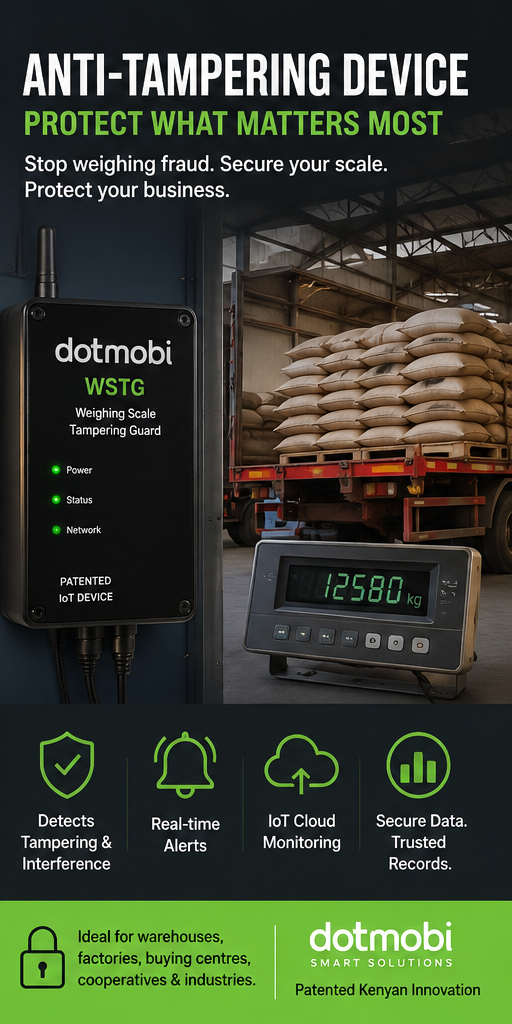
The Dotmobi Weighing Scale Tampering Guard, commonly referred to as WSTG, is a patented IoT-based solution developed to strengthen the protection of commercial weighing operations.
The system is designed to support the detection of suspicious interference and provide alerts where unauthorised activity is identified.
Rather than depending only on a manager being physically present, WSTG adds an intelligent monitoring layer around the weighing process.
The technology helps businesses move from occasional observation to more continuous digital supervision.
Real-Time Alerts Change How Management Responds
Without an anti-tampering system, a business may discover a problem only after reviewing monthly stock reports.
By then:
- The affected transactions may be difficult to identify.
- Staff may not remember what happened.
- Suppliers may already have been paid.
- Goods may have left the premises.
- The scale may have been returned to its normal condition.
- Evidence of interference may no longer be visible.
Where configured, the Dotmobi WSTG can support real-time notifications when suspicious activity or unauthorised interference is detected.
This gives management an opportunity to investigate closer to the time of the event rather than several weeks later.
From Suspicion to an Audit Trail
One of the biggest challenges in a weighing dispute is the absence of reliable evidence.
A warehouse manager may suspect an operator. The operator may blame the equipment. The technician may report that the scale was working correctly when inspected.
Without a monitoring record, the discussion becomes based on accusations.
IoT-based monitoring can strengthen the audit trail by helping management relate alerts and system events to particular periods or weighing operations.
This does not replace proper management, verification or investigation. It gives those processes better information.
Protecting More Than the Scale
A weighing scale anti-tampering device protects more than a piece of equipment.
It helps protect:
- Supplier confidence
- Customer trust
- Stock records
- Production reports
- Revenue
- Farmer payments
- Employee accountability
- Management decisions
- The organisation’s reputation
Where weight determines payment, an unreliable weighing process can damage relationships throughout the supply chain.
Suitable Weighing Environments
The Dotmobi Weighing Scale Tampering Guard can be considered for:
- Tea factories
- Agricultural produce collection points
- Cooperatives
- Farmer buying centres
- Warehouses
- Manufacturing plants
- Commercial stores
- Logistics operations
- Industrial weighing points
- Institutions using commercial scales
- Businesses where weight determines payment or stock
Each installation should be assessed according to the type of scale, operating environment, existing systems and required monitoring arrangement.
Locally Developed IoT Support
Dotmobi is a Kenyan technology company specialising in weighing automation, IoT monitoring, secure data capture and data-integrity solutions.
The WSTG solution is supported locally, enabling organisations to access installation guidance, technical discussions and first-level assistance within Kenya.
The anti-tampering device can also form part of a wider digital weighing environment that includes cloud monitoring, weighbridge automation and secure transaction management.
Warning Signs That a Weighing Operation Needs Better Protection
A business should assess its weighing controls when it experiences:
- Repeated stock variances
- Frequent supplier complaints
- Unexplained differences between incoming and outgoing weights
- Suspicious activity around the scale
- Unauthorised access to weighing equipment
- Weak control of scale keys or enclosures
- Missing weighing records
- Inconsistent readings between scales
- Excessive dependence on one operator
- Difficulty investigating past weighing incidents
These signs do not automatically prove tampering. However, they show that the organisation may need stronger monitoring and accountability.
Frequently Asked Questions
Does the anti-tampering device replace scale verification?
No. Proper verification, sealing, calibration and maintenance remain important. WSTG adds an intelligent monitoring and alert layer to strengthen the existing controls.
Can WSTG detect suspicious interference?
The device is designed to detect specified tamper-related or unauthorised activities and support alerts according to the installed configuration.
Can alerts be received in real time?
Where properly configured and connected, the system can support real-time notifications for detected events.
Is WSTG suitable only for agricultural weighing?
No. It can also be considered for warehouses, manufacturing plants, commercial stores, logistics operations and other environments where weight affects payment or stock records.
Can the system help resolve disputes?
Monitoring records and alerts can provide additional information for management investigations, audits and dispute resolution.
Is Dotmobi WSTG patented?
Yes. Dotmobi’s Weighing Scale Tampering Guard is a patented Kenyan innovation developed for protecting commercial weighing operations.
The Scale Was Not the Only Thing That Needed Inspection
The warehouse had concentrated on whether the scale was accurate whenever a technician visited.
That was important—but incomplete.
The business also needed to know whether the weighing process remained protected between inspections.
An ordinary scale reports weight.
A protected and monitored weighing environment helps management determine whether that weight can be trusted.
Dotmobi can assess your factory, warehouse, cooperative, produce-buying centre or commercial weighing operation and advise how the Weighing Scale Tampering Guard can strengthen your controls.
Call Dotmobi: +254 722 761 322
Email: info@dotmobi.co.ke
Website: dotmobi.co.ke