Table of Contents
Kenya is moving toward automated water-abstraction monitoring. The 2027 smart water meter requirement Kenya introduces an important compliance deadline for certain commercial, institutional and large-scale water users regulated by the Water Resources Authority (WRA).
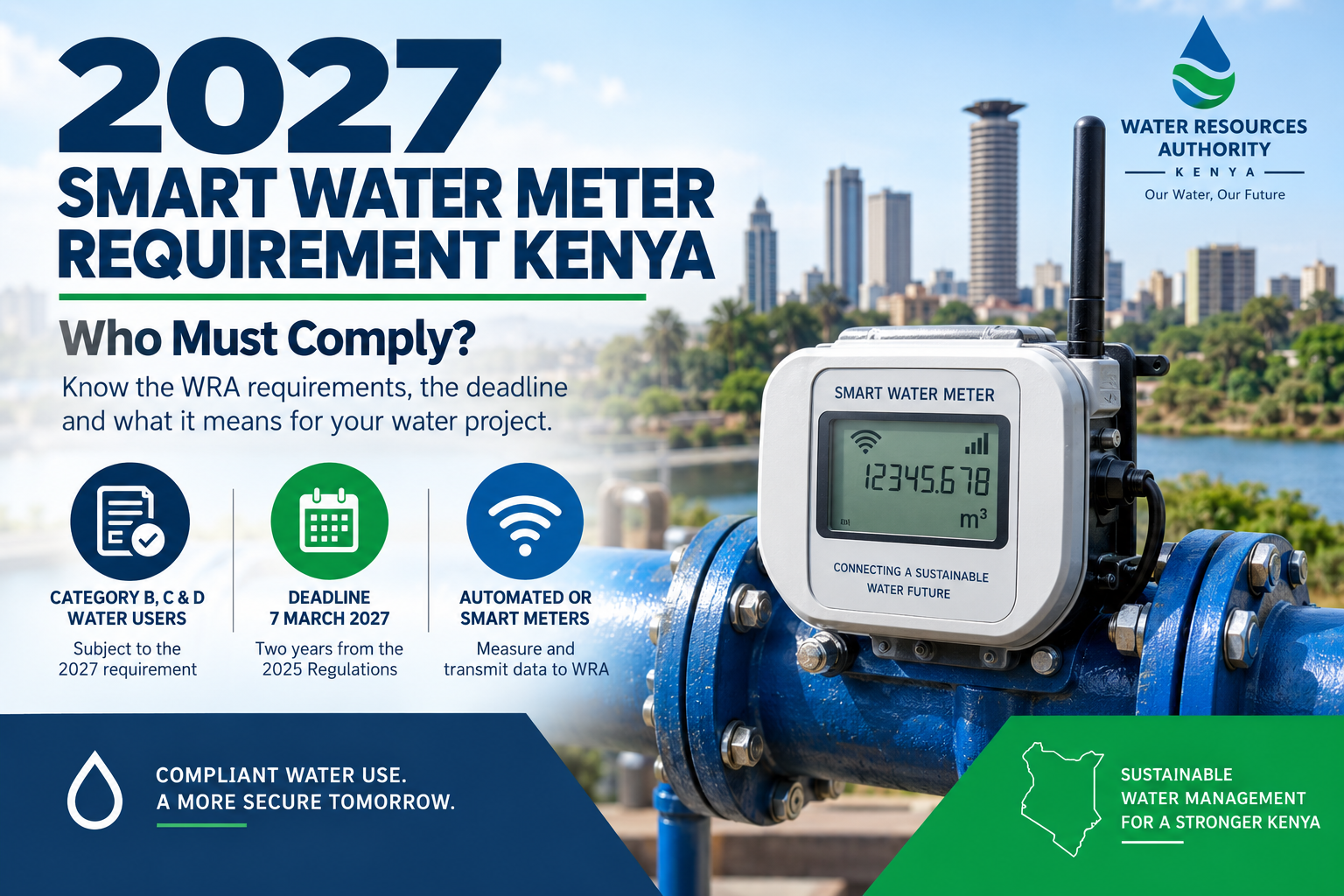
Under the Water (Resources) Regulations, 2025, Category B, C and D water users are required to install automated measuring meters or smart meters within the specified transition period.
The Regulations commenced on 7 March 2025, meaning the two-year compliance period points to 7 March 2027.
However, one distinction is particularly important:
This is not a blanket requirement for every household, apartment, landlord or ordinary water consumer in Kenya to install a smart water meter by 2027.
The specific requirement targets Category B, Category C and Category D water users regulated by WRA.
What Does the 2027 Smart Water Meter Requirement Kenya Mean?
Regulation 72 of the Water (Resources) Regulations, 2025 requires every Category B, C or D water user, whether involved in water abstraction or effluent discharge, to install an automated measuring meter or smart meter.
The meter is intended to accurately measure water that is abstracted, diverted or otherwise regulated, as well as regulated effluent discharge.
The Regulations also require the meter to be inspected when necessary to ensure measurements remain accurate. WRA is responsible for sealing automated or smart meters installed under these provisions.
This makes smart metering more than simply a convenient way of obtaining water-consumption reports.
For affected permit holders, smart metering is becoming part of regulatory compliance.
Who Must Comply With WRA Smart Meter Requirements?
The Regulations divide water-use activities into Categories A, B, C and D according to their scale and potential impact on Kenya’s water resources.
Category B Water Users
Category B covers water-use activities which, because of their scale, have the potential to make a significant impact on the water resource.
These permit applications are handled through WRA regional offices, with consultation involving the relevant Water Resource Users Association or equivalent local body.
Category C Water Users
Category C involves activities considered to have a significant impact on the water resource.
Their applications involve a higher level of assessment, including advice from the relevant Basin Water Resources Committee.
Category D Water Users
Category D covers large-scale or complex water-use activities, including activities involving different basin areas, where the scale may have a large impact on the water resource.
These applications are handled at WRA headquarters with advice from the relevant Basin Water Resources Committees.
Accordingly, organisations holding or requiring Category B, C or D water-use permits should pay particular attention to the March 2027 smart-meter requirement.
Depending on their WRA classification, affected users may include:
- Commercial borehole operators
- Water service providers
- Industries and factories
- Commercial farms and irrigation schemes
- Institutions with significant groundwater abstraction
- Private water-supply projects
- Large residential or commercial developments operating their own water sources
- Organisations abstracting surface water
- Operators with regulated effluent-discharge permits
Importantly, organisations should confirm their category from their WRA permit or directly with WRA. Classification should not be assumed merely from the size of a borehole, pump, pipe or water meter.
WRA describes Category A largely in the context of social water use, while Categories B, C and D relate to progressively more significant economic water use. More information is available from the Water Resources Authority’s water-use allocation guidance.
2027 Smart Water Meter Requirement Kenya for Borehole Owners
Borehole owners need to distinguish between the general requirement to meter borehole abstraction and the more specific requirement for certain users to install an automated or smart meter.
Regulation 58 provides that, within 12 months of commencement of the 2025 Regulations, all borehole water abstractors should ensure that boreholes are fitted with dipper tubes, that abstracted water passes through a meter and that the meter is periodically inspected to ensure it is not defective.
Because the Regulations commenced on 7 March 2025, that 12-month period reached 7 March 2026.
The distinction is therefore important.
The borehole provision requires metering, while the specific two-year provision for Category B, C and D water users requires an automated measuring meter or smart meter.
This means a borehole owner should first establish the applicable WRA permit category before deciding what meter technology is required.
A Smart Water Meter Must Do More Than Display a Reading
Installing a digital meter with an LCD screen should not automatically be assumed to satisfy WRA’s automated smart-meter requirements.
The regulatory direction is toward connected measurement and electronic data management.
Regulation 73 states that WRA is to publish an acceptable Application Programming Interface (API) compatible with its systems to guide members of the public when acquiring automated meters.
The provision also allows WRA, subject to procurement requirements, to accredit smart-meter manufacturers.
This has significant implications when selecting new bulk or smart meters.
A buyer should not consider measurement accuracy alone.
The meter’s ability to communicate with monitoring infrastructure may become equally important.
WRA Advanced Metering Infrastructure and Smart Water Meters
WRA has also described the development of an Advanced Metering Infrastructure (AMI) capable of receiving, storing and analysing abstraction data from smart meters installed at boreholes, intakes and effluent-discharge points.
The Authority also describes a Centralized Smart Meter Billing Integration Platform through which smart-meter information can be transmitted for regulatory and billing purposes.
More information on these systems is available on the WRA innovations page.
This means organisations planning water-meter purchases should consider connectivity and integration capability, not simply meter accuracy or price.
Can an Existing Mechanical Water Meter Be Used?
For Category B, C and D compliance after the transition period, an ordinary manually read mechanical water meter may not by itself satisfy a requirement for an automated measuring meter or smart meter.
Before replacing an existing meter, organisations should determine whether the proposed meter can support:
- Automatic consumption measurement
- Remote transmission of readings
- Reliable cumulative flow records
- WRA system or API integration
- Secure meter identification
- Tamper protection
- Appropriate communications technology
- Long-term data availability
- Accurate measurement across the required flow range
- Calibration, inspection and sealing requirements
Communication could technically involve technologies such as cellular IoT, depending on the meter and the interface ultimately accepted by WRA.
However, organisations should confirm current WRA API and integration requirements before committing to a particular communications protocol, meter model or manufacturer.
This is especially important when purchasing large bulk ultrasonic or electromagnetic meters.
Water Meter Data and Transmission to WRA
The Regulations go beyond simply installing a meter.
Regulation 84 requires a permit holder to install an automated measuring device for assessing water use and provides for transmission of readings from the automated meter to WRA.
Category B, C and D permit holders are also required to maintain records of daily abstraction or effluent discharge in cubic metres per day.
The direction is therefore increasingly toward electronically available and auditable water-consumption data rather than occasional manual meter readings.
For organisations affected by the 2027 smart water meter requirement Kenya, the communications and data-management side of the meter should therefore be considered during procurement.
What Happens If a Water User Does Not Comply?
The Regulations provide financial consequences relating to inadequate measurement.
Under Regulation 74, where assessment of water use is not based on continuous measurement through an automated and appropriately sealed flow-measuring meter, the water user may face a 10% penalty on the full amount of water used.
The Regulations also address meter tampering.
Where WRA establishes that a permit holder has tampered with a meter and consequently under-declared water use, the Authority can charge for the under-declared water in arrears.
Smart metering is therefore not simply an operational-efficiency issue.
It increasingly affects regulatory compliance, billing accuracy and accountability for water use.
What Should Water Users Do Before March 2027?
Organisations abstracting significant quantities of groundwater or surface water should not wait until early 2027 to start assessing their installations.
The first step should be to examine the existing WRA water-use permit and confirm:
- Whether the water-use activity is Category A, B, C or D.
- The authorised abstraction quantity.
- Whether the existing meter is mechanical, automated or smart.
- Whether the meter can transmit readings remotely.
- Whether its communications system can integrate with WRA infrastructure.
- Whether the meter is suitable for the pipe size and expected flow range.
- Whether calibration, sealing and inspection requirements can be met.
- Whether WRA currently requires an accredited manufacturer or a particular API configuration.
This assessment is especially important when purchasing bulk ultrasonic or electromagnetic water meters.
Replacing a large meter after installation can be substantially more expensive than establishing the technical and regulatory requirements before procurement.
Preparing early for the 2027 smart water meter requirement Kenya can therefore help organisations avoid investing in meters that may not support the required monitoring infrastructure.
Dotmobi’s Approach to Smart Water Metering in Kenya
The transition toward connected water measurement creates an opportunity to move beyond simply recording how much water has passed through a pipe.
A properly designed smart-meter installation can provide:
- Automated consumption monitoring
- Water-loss identification
- Abnormal-consumption alerts
- Bulk-meter reconciliation
- Historical water-usage analysis
- Remote meter monitoring
- Integration with cloud-based water-management systems
Dotmobi is evaluating smart bulk-meter technologies and communication options suitable for Kenyan water projects, including the integration requirements associated with automated monitoring.
For organisations operating boreholes, commercial water systems or other large water installations, the first step should be to establish the applicable WRA permit category and then match the meter to both the regulatory and technical requirements.
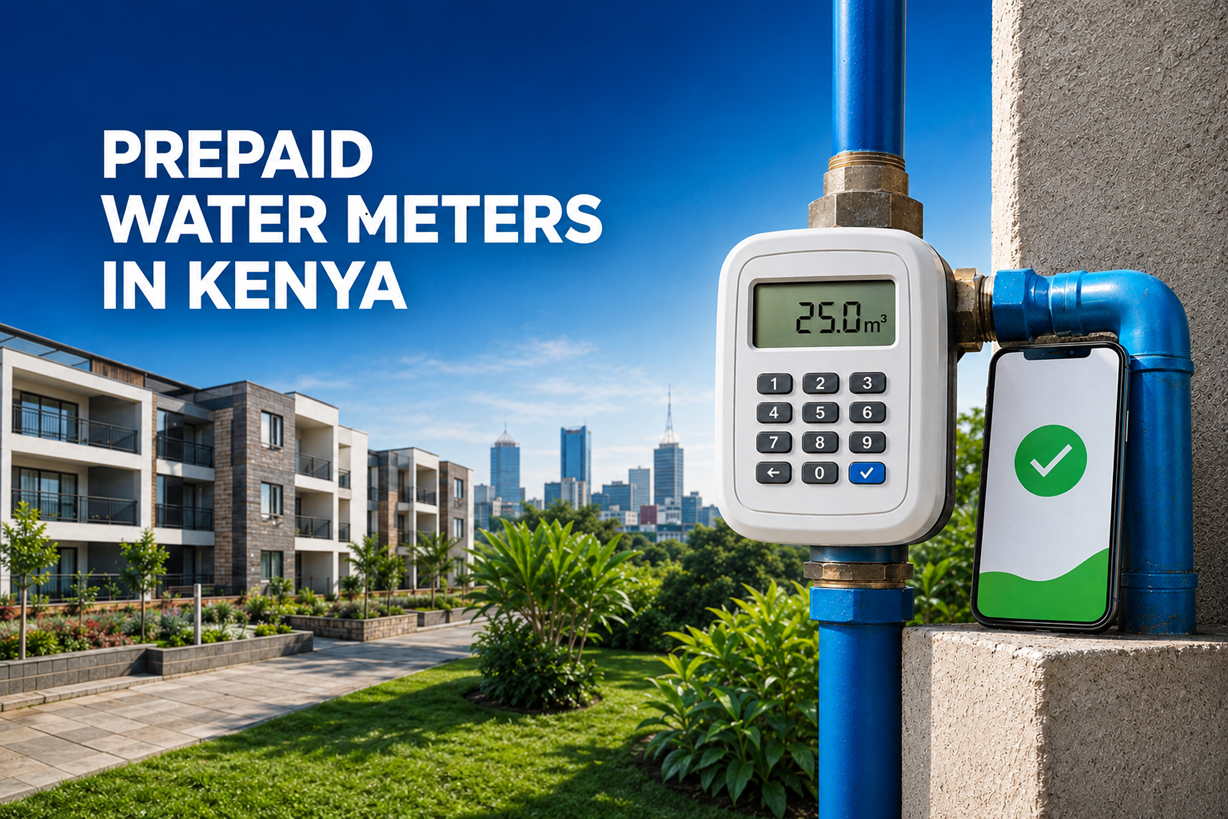
For smaller consumer installations, prepaid water meters remain useful for revenue control, tenant billing and consumption accountability.
However, prepaid consumer metering should not automatically be confused with WRA’s regulatory requirements for smart water-resource abstraction monitoring.
Read our related guide on prepaid water meters in Kenya to understand how prepaid metering can improve water accountability and revenue management.
Frequently Asked Questions About Smart Water Meters in Kenya
Who must install a smart water meter in Kenya by 2027?
The specific two-year requirement applies to WRA Category B, C and D water users covered by the relevant provisions of the Water (Resources) Regulations, 2025.
Water users should confirm their individual classification from their WRA permit or directly with the Authority.
Does every borehole in Kenya need a smart meter?
Borehole abstraction is subject to metering requirements, but the specific requirement for automated measuring meters or smart meters applies according to the relevant WRA regulatory category.
Borehole owners should therefore confirm their permit classification rather than assuming that every borehole is subject to exactly the same smart-meter requirement.
What is the smart water meter deadline in Kenya?
The Water (Resources) Regulations, 2025 commenced on 7 March 2025.
The two-year transition period applicable to the relevant smart-meter provision therefore points to 7 March 2027.
Can I continue using a mechanical water meter?
Affected Category B, C and D water users should determine whether their existing meter satisfies WRA’s automated measuring and smart-meter requirements.
A conventional manually read mechanical meter may not, by itself, provide the automated measurement and data capabilities contemplated under the Regulations.
Does the smart meter need to transmit data to WRA?
The Regulations provide for automated measurement and transmission of readings, while WRA has been developing infrastructure for receiving, storing and analysing smart-meter information.
This makes communications capability and system integration important considerations when purchasing a meter.
Should I buy a smart water meter now?
Before purchasing a meter specifically for regulatory compliance, establish your WRA permit category, required flow range and current WRA integration requirements.
This can help prevent an organisation from buying a meter that measures accurately but cannot support the required communications or regulatory infrastructure.
The March 2027 Smart Water Meter Deadline Is Getting Closer
Kenya’s water sector is clearly moving toward connected and more accountable water measurement.
The important question for affected water users is no longer simply:
“Do we have a water meter?”
The more important questions are:
“Is our meter automated? Can it be remotely monitored? Can its data be integrated with WRA’s infrastructure?”
The 2027 smart water meter requirement Kenya makes these questions particularly important for Category B, C and D water users.
Organisations should establish their permit classification, meter technology, communications capability and WRA integration requirements well before 7 March 2027.
Meter selection, communication technology and regulatory compliance should be considered together — before equipment is purchased and installed.
Need assistance assessing a smart or bulk water meter for your water project? Contact Dotmobi LLP for smart water-meter selection, integration and monitoring solutions.