What happens when a tenant pays for water using M-Pesa, receives a successful payment confirmation, but the prepaid water meter does not receive the credit?
This is an important question for landlords, property managers, water suppliers and prepaid water meter operators in Kenya.
With STS prepaid water meters, purchasing water credit and loading that credit into the meter are two separate processes.
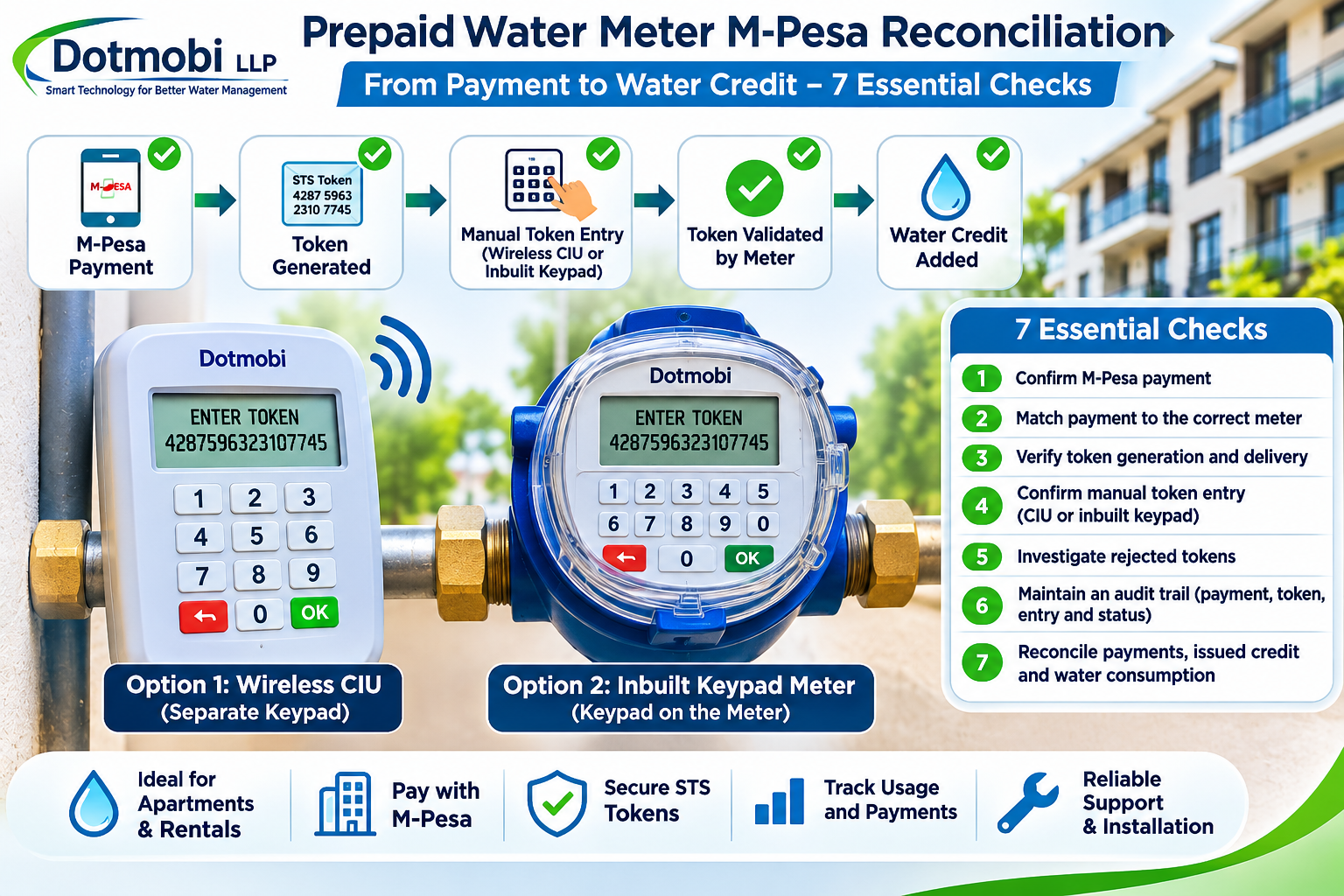
After making an M-Pesa payment, the customer receives a prepaid water token. The customer must then manually enter the token using either a wireless Customer Interface Unit (CIU) or a keypad built into the prepaid water meter.
The meter validates the token before adding the purchased water credit to the available balance.
A reliable prepaid water meter M-Pesa reconciliation process therefore needs to distinguish between successful payment, token generation, token delivery and successful manual token loading.
At Dotmobi LLP, we believe that effective prepaid water management requires accurate payment processing, secure token generation, dependable metering equipment and responsive technical support.
Why Prepaid Water Meter M-Pesa Reconciliation Matters in Kenya
Water management remains an important challenge for property owners, water service providers and institutions across Kenya.
According to the Water Services Regulatory Board (WASREB), non-revenue water continues to affect the financial sustainability of water services.
Non-revenue water includes physical losses from leaking pipes and commercial losses associated with inaccurate measurement, unauthorised consumption and weaknesses in billing or revenue collection.
Prepaid water meters help address some payment-collection challenges by requiring customers to purchase water credit before consumption.
However, receiving payment does not automatically mean that water credit has been successfully loaded into the meter.
For STS prepaid water meters with manual token entry, the customer must complete the process by entering the purchased token into the appropriate keypad.
Understanding this distinction is essential when investigating water-token disputes.
How M-Pesa Payments Work with STS Prepaid Water Meters
A typical Dotmobi STS prepaid water meter installation uses one of two customer interfaces:
Option 1: Wireless CIU Prepaid Water Meter
The meter is installed on the water supply pipe, while a separate wireless Customer Interface Unit (CIU) provides a keypad and display.
After purchasing water credit through M-Pesa, the customer enters the received token into the CIU.
The CIU communicates with the associated water meter using the supported wireless communication system.
If the token is valid and the communication succeeds, the meter accepts the token and updates the available water credit.
A wireless CIU offers the convenience of entering tokens and viewing supported meter information without physically accessing the meter installation point.
Option 2: Prepaid Water Meter with Inbuilt Keypad
For this type of meter, the keypad and display are integrated into the meter itself.
After purchasing water credit through M-Pesa, the customer physically accesses the meter and enters the token using its inbuilt keypad.
The meter validates the token and updates its available water balance when the token is accepted.
This configuration does not require a separate wireless CIU for entering tokens.
Comparison of the Two Meter Types
| Feature | Wireless CIU meter | Inbuilt keypad meter |
|---|---|---|
| Token entry | Manual | Manual |
| Where token is entered | Separate wireless CIU | Keypad on meter |
| Meter location | On water pipe | On water pipe |
| Customer keypad | Separate unit | Integrated |
| Communication to meter | Wireless | Internal |
| Internet required for token entry | No continuous internet required | No continuous internet required |
| Token validation | By the meter | By the meter |
| Water credit loading | After successful token acceptance | After successful token acceptance |
Both systems rely on valid STS tokens, but their customer interfaces differ.
Learn more about Dotmobi STS Prepaid Water Meters in Kenya.
7 Essential Checks for Reliable Prepaid Water Meter M-Pesa Reconciliation
1. Confirm That the M-Pesa Payment Was Successful
The first step is confirming that the customer made a successful payment.
The water-vending system should record the transaction reference, payment amount, date, time and relevant customer or meter account.
A customer reporting that money was deducted does not necessarily prove that the vending platform successfully processed the payment.
Where a transaction is disputed, the operator should verify its status using authorised payment records.
Safaricom provides the Daraja API platform for M-Pesa payment integrations and transaction-processing services.
Important: Payment confirmation and token loading are different events.
2. Verify That the Payment Was Assigned to the Correct Meter
Every prepaid water meter has an identification or account reference used by the vending system.
Before generating a token, the system must associate the payment with the correct meter.
For apartment buildings and rental properties, a typical customer register should contain:
- Property or building identification
- House or unit number
- Customer account reference
- Water meter identification number
- Applicable water tariff
- Payment transaction reference
Incorrect account information can result in a token being generated for a different meter.
An STS token generated for another meter will ordinarily not be accepted by the intended meter.
This is particularly important in apartment buildings where many tenants purchase water credit independently.
Read our related article on prepaid water meters for apartments in Kenya.
3. Confirm That the Water Token Was Generated and Delivered
After payment confirmation, the vending platform should generate the appropriate STS water-credit token.
The token represents the purchased water credit and is associated with the intended meter.
The customer then receives the token through the supported delivery channel, such as SMS.
A successful payment does not necessarily mean that a token has already been delivered.
There may be delays caused by payment-processing problems, system interruptions or SMS delivery failures.
A reliable vending platform should distinguish between:
Payment received → Token generated → Token delivered
Where a token has not been received, the operator should investigate the original transaction rather than immediately creating another credit transaction.
4. Confirm That the Customer Manually Entered the Token
This is a critical step in STS prepaid water metering.
The customer must enter the token into the meter using the appropriate customer interface.
For a wireless CIU meter:
- The customer receives the water token.
- The customer uses the wireless CIU keypad.
- The customer enters the complete token.
- The customer presses the confirmation key, according to the CIU instructions.
- The CIU communicates the entered token to the associated meter.
- The meter validates the token and updates the water balance if accepted.
For a meter with an inbuilt keypad:
- The customer receives the water token.
- The customer accesses the meter’s keypad.
- The customer enters the complete token.
- The customer presses the confirmation key, according to the meter instructions.
- The meter validates the token.
- The meter updates the available water balance if the token is accepted.
The customer should verify the displayed balance or token-acceptance indication.
A token being generated or delivered does not prove that it has been entered or accepted.
Unless the meter provides an appropriate communication mechanism that reports token acceptance, the vending system should not claim to have independently confirmed successful loading.
5. Investigate Rejected or Unaccepted Tokens
A water token may be rejected even after the customer has successfully paid.
Possible causes include:
- Incorrect token digits entered by the customer
- A token generated for a different meter
- A token that has already been used
- Incorrect meter or vending security configuration
- A token that is otherwise invalid for the receiving meter
- Communication failure between a wireless CIU and its associated meter
For wireless CIU installations, the customer should check whether the CIU can communicate with the water meter.
For meters with an inbuilt keypad, the customer should check the keypad response and displayed error or rejection indication.
A failed token entry should not automatically be interpreted as a failed M-Pesa payment.
The appropriate action depends on the actual cause.
Read our article on prepaid water meter token failures and troubleshooting.
6. Prevent Duplicate Token Generation and Maintain an Audit Trail
A reliable prepaid water vending platform should maintain records of payments and corresponding water tokens.
This helps prevent the same payment from being processed more than once.
For example, if a customer reports that an SMS containing a token was not received, the operator should establish whether the token was already generated.
Where appropriate, the original token can be retrieved and resent using an authorised support process.
Generating a second credit token without adequate checks could result in unintended additional water credit.
Useful audit records include:
- M-Pesa transaction reference
- Payment amount and date
- Customer or meter identification
- Token-generation status
- Issued token reference or securely retained token record
- Token-delivery status
- Support actions and transaction corrections
A critical distinction must be maintained between token issued, token delivered, and token accepted by the meter.
For manually operated meters without remote reporting, successful acceptance may only be known through the meter display or customer-provided evidence.
This distinction improves the accuracy of transaction records.
7. Reconcile Payments, Token Sales and Actual Water Consumption
Financial reconciliation should compare payments received with the water credit issued through the vending platform.
Water consumption should be analysed separately.
For example, consider a hypothetical rental apartment building:
| Transaction measure | Illustrative amount |
|---|---|
| Total M-Pesa collections | KES 45,000 |
| Water credit issued | KES 45,000 |
| Unresolved vending transactions | KES 0 |
| Estimated equivalent of unused credit | KES 12,000 |
In this illustration, the unused credit is not automatically lost revenue.
It may represent water already purchased but not yet consumed.
Importantly, unused credit should not be assumed to have reached the meters without appropriate evidence of token acceptance and balance records.
Where supported, meter-reading information can help operators assess actual consumption and remaining balances.
For large apartment buildings, estates or institutions, individual prepaid water consumption can also be compared with the total water measured by a bulk meter.
Learn more about bulk water meter integration with prepaid meters.
What Research Shows About Prepaid Water Meter Reliability
Research into prepaid water systems indicates that successful implementation requires more than the installation of metering hardware.
A study published in Water Practice & Technology, examining prepaid water technology in Kampala, Uganda, identified operational challenges associated with vending systems, monitoring and technology implementation.
These findings highlight the importance of dependable vending software, accurate records and effective customer support.
Read the research published by IWA Publishing.
Another study examining prepaid water metering in Nakuru, Kenya, provides insight into the operation of prepaid water services and their effects on users.
Read the Nakuru prepaid water metering study.
For landlords and water operators, the practical lesson is that a meter should be evaluated together with its token-vending system, customer interface, installation requirements and support arrangements.
Benefits of Wireless CIU and Inbuilt Keypad Prepaid Water Meters
Both meter designs provide benefits to property owners and water consumers.
Benefits for Property Owners and Managers
- Reduce the accumulation of unpaid water bills through prepayment.
- Improve the allocation of water costs to individual users.
- Maintain records of water-credit purchases.
- Reduce manual water-billing administration.
- Support clearer investigation of payment and token disputes.
- Encourage users to monitor available water credit.
Benefits for Tenants and Water Consumers
- Purchase water credit according to their needs.
- Use M-Pesa for convenient payments.
- Receive a water token for manual entry.
- Check remaining water credit using the supported meter interface.
- Avoid dependence on a continuous internet connection at the meter for entering valid offline STS tokens.
Why Choose a Wireless CIU?
A wireless CIU can be convenient where the meter is installed outside the occupied room or in a less accessible location.
The customer can enter tokens using a separate keypad without directly accessing the meter, provided the CIU remains within the supported communication range.
Why Choose an Inbuilt Keypad Meter?
An inbuilt keypad meter offers an integrated design where token entry and meter functionality are combined in one unit.
It can be suitable where the meter location is safely and conveniently accessible to the customer.
The most appropriate option depends on the installation environment, accessibility, property design and operating requirements.
How Dotmobi Supports STS Prepaid Water Meter Installations in Kenya
Dotmobi LLP supplies STS prepaid water metering solutions suitable for rental apartments, residential properties, institutions and other water-management projects.
Our solutions include prepaid meters with wireless Customer Interface Units and meters with inbuilt keypads.
Customers purchase water credit through the supported M-Pesa vending process and manually enter the issued token into the CIU or meter keypad.
Dotmobi also provides installation, system integration and technical support services.
Property owners considering prepaid water metering should assess the complete solution, including:
- Meter selection and installation
- Water-vending platform
- M-Pesa integration
- STS token generation
- Customer token-entry interface
- Transaction records and reconciliation
- Customer support and maintenance
See our previous prepaid water meter installation in Olkeri.
Frequently Asked Questions About Prepaid Water Meter M-Pesa Reconciliation
Does an M-Pesa payment automatically load water credit into the meter?
No. With the manually operated STS prepaid water meters discussed here, the customer receives a water token and enters it using a wireless CIU or the keypad built into the meter.
The meter must accept the token before the corresponding water credit is added.
What is the difference between a wireless CIU and an inbuilt keypad?
A wireless CIU is a separate customer interface used to enter tokens and communicate with the meter.
An inbuilt keypad is integrated directly into the meter, allowing customers to enter tokens at the meter itself.
Can I enter a token without an internet connection?
Yes. Valid STS tokens can generally be entered without a continuous internet connection to the meter.
However, purchasing and receiving the token may require network connectivity.
Wireless CIU models require a working communication link between the CIU and meter.
What should I do if I have paid but my token has not arrived?
Confirm the payment, check the registered account details and contact the authorised vending operator.
The operator should verify whether the original token was generated and delivered.
What happens when a prepaid water meter rejects a token?
Check that the token was entered correctly and that it belongs to the intended meter.
For a wireless CIU, also check the communication between the CIU and meter.
If the problem continues, contact the authorised support provider with the payment reference and displayed error.
Can the vending platform confirm that a manually entered token was accepted?
Not necessarily.
A vending platform may confirm that a payment was received and a token issued, but successful token acceptance requires evidence from the meter or a supported reporting mechanism.
For meters without remote status reporting, confirmation may depend on the meter display or information provided by the customer.
Can prepaid water meters help landlords reduce unpaid bills?
Yes. Prepayment can reduce exposure to unpaid water consumption by requiring customers to purchase credit before using water.
However, proper installation, maintenance and transaction controls remain important.
Conclusion: Reliable Water Vending Requires Accurate Payment and Token Records
A successful M-Pesa payment is only one stage in a prepaid water transaction.
For Dotmobi STS prepaid water meters, the customer must receive a valid token and manually enter it using either a wireless CIU or the meter’s inbuilt keypad.
The meter then validates the token before adding the purchased water credit.
Proper reconciliation therefore involves connecting payment records, meter identification, token generation and token delivery while distinguishing these events from actual token acceptance.
For landlords, property managers and institutions in Kenya, this approach improves transaction accountability and supports more dependable prepaid water services.
Looking for STS prepaid water meters for your property?
Contact Dotmobi LLP for wireless CIU prepaid water meters, inbuilt keypad models, M-Pesa vending integration, installation and technical support.
Telephone: +254 722 761 322
Email: info@dotmobi.co.ke
Website: https://dotmobi.co.ke/
Dotmobi LLP — Smart Technology for Better Water Management.