
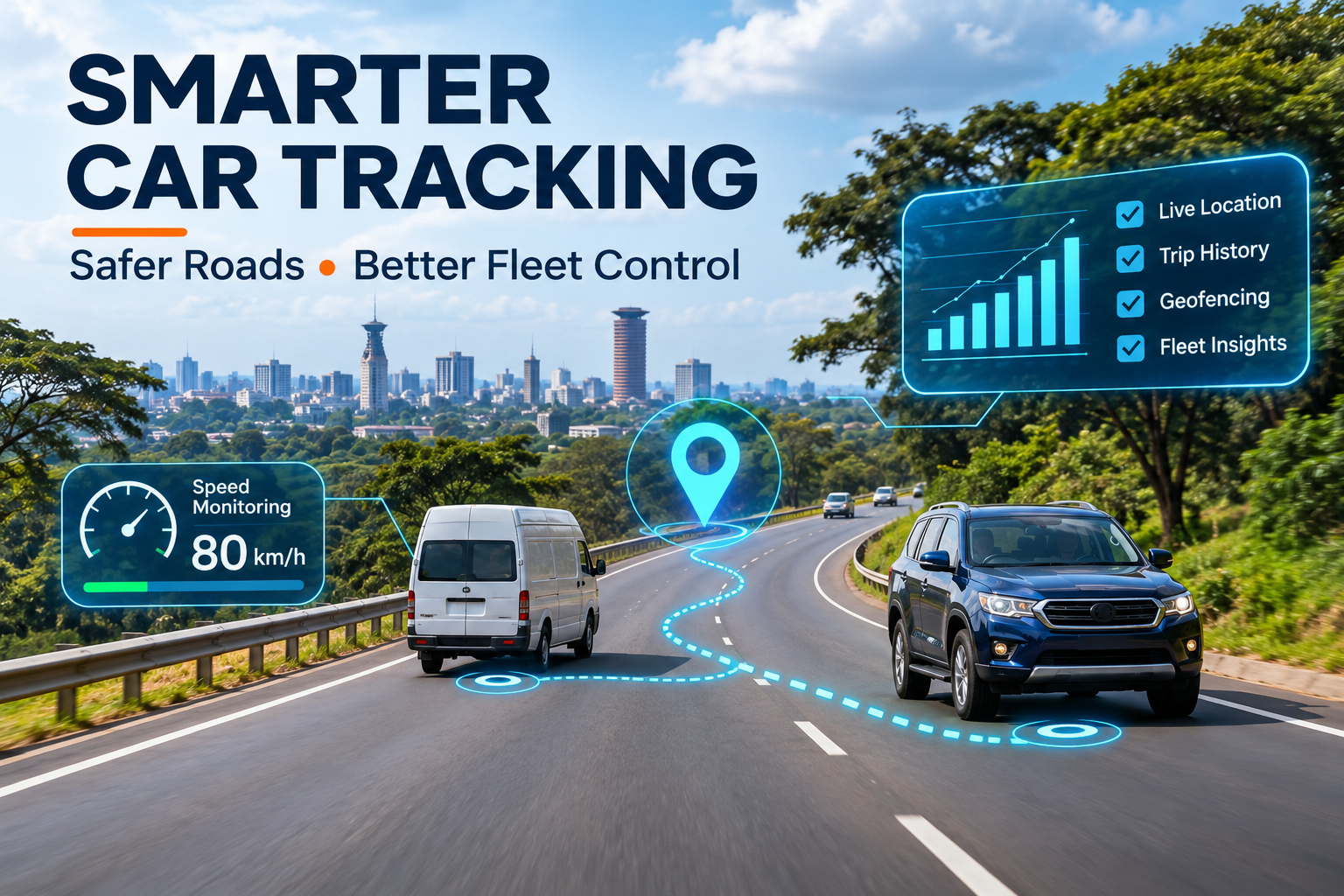
Car tracking in Kenya is becoming increasingly important as businesses and motorists seek better ways to monitor speeding, improve driver accountability and reduce road safety risks.
For many years, vehicle tracking was primarily associated with locating stolen vehicles. Today, modern GPS vehicle tracking can play a much wider role in transport safety, particularly when combined with driver monitoring, reporting and corrective action.
Recent developments in Kenya make this especially relevant.
On 24 October 2026, the Kenya News Agency reported that the National Transport and Safety Authority (NTSA) was intensifying road safety enforcement ahead of the festive season. The announcement highlighted speeding, driver fatigue, drunk driving and dangerous driving behaviours.
For businesses operating vehicles, the message is increasingly clear: road safety should not depend entirely on detecting dangerous driving after an accident has occurred.
Car tracking in Kenya can help fleet operators identify warning signs earlier and respond before unsafe behaviour becomes a recurring problem.
1. Why NTSA’s October 2026 Announcement Matters for Vehicle Owners
According to the Kenya News Agency report of 24 October 2026, NTSA announced enhanced enforcement targeting speeding, driver fatigue and other dangerous driving practices.
The report also stated that NTSA had upgraded its Intelligent Road Safety Management System to help detect, record and track speeding violations.
Additional enforcement measures included night-time checks, speed-limiter monitoring and greater attention to fleet management and driver preparedness.
These developments are particularly relevant for:
- Transport and logistics companies
- School transport operators
- Delivery and distribution businesses
- Public service vehicle operators
- Commercial fleet owners
- Companies operating field-service vehicles
- Owners of private cars and motorcycles
For fleet owners, car tracking in Kenya provides an opportunity to complement enforcement with internal monitoring and preventive action.
Rather than waiting for a traffic offence, complaint or accident, businesses can review available vehicle movement and driver behaviour data.
However, GPS tracking is not a replacement for legally required speed limiters, driver training, vehicle inspections or other regulatory obligations.
2. Research Shows Why Driver Monitoring Matters
A major reason to consider GPS vehicle tracking for road safety is the growing body of research into driver behaviour.
A study published in Transportation Research Part F in May 2026 examined a telematics-based driver feedback system involving 175 drivers and 73,869 journeys.
The researchers found that feedback mechanisms helped reduce time spent speeding and harsh braking events.
The study also observed an increase in harsh acceleration events, demonstrating that monitoring interventions require careful design and ongoing evaluation.
Read the 2026 driver behaviour research.
Another study published in Accident Analysis & Prevention examined telematics information from more than 28 million vehicle journeys.
The researchers identified speeding as an important driving behaviour associated with crash risk in their analysis, while acknowledging limitations that required further validation.
These findings are significant for organisations considering car tracking in Kenya.
They suggest that location information becomes more valuable when it is used alongside meaningful driver feedback and safety management.
The greatest benefit may come not from collecting vehicle data, but from using that data to change dangerous behaviour.
3. Seven Ways Car Tracking in Kenya Can Improve Road Safety
1. Speed Monitoring and Overspeed Alerts
Speeding is one of the most important driving behaviours that fleet operators should monitor.
Depending on the tracking equipment and software, a GPS vehicle tracking system can record vehicle speed and generate notifications when a configured threshold is exceeded.
For example, a transport company may establish different internal speed policies for various classes of vehicles.
If a monitored vehicle exceeds its configured threshold, the system may:
- Record the event
- Identify the vehicle involved
- Capture the time and location
- Notify an authorised fleet controller
- Store the event for subsequent review
This allows management to address repeated speeding patterns rather than relying entirely on complaints or police enforcement.
Importantly, a GPS speed alert is a monitoring function. It should not be confused with an approved speed-limiting device where one is legally required.
For fleet operators, car tracking in Kenya offers an opportunity to review speeding incidents, identify repeated driver behaviour problems and support corrective training. GPS records can help management make informed decisions instead of relying entirely on complaints.
2. Monitoring Harsh Braking and Aggressive Driving
Sudden braking, aggressive acceleration and dangerous cornering can sometimes indicate unsafe driving behaviour.
Research involving heavy goods vehicle fleets has demonstrated that monitoring and driver coaching can reduce certain risky driving events.
In one published study, the fleet receiving coaching recorded a 16.82% reduction in the mean frequency of harsh braking incidents, compared with a 4.62% reduction in a comparison fleet without coaching.
Although results may vary between vehicles, drivers and operating environments, the findings support the value of combining monitoring with driver education.
With compatible sensors and software, advanced vehicle telematics systems can identify:
- Harsh braking
- Rapid acceleration
- Aggressive cornering
- Repeated overspeeding
- Unusual driving patterns
Fleet managers can use these records to identify drivers who may benefit from additional training.
An important distinction is that not every GPS tracker supports harsh-driving detection. These capabilities should be confirmed before installation.
3. Monitoring Long Journeys and Driver Fatigue Risks
Driver fatigue is an important concern for long-distance transport operators.
In its October 2026 announcement, NTSA emphasised journey planning and fatigue management, particularly for long-distance and night-time operations.
Car tracking in Kenya can help fleet operators review trip durations, stopping periods and vehicle movements.
For example, a company operating between Nairobi and Mombasa may use tracking records to determine:
- When a journey started
- How long the vehicle has been travelling
- Where the vehicle stopped
- How long each stop lasted
- Whether the planned route was followed
This information can support journey planning and compliance reviews.
However, GPS tracking cannot independently establish whether a driver is tired, asleep or fit to drive.
Effective fatigue management also requires appropriate rest arrangements, driver scheduling, supervision and, where necessary, specialised fatigue-detection equipment.
4. Geofencing for Safer Fleet Operations
Geofencing allows a vehicle owner or fleet manager to establish virtual geographical boundaries.
A compatible tracking system can generate notifications when a vehicle enters or leaves a specified area.
A business may establish geofences around:
- Company premises
- Warehouses
- Customer delivery locations
- School compounds
- Construction sites
- Designated operating areas
For example, a school transport operator may use geofencing to monitor vehicle arrivals and departures from approved locations.
A distribution company may use the same technology to identify unexpected movements outside designated delivery areas.
Geofencing does not guarantee safe driving, but it can improve fleet visibility and operational control.
5. Route History for Investigating Unsafe Driving
Imagine a delivery company receiving a complaint that one of its drivers was speeding or driving dangerously.
Without reliable records, management may struggle to determine which vehicle was involved or what happened.
A GPS tracking system with route history can provide useful evidence about:
- Vehicle location
- Travelled routes
- Recorded speeds
- Stopping points
- Journey times
- Unusual deviations
This information can help supervisors investigate complaints and assess whether further action is needed.
It is important to recognise that GPS information may contain measurement errors or interruptions.
Consequently, serious incidents should be investigated using all available evidence rather than relying on a single tracking record.
For another example of operational monitoring, read Dotmobi’s article on how GPS tracking helps investigate delivery vehicle delays.
When choosing car tracking in Kenya, businesses should consider device reliability, tracking accuracy, mobile network coverage, reporting features and the availability of local technical support.
6. Driver Accountability Through Regular Reports
Car tracking in Kenya can also support structured driver performance reviews.
Instead of monitoring drivers only when a problem occurs, a company can establish regular reviews of vehicle activity.
Useful indicators may include:
| Monitoring indicator | Management benefit |
|---|---|
| Overspeeding events | Identify repeated speed violations |
| Trip duration | Review journey planning |
| Route deviations | Investigate unauthorised movements |
| Excessive idling | Review unnecessary engine running |
| Harsh driving events | Identify possible coaching needs |
| Vehicle utilisation | Improve fleet allocation |
Not every tracker provides all these indicators.
The availability and accuracy of each measurement depend on the installed equipment, connected sensors and tracking platform.
Businesses should also establish clear policies governing employee monitoring, access to location records and retention of personal data.
A well-managed system should support safer driving and accountability without creating unnecessary surveillance or misuse of employee information.
7. Faster Response to Roadside Incidents
Vehicle tracking may also help a business respond when a vehicle breaks down, stops unexpectedly or becomes involved in an incident.
Consider a company vehicle travelling along a remote section of a highway.
If the driver reports an emergency, the fleet controller can use the latest available GPS position to help identify the vehicle’s location.
Depending on the system, the organisation may also review:
- The last reported location
- The vehicle’s previous route
- The last communication time
- Ignition status
- Nearby fleet vehicles
This can assist with coordinating roadside assistance or emergency support.
However, location tracking alone does not automatically detect a crash or notify emergency services.
Automatic incident detection requires suitable additional technology and a properly configured response process.
4. Why Businesses Should Move Beyond Basic GPS Tracking
Traditional vehicle tracking often concentrates on one question:
Where is my vehicle?
Modern fleet management should ask additional questions:
- Is the vehicle being driven safely?
- Is the driver repeatedly exceeding speed thresholds?
- Are journeys being completed within reasonable operating schedules?
- Are vehicles operating on authorised routes?
- Are dangerous driving events increasing or decreasing?
- Are supervisors acting on identified safety concerns?
A vehicle tracker becomes more valuable when its information is incorporated into everyday operational decisions.
For example, a company might introduce a monthly fleet safety review in which speeding events are discussed with drivers.
A repeated pattern could lead to targeted coaching, route review or further supervision.
Over time, management can evaluate whether corrective measures are producing improvements.
This approach transforms car tracking in Kenya from a vehicle-location service into a practical fleet-management resource.
5. What Should Kenyan Fleet Owners Look for in a GPS Tracking System?
Businesses considering vehicle tracking should evaluate both hardware and software capabilities.
Important questions include:
Does the system provide reliable location updates?
The tracking platform should provide current location information when satellite positioning, mobile-network connectivity and device power are available.
Can management review historical journeys?
Route history is useful for fleet reviews, incident investigations and driver accountability.
Does the platform support speed monitoring?
A suitable system should allow the customer to review recorded speeds and, where supported, configure relevant alerts.
Can multiple vehicles be monitored centrally?
Fleet operators should consider whether authorised users can review vehicles and reports through a central platform.
Are additional driver-behaviour features available?
Harsh braking, aggressive acceleration and detailed vehicle diagnostics may require specialised equipment.
What happens when a device loses communication?
A tracker may temporarily stop reporting because of network coverage, device failure, power interruption or interference.
Fleet managers should understand how the selected system reports such events.
Is local installation and technical support available?
Professional installation, correct configuration and reliable after-sales support are important factors when selecting a tracking provider.
6. Car Tracking in Kenya: A Practical Example for a Delivery Business
Consider a hypothetical company operating ten delivery vehicles across Nairobi and neighbouring counties.
Before installing a tracking system, management relies mainly on telephone calls to determine where vehicles are operating.
The company experiences occasional complaints about late deliveries and unsafe driving.
After introducing suitable GPS vehicle tracking, management establishes a basic fleet safety procedure.
Every week, supervisors review available speed records, journey durations and unusual route deviations.
Drivers responsible for repeated unsafe events are invited for discussions and appropriate coaching.
Rather than using tracking information only to assign blame, the company uses it to identify operational problems and improve driver awareness.
This example illustrates a practical application of telematics. It is not a claim of measured results from an actual Dotmobi customer installation.
7. Dotmobi GPS Car Tracking Solutions in Kenya
At Dotmobi LLP, we recognise that vehicle tracking is not only about protecting vehicles against theft.
It can also help businesses improve operational visibility, driver accountability and fleet management.
Dotmobi provides GPS vehicle and motorcycle tracking solutions for individuals and organisations in Kenya.
Depending on the selected system and installation requirements, vehicle-tracking functionality can include:
- GPS location monitoring
- Historical journey records
- Route monitoring
- Speed monitoring
- Vehicle movement records
- Geofencing
- Fleet activity reporting
- Vehicle security monitoring
For advanced driver-behaviour monitoring, customers should confirm the availability of compatible devices and additional sensors during solution selection.
Businesses managing delivery vehicles, company cars, commercial motorcycles, pickups or larger fleets can discuss their requirements with Dotmobi to identify an appropriate configuration.
You can also explore our earlier article, Car Tracking in Kenya: 7 Powerful Security Lessons, which examines vehicle theft and security risks.
Frequently Asked Questions About Car Tracking in Kenya
Can car tracking reduce road accidents?
Car tracking can support road safety by providing speed information, journey records and, with compatible equipment, driving-behaviour alerts.
Research suggests that appropriate monitoring and feedback can improve some driving behaviours. However, installing a GPS tracker alone does not guarantee fewer accidents.
Can a GPS tracker detect overspeeding?
Yes. Many GPS vehicle tracking systems can record speed and generate alerts when configured limits are exceeded.
The accuracy and functionality depend on the equipment, connectivity and software.
Is GPS vehicle tracking compulsory in Kenya?
GPS tracking is not universally compulsory for every private vehicle in Kenya.
Different vehicle categories may be subject to specific transport safety and monitoring requirements.
Vehicle owners should verify the regulations applicable to their particular vehicle category.
Can car tracking detect driver fatigue?
Ordinary GPS tracking cannot directly establish driver fatigue.
Journey duration, travel patterns and stopping records can support fatigue management, while specialised detection requires additional systems.
Is car tracking useful for small businesses?
Yes. Businesses operating even one or two delivery vehicles can benefit from better journey visibility, route history and vehicle security monitoring.
The appropriate solution depends on the business’s needs and budget.
Conclusion: Safer Driving Begins Before an Accident
Kenya’s renewed attention to speeding, driver fatigue and road safety provides an important reminder to businesses and vehicle owners.
Preventing dangerous driving requires more than reacting after something has gone wrong.
Car tracking in Kenya can support a proactive road safety approach through speed monitoring, journey analysis, driver accountability and better fleet supervision.
Research also demonstrates the importance of combining monitoring with meaningful driver feedback.
For businesses, the objective should be to use vehicle information responsibly, identify recurring problems and encourage safer driving practices.
A good vehicle tracking system does more than tell you where a car is.
It helps you understand how the vehicle is being used.
Need GPS Car Tracking in Kenya?
Dotmobi LLP offers GPS tracking solutions for private cars, motorcycles, delivery vehicles and business fleets.
Contact our team to discuss a suitable vehicle tracking solution for your requirements.
Call: +254 722 761 322
Email: info@dotmobi.co.ke
Website: https://dotmobi.co.ke/
Dotmobi LLP — Track Smarter. Drive Safer. Manage Better.
Research References
- Kenya News Agency (24 October 2026): NTSA Steps Up Enforcement to Curb Festive Season Road Crashes.
- Kontaxi, A., Ziakopoulos, A. & Yannis, G. (2026): Impacts of Different Feedback Features on Driver Behaviour.
- Winlaw, M. et al. (2019): Using Telematics Data to Find Risky Driver Behaviour.
- Evaluating the Impact of Heavy Goods Vehicle Driver Monitoring and Coaching.