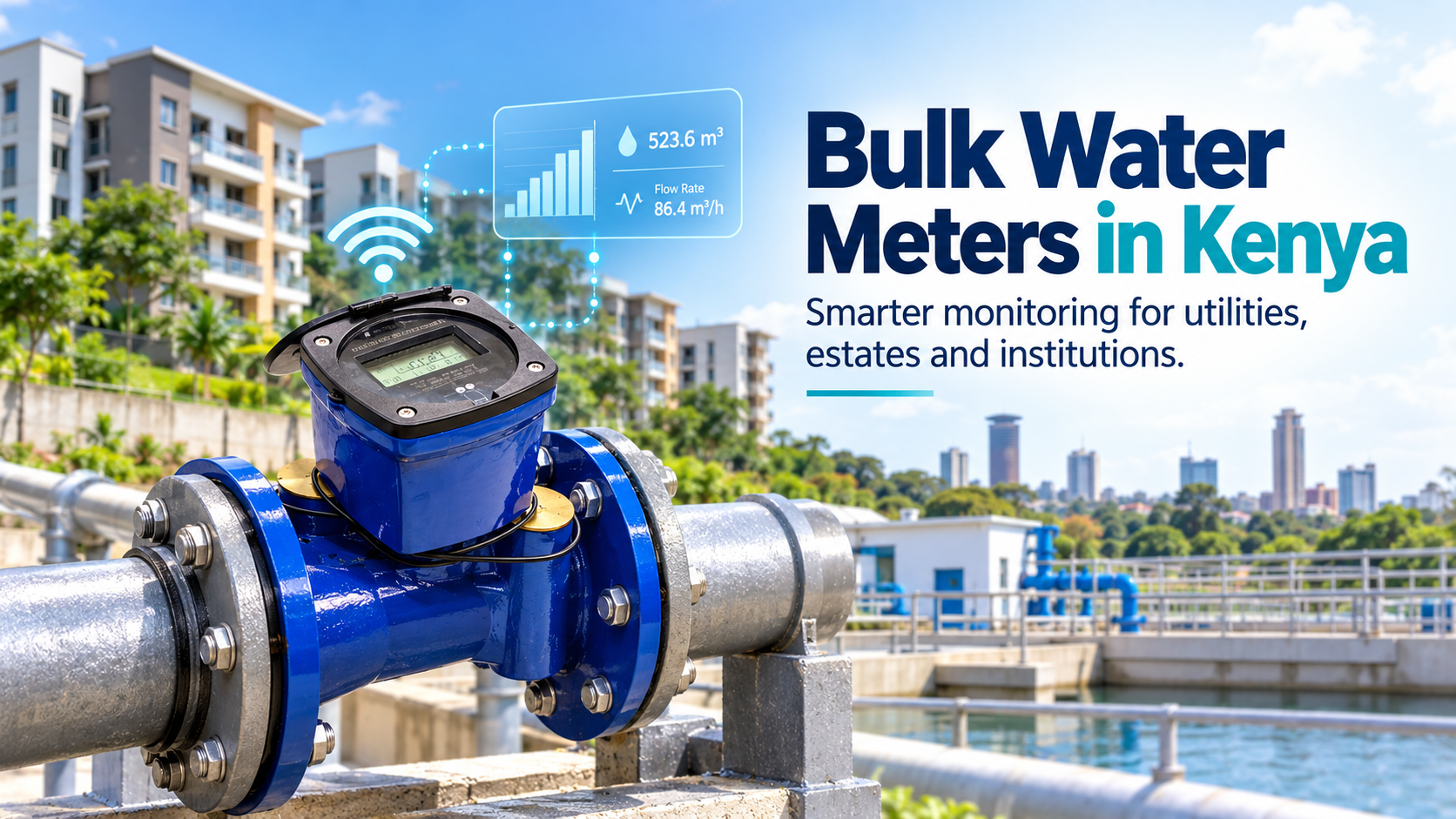
Bulk water meters in Kenya are becoming increasingly important as water utilities, estates, industries, institutions and community water projects seek better control over water consumption and losses.
The need is becoming more urgent.
The latest Water Services Regulatory Board (WASREB) sector report shows that non-revenue water in Kenya increased from 44% in 2023/24 to 48% in 2024/25.
That means a very large proportion of water entering distribution systems is not translating into properly accounted-for consumption.
Reliable bulk water measurement is therefore no longer simply a billing issue.
It is becoming an important part of water accountability, loss management and digital water monitoring.
Modern bulk water meters in Kenya can help organisations understand how much water enters a network, where it is distributed and whether unusual differences require investigation.
Table of Contents
- Why Bulk Water Meters in Kenya Matter
- How Bulk Water Meters in Kenya Improve Water Accountability
- Smart Bulk Water Meters in Kenya
- Why Ultrasonic Bulk Water Meters Are Worth Considering
- Kenya Is Moving Toward Smart Water Monitoring
- Seven Powerful Ways Bulk Water Meters Improve Water Management
- Minimum Night Flow Monitoring
- District Metered Areas
- Where Bulk Water Meters in Kenya Can Be Used
- Connectivity and Remote Monitoring
- What to Check Before Buying Bulk Water Meters in Kenya
- Correct Bulk Meter Sizing
- Installation and Accuracy
- Smart Meter Accuracy
- Cybersecurity
- Dotmobi’s Approach to Bulk Water Meters in Kenya
- Frequently Asked Questions
- Conclusion
WORDPRESS NOTE: Replace this manual list with the Rank Math Table of Contents block after pasting. In Gutenberg, click + → Table of Contents → Rank Math Table of Contents.
1. Why Bulk Water Meters in Kenya Matter
A bulk water meter measures large volumes of water passing through a main pipeline.
Unlike a normal domestic water meter, a bulk meter is usually installed at an important control point in the water network.
Typical locations include:
- Borehole outlets
- Water treatment plants
- Reservoir outlets
- Pumping stations
- Main distribution pipelines
- Gated communities
- Apartment developments
- Factories
- Hotels
- Schools and universities
- Hospitals
- Irrigation schemes
- Community water projects
- District Metered Areas
The purpose is not only to determine how much water should be billed.
A bulk meter can provide a reference measurement against which downstream water consumption can be compared.
This makes bulk water meters in Kenya particularly relevant where operators need to reconcile water supplied against water billed or otherwise accounted for.
Kenya’s Non-Revenue Water Challenge
WASREB’s latest sector reporting shows that non-revenue water remains a major challenge for the Kenyan water sector.
According to the regulator, sector-wide non-revenue water reached 48% during 2024/25, compared with 44% during 2023/24.
Non-revenue water can include physical leakage, commercial losses, unbilled authorised consumption and other differences between water supplied and water accounted for.
Earlier WASREB analysis also estimated that, after allowable losses, approximately 203 million cubic metres of non-revenue water represented about KSh 11.9 billion in financial losses during the 2023/24 reporting period.
You can review Kenya’s water-sector performance through the WASREB Impact Reports.
These figures underline why better measurement matters.
You cannot effectively manage a water loss that you cannot measure.
2. How Bulk Water Meters in Kenya Improve Water Accountability
Consider a gated estate receiving water through one main pipeline.
The main bulk meter records:
1,000 cubic metres
during a particular period.
All downstream household meters together record:
800 cubic metres
The difference is:
200 cubic metres
That does not automatically mean 200 cubic metres have been stolen or leaked.
The difference could result from:
- Underground leakage
- Tank overflow
- Common-area consumption
- Illegal connections
- Faulty consumer meters
- Meter-reading errors
- Unmetered authorised consumption
However, the bulk meter has revealed something important:
There is a measurable difference requiring investigation.
Without that main bulk measurement, management may not even know that the discrepancy exists.
Correctly installed bulk water meters in Kenya can therefore provide a valuable starting point for investigating unusual water differences.
Bulk Meters and Water Balances
A water balance compares water entering a system with water leaving or being consumed within that system.
A simplified calculation is:
Bulk Water Supplied – Accounted Consumption = Difference to Investigate
Bulk meters therefore provide an important starting point for water-loss management.
WASREB’s non-revenue water management guidance emphasises the importance of properly installed production and bulk meters when determining the amount of water entering a service area.
3. Smart Bulk Water Meters in Kenya Can Provide More Than a Reading
Traditional bulk water meters can provide accurate cumulative consumption.
However, somebody may still need to physically visit the meter and record the reading.
A smart bulk water meter can take this further.
Depending on the meter and communication system, measurements can be transmitted automatically to a monitoring platform.
The architecture may look like this:
Bulk Meter → Communication Device → Network → Cloud/Server → Dashboard → Reports and Alerts
This can provide much better operational visibility.
For organisations adopting bulk water meters in Kenya, remote data access can reduce dependence on manual reading and help management identify abnormal patterns sooner.
What Can Be Monitored?
Depending on the equipment selected, a monitoring platform may display:
- Cumulative consumption
- Current flow rate
- Daily consumption
- Monthly consumption
- Historical consumption
- Minimum night flow
- Abnormal high flow
- Unusual continuous flow
- Reverse flow
- Meter status
- Communication status
- Battery condition
- Alarm conditions
Instead of discovering unusual consumption several weeks later, authorised personnel may be able to see changes much sooner.
4. Why Ultrasonic Bulk Water Meters Are Worth Considering
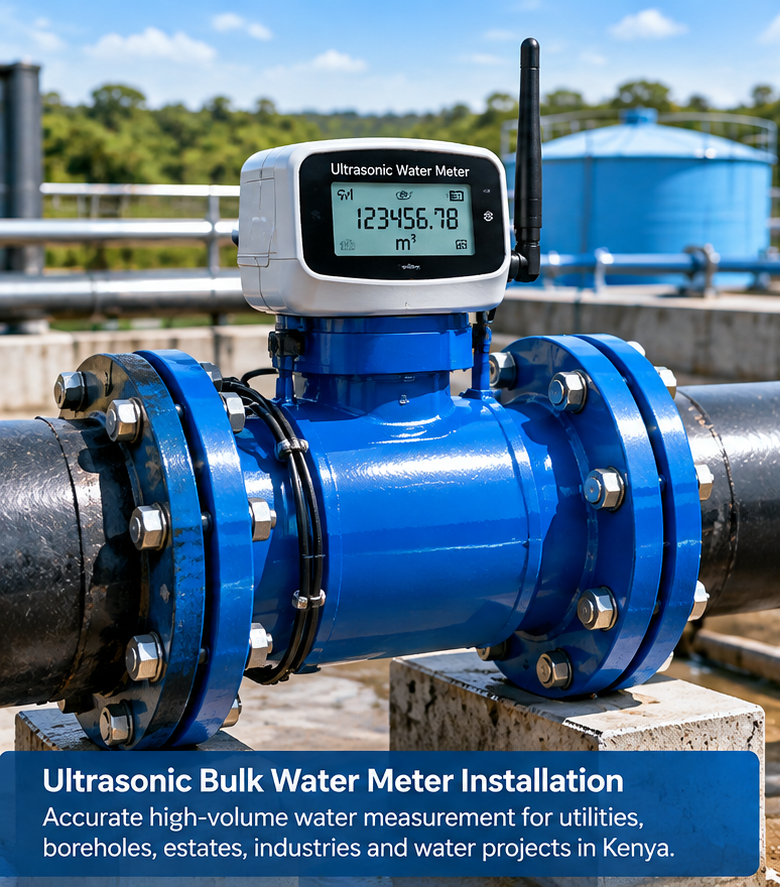
One technology increasingly used for large-pipe applications is the ultrasonic bulk water meter.
Ultrasonic meters measure water flow using ultrasonic signals.
They do not depend on the conventional rotating measuring components found in many traditional mechanical meters.
This can make them attractive for applications requiring wide measurement ranges, digital communication and remote monitoring.
Typical Smart Ultrasonic Meter Features
Depending on the particular model, features may include:
- Digital LCD display
- High ingress protection
- Low-flow measurement
- Wide measurement range
- Alarm information
- Long-life battery options
- Remote communication
- Large-diameter pipe configurations
One bulk ultrasonic meter reviewed while preparing this article is available in sizes ranging from DN50 to DN400.
Its communication options include:
- RS485 Modbus
- Pulse output
- GPRS
- NB-IoT
- LoRaWAN
The manufacturer’s technical information can be viewed on the Shanghong bulk ultrasonic water meter page.
These communication interfaces demonstrate how modern bulk meters are evolving from isolated measuring instruments into connected IoT devices.
For projects involving bulk water meters in Kenya, communication capability should therefore be evaluated alongside accuracy, pipe size and expected flow.
Why No Moving Measuring Parts Can Matter
Mechanical measuring components experience physical movement as water passes through the meter.
Ultrasonic measurement avoids the conventional turbine or impeller measurement principle.
For suitable applications, this may reduce some forms of mechanical wear.
However, the correct meter must still be selected according to the actual water conditions, pipe size and expected flow range.
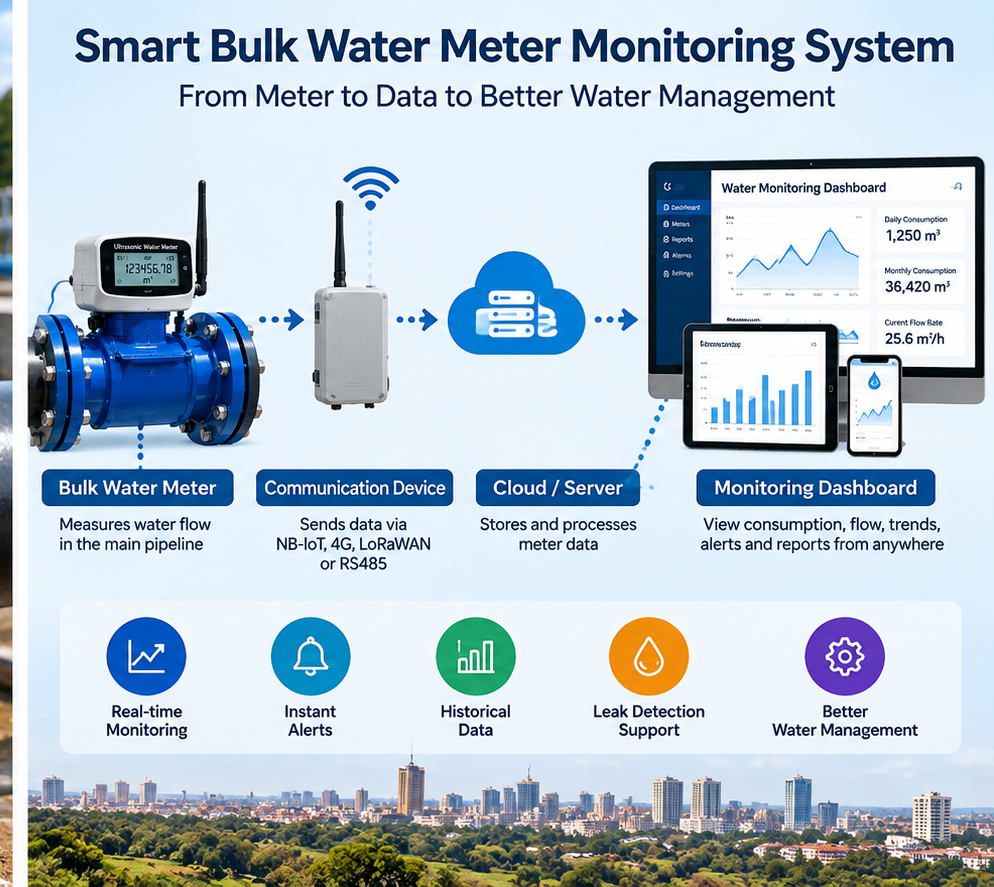
Smart bulk water meters can combine accurate measurement with remote monitoring and consumption analysis.
5. Kenya Is Moving Toward Smart Water Monitoring
The move toward connected water measurement is not limited to private water projects.
Kenya’s Water Resources Authority (WRA) is increasingly using digital technology for water-resource monitoring.
WRA states that it is developing Advanced Metering Infrastructure, or AMI, for receiving, storing, retrieving and analysing abstraction data from smart meters.
These meters may be installed at locations such as:
- Boreholes
- Water intakes
- Effluent discharge points
WRA has also described a centralised smart-meter billing integration platform through which meter information can be transmitted for regulatory and billing purposes.
More information is available on the Water Resources Authority smart metering and AMI page.
This development is important for organisations purchasing bulk water meters in Kenya today.
The question should no longer be only:
“What size meter do we need?”
It should also be:
“How will this meter communicate with other systems?”
Kenyan Regulations Also Require Measurement
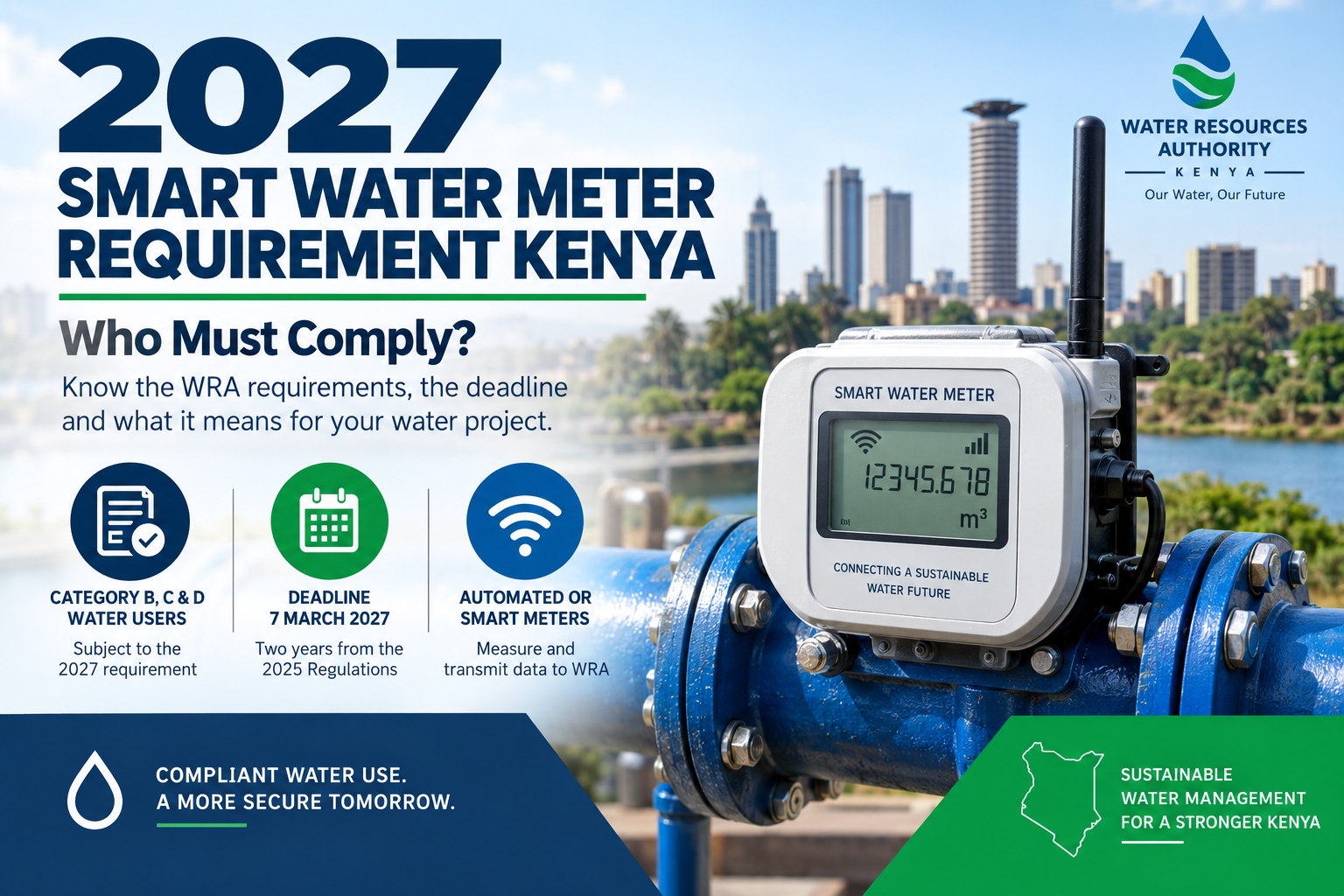
Kenya’s Water Resources Regulations require Category B, C and D users covered by the relevant provisions to install automated measuring meters or smart meters for accurate measurement of water abstraction or effluent discharge.
The regulations also require relevant measuring devices to be calibrated, with calibration results made available to WRA when requested.
This reinforces an important principle:
Smart communication and measurement accuracy must go together.
A meter is not useful simply because it can send information remotely.
The underlying measurement must also be reliable.
6. Seven Powerful Ways Bulk Water Meters Improve Water Management
1. Measure Water Entering a System
A bulk meter establishes how much water is entering an estate, factory, institution or distribution zone.
This becomes the primary reference against which other measurements can be compared.
2. Identify Unexplained Water Differences
Comparing the bulk meter against downstream meters can reveal differences requiring investigation.
This can help focus attention on areas with possible leakage or other losses.
3. Support Non-Revenue Water Management
For water utilities, accurate production and bulk-meter measurements are essential when calculating non-revenue water.
Poor source measurements can distort the entire water balance.
4. Enable Remote Water Monitoring
Smart meters can transmit readings to a remote monitoring platform where suitable communication infrastructure is available.
This reduces dependence on purely manual readings.
5. Detect Unusual Consumption Earlier
A sudden increase in flow may justify investigation.
Continuous flow during periods when consumption should be low may also indicate a problem.
The meter itself does not necessarily identify the cause, but it provides the data needed to investigate.
6. Improve Management Reporting
Digital meter information can support daily, weekly and monthly consumption reports.
Management can compare consumption over time and monitor trends.
7. Support Better Water Planning
Reliable historical information helps organisations understand demand patterns.
This can support decisions involving storage, pumping, infrastructure expansion and conservation.
These benefits make bulk water meters in Kenya increasingly relevant to both utilities and large private water consumers.
7. Minimum Night Flow Can Reveal Important Clues
One useful water-management technique is monitoring minimum night flow.
In many residential areas, legitimate water consumption falls substantially during late-night and early-morning hours.
If significant flow continues throughout these periods, the pattern may justify further investigation.
Possible causes include:
- Underground leakage
- Tank overflow
- Open valves
- Unauthorised consumption
- Genuine continuous commercial activity
Night flow does not automatically prove a leak.
It provides a useful indicator that helps operators decide where further investigation may be required.
Smart bulk water meters in Kenya can make this type of trend analysis easier when readings are transmitted automatically to a monitoring platform.
8. District Metered Areas Can Narrow Down Water Losses
Large distribution systems are difficult to investigate as one network.
Water utilities can therefore divide networks into smaller monitored zones commonly known as District Metered Areas, or DMAs.
A bulk meter is installed at the point where water enters the zone.
Operators can then compare:
Water entering the DMA
with
Water accounted for within the DMA
If one zone begins recording a larger unexplained difference than others, investigation can be concentrated there.
This is more efficient than attempting to search an entire distribution network for a leak.
WASREB’s NRW management guidance specifically discusses bulk metering and the importance of proper monitoring when calculating water supplied to service areas.
A main bulk meter can measure all water entering an apartment development.
Management can compare that figure with the total consumption recorded by individual apartment meters.
Large differences can then be investigated.
Gated Communities
A large estate can be divided into several water-monitoring zones.
This makes it easier to determine where unusual losses may be occurring.
Factories
Factories can monitor water entering the facility and compare consumption across production areas.
This can improve operational control and assist with water-conservation programmes.
Hotels
Hotels use water in guest rooms, kitchens, laundries, gardens and swimming pools.
Bulk monitoring can help management identify unusual changes in consumption.
Schools and Universities
Educational institutions may have hostels, kitchens, laboratories, offices and sports facilities.
Strategic bulk and sub-metering can provide better visibility into where water is consumed.
Hospitals
Hospitals depend on reliable water supplies for numerous critical activities.
Bulk monitoring can provide better information on overall consumption and unusual changes.
Irrigation Schemes
Large irrigation projects can use bulk meters to measure water distributed through major pipelines.
Community Water Projects
A community project may have a system such as:
Borehole → Storage Tank → Distribution Network → Consumer Meters
A bulk meter can measure water entering the distribution network and provide a reference for comparison with consumer consumption.
10. Connectivity Should Be Considered Before Buying a Meter
Not every smart meter communicates in the same way.
Before buying bulk water meters in Kenya, establish how data will be transferred to the intended platform.
RS485 / Modbus
RS485 with Modbus is widely used for industrial communications.
It can connect meters to nearby data loggers, controllers or communication gateways.
Pulse Output
Pulse outputs can allow an external device to count water-volume pulses generated by the meter.
NB-IoT
Narrowband IoT can provide low-power cellular communication where compatible network services are available.
Cellular Communication
A modem or Data Transfer Unit can transmit readings over a mobile network.
LoRaWAN
LoRaWAN can be useful where multiple meters need long-range, low-power communications within an appropriate network architecture.
The correct communication technology depends on the particular project.
11. Ask These Questions Before Buying Bulk Water Meters in Kenya
Before procurement, establish:
- What is the pipe diameter?
- What is the minimum expected flow?
- What is the normal operating flow?
- What is the maximum expected flow?
- What is the system pressure?
- What water quality will pass through the meter?
- What accuracy is required?
- Is mains power available?
- Must the meter operate from batteries?
- Is mobile-network coverage available?
- What communication protocol is required?
- Does the meter support remote reading?
- Is API integration required?
- Is WRA integration required?
- What calibration requirements apply?
- What verification requirements apply?
- Who owns the meter data?
- How is the communications link secured?
- Can the data be exported?
- Is local technical support available?
These questions should ideally be answered before the meter is ordered.
Selecting bulk water meters in Kenya should therefore be approached as a system-design decision rather than simply a hardware purchase.
12. Correct Bulk Meter Sizing Is Critical
A bigger meter is not automatically better.
The correct meter should be selected according to the expected flow range, not only the existing pipe diameter.
An oversized meter may spend too much time operating at very low flow.
An undersized meter may be exposed to flows beyond its designed operating range.
Important design information includes:
- Minimum flow
- Normal flow
- Maximum flow
- Pipe diameter
- Operating pressure
- Temperature
- Water quality
- Installation orientation
Good meter selection starts with understanding the application.
13. Installation Can Affect Measurement Accuracy
Even a high-quality meter may give poor results if it is incorrectly installed.
WASREB’s NRW guidance warns that air entering bulk meters during water-supply interruptions can affect measurement.
The guidance recommends proper installation and attention to conditions that ensure the pipe remains appropriately filled.
Installation considerations may include:
- Correct flow direction
- Pipe flushing
- Straight pipe requirements
- Proper valves
- Strainers or filters
- Flange alignment
- Pipe support
- Air in the pipeline
- Accessibility for maintenance
Always follow the manufacturer’s installation requirements for the particular meter model.
For bulk water meters in Kenya, correct installation is just as important as selecting a meter with good technical specifications.
14. Smart Does Not Automatically Mean Accurate
A meter may have:
- Cloud connectivity
- Wireless communication
- Mobile applications
- Dashboards
- Alarms
but still require correct installation and calibration.
Connectivity tells you how measurements are transmitted.
Accuracy tells you whether those measurements can be trusted.
A good smart-meter project requires both.
This is particularly important when bulk water meters in Kenya are being used for billing, regulatory reporting or water-loss calculations.
15. Cybersecurity Matters in Smart Water Metering
Once a water meter is connected to a network, data security becomes important.
Organisations should consider:
- Secure authentication
- User access controls
- HTTPS communication
- Secure APIs
- Strong passwords
- Server security
- Audit logs
- Device identification
- Firmware security
This becomes particularly important when meter information is connected to billing or regulatory systems.
Why Secure APIs Matter
When meter information is transmitted to an internet-based platform, organisations should establish:
- Whether HTTPS is supported
- Where data is stored
- Who controls the server
- How authentication works
- Who owns the data
- Whether historical data can be exported
- Whether the meter can later connect to another platform
These questions can reduce both security risks and vendor lock-in.
16. Dotmobi’s Approach to Bulk Water Meters in Kenya
At Dotmobi, we believe a smart water-meter project should go beyond supplying the meter.
A complete solution may combine:
- Bulk ultrasonic water meters
- Communication devices
- IoT connectivity
- Cloud or local servers
- Water-monitoring dashboards
- Consumption reports
- Historical analysis
- Alerts
- API integration
The purpose is to turn meter readings into useful management information.
Dotmobi’s broader IoT and water-metering solutions are designed around the principle that the physical meter, communication layer and monitoring platform should work together.
For organisations handling substantial quantities of water, the key questions become:
How much water entered the system?
How much was accounted for?
Where did the difference go?
A properly designed bulk water meters in Kenya project should help management answer these questions with reliable measurement data.
17. Frequently Asked Questions About Bulk Water Meters in Kenya
What is a bulk water meter?
A bulk water meter measures large quantities of water flowing through a main pipeline.
It is commonly used at boreholes, treatment facilities, reservoirs, estates, factories and major distribution points.
Why are bulk water meters in Kenya important?
Bulk water meters in Kenya can provide a reference measurement for water entering an estate, institution, factory, utility zone or other major water system.
This makes it easier to compare water supplied against downstream consumption.
What is an ultrasonic bulk water meter?
An ultrasonic bulk water meter uses ultrasonic signals to determine water flow rather than relying on a conventional mechanical turbine or impeller measuring mechanism.
Can bulk water meters be monitored remotely?
Yes.
Depending on the model, communications may include RS485, Modbus, pulse output, GPRS, NB-IoT or LoRaWAN.
Can a bulk meter detect water leaks?
A bulk meter generally does not locate a leak by itself.
However, unusual consumption or continuous-flow patterns can indicate that further investigation is required.
Can bulk meters help reduce non-revenue water?
They can provide the measurements needed to identify and analyse water differences.
Accurate production and distribution measurements are fundamental to calculating non-revenue water.
Does WRA require smart meters?
Kenya’s Water Resources Regulations contain automated or smart-meter requirements for specified categories of water users, including Category B, C and D users covered by the regulations.
Users should confirm the requirements applicable to their particular permit and abstraction.
What size bulk water meter should I buy?
The meter should be selected using the actual expected flow range, system pressure, pipe diameter and application requirements.
Pipe diameter alone should not determine the meter.
Should integration be considered before buying the meter?
Yes.
If the meter will connect to a cloud platform, WRA system or internal application, communication and integration requirements should be confirmed before procurement.
Conclusion: Bulk Water Meters in Kenya Are Becoming More Important
Bulk water meters in Kenya are becoming increasingly important as pressure grows to reduce water losses and improve accountability.
The latest WASREB reporting shows that non-revenue water remains a serious challenge.
At the same time, WRA’s development of Advanced Metering Infrastructure demonstrates the direction in which water-resource monitoring is moving.
The future of bulk water measurement is therefore increasingly:
Meter → Connectivity → Data → Analysis → Action
Smart bulk water meters can provide the measurement foundation.
But successful implementation also requires correct meter selection, proper installation, calibration, secure connectivity and useful data analysis.
The objective should not simply be to install another meter.
It should be to obtain trustworthy information that helps answer:
How much water entered the system, where did it go, and where should management investigate?
Looking for Bulk Water Meters in Kenya?
Dotmobi LLP provides water-metering, IoT and remote-monitoring solutions for utilities, property developments, industries, institutions and water projects.
We can assist with:
- Bulk ultrasonic water meters
- Remote water-meter monitoring
- IoT meter connectivity
- Borehole monitoring
- Smart water-meter integration
- Water-consumption dashboards
- Prepaid water metering
- API and software integration
Organisations considering bulk water meters in Kenya should establish the pipe size, expected flow range, communications requirements and monitoring objectives before selecting equipment.
Learn more about Dotmobi’s smart metering and IoT solutions.
Contact Dotmobi to discuss your bulk water-metering project and request a proposal.
Sources
Water Services Regulatory Board (WASREB) – Impact Reports
Water Resources Authority (WRA) – Smart Metering and Advanced Metering Infrastructure