Managing water in an apartment building is not simply about knowing how much each tenant consumes.
For landlords and property managers, a bigger question is whether the total amount of water entering the property matches the total water recorded by individual tenant meters.
This is where prepaid water meters for apartments in Kenya, combined with a bulk water meter, can provide a much clearer picture of water consumption, billing and possible losses.
Instead of relying only on a main water bill or manually dividing charges among tenants, landlords can create a structured water-management system where:
- a bulk water meter measures the total water entering the property;
- individual prepaid water meters measure consumption within each apartment or rental unit; and
- management can compare the two readings to identify unexplained differences.
This approach is useful for apartment blocks, rental estates, hostels, gated communities, institutions and commercial properties.
For landlords seeking better billing control and clearer consumption records, prepaid water meters for apartments in Kenya can provide a practical way to connect individual water usage with payment.
Why Water Accountability Matters in Kenya
Water losses remain a major challenge in Kenya.
Non-revenue water can result from physical leaks, inaccurate metering, illegal connections, billing weaknesses and other losses within a water-distribution system.
Kenya’s Water Services Regulatory Board provides detailed guidance on non-revenue-water management, including the importance of properly installed bulk meters, accurate meter readings and comparison between bulk supply and customer consumption.
WASREB Non-Revenue Water Management Guidelines
WASREB’s guidelines specifically recommend accurate bulk-meter installation, regular meter readings and synchronized comparison of bulk-meter and customer-meter consumption when calculating non-revenue water.
While regulated water utilities operate on a much larger scale than a private apartment development, the same basic principle can be useful to a landlord:
How much water entered the property, and how much water can be accounted for at the point of consumption?
For a landlord, individual tenant meters help answer the second question.
A bulk meter helps answer the first.
When both measurements are available, a property owner can more easily investigate whether water is being lost through leaks, common-area consumption, plumbing faults, overflowing tanks or unmetered usage.
What Is Bulk-to-Tenant Water Metering?
A typical apartment development may have one main incoming water line supplying:
- an underground water tank;
- an elevated storage tank;
- several apartment blocks;
- rental houses;
- shops;
- hostels; or
- individual residential units.
A bulk water meter is installed on the main supply line to measure the total amount of water entering the property.
Individual prepaid water meters are then installed for each tenant or unit.
For example:
Bulk meter consumption: 1,000 m³
Total tenant-meter consumption: 920 m³
Difference: 80 m³
That 80 m³ does not automatically mean theft.
The difference may result from:
- leaking pipes;
- overflowing storage tanks;
- common-area water use;
- gardening;
- cleaning;
- plumbing faults;
- meter-reading periods that do not match;
- meter inaccuracies; or
- unmetered connections.
However, without a bulk reference meter, identifying such a difference can be much more difficult.
How Prepaid Water Meters for Apartments in Kenya Improve Water Management
Installing prepaid water meters for individual apartments gives each tenant direct responsibility for their own consumption.
Instead of waiting for a monthly bill, the tenant purchases water credit before using the water.
This can help landlords reduce:
- unpaid water bills;
- manual billing;
- disagreements over shared bills;
- payment follow-ups;
- disputes over consumption; and
- uncertainty about individual tenant usage.
It also gives tenants better visibility and control over how much water they consume.
For multi-tenant properties, prepaid water meters for apartments in Kenya can therefore provide more than a payment mechanism. They can form part of a structured water-accountability system.
A Practical Apartment Water Metering Setup
A well-designed apartment water-management system can have three main levels.
1. Bulk Water Meter
The bulk meter records the total amount of water entering the property.
It provides an overall reference point against which individual tenant consumption can be compared.
Bulk meters can be particularly useful for:
- apartment complexes;
- gated communities;
- private estates;
- hostels;
- schools;
- hospitals;
- factories;
- commercial developments;
- borehole systems; and
- private water-distribution networks.
WASREB’s non-revenue-water guidance also recognizes the importance of effective metering for large residential buildings and notes master-meter arrangements as one approach for improving accountability.
2. Individual Prepaid Water Meters
Each apartment or rental unit is fitted with its own prepaid water meter.
The tenant purchases water credit according to their requirements rather than relying on a shared monthly bill.
This improves accountability because each household pays according to its own water consumption.
3. Customer Interface Unit
The Customer Interface Unit, commonly referred to as a CIU, allows the user to interact with the prepaid water-metering system.
Dotmobi provides prepaid water meters with either:
- a separate wireless CIU; or
- an inbuilt CIU.
The most suitable configuration depends on where the meter is installed and how easily it can be accessed.
Landlords and property managers can learn more about the available models on the Dotmobi product page:
Dotmobi STS Prepaid Water Meters in Kenya
Dotmobi’s STS prepaid meters are designed for applications including apartments, rental houses, gated communities, borehole projects, schools, commercial buildings and other water-management applications.
Dotmobi Prepaid Water Meter With Wireless CIU
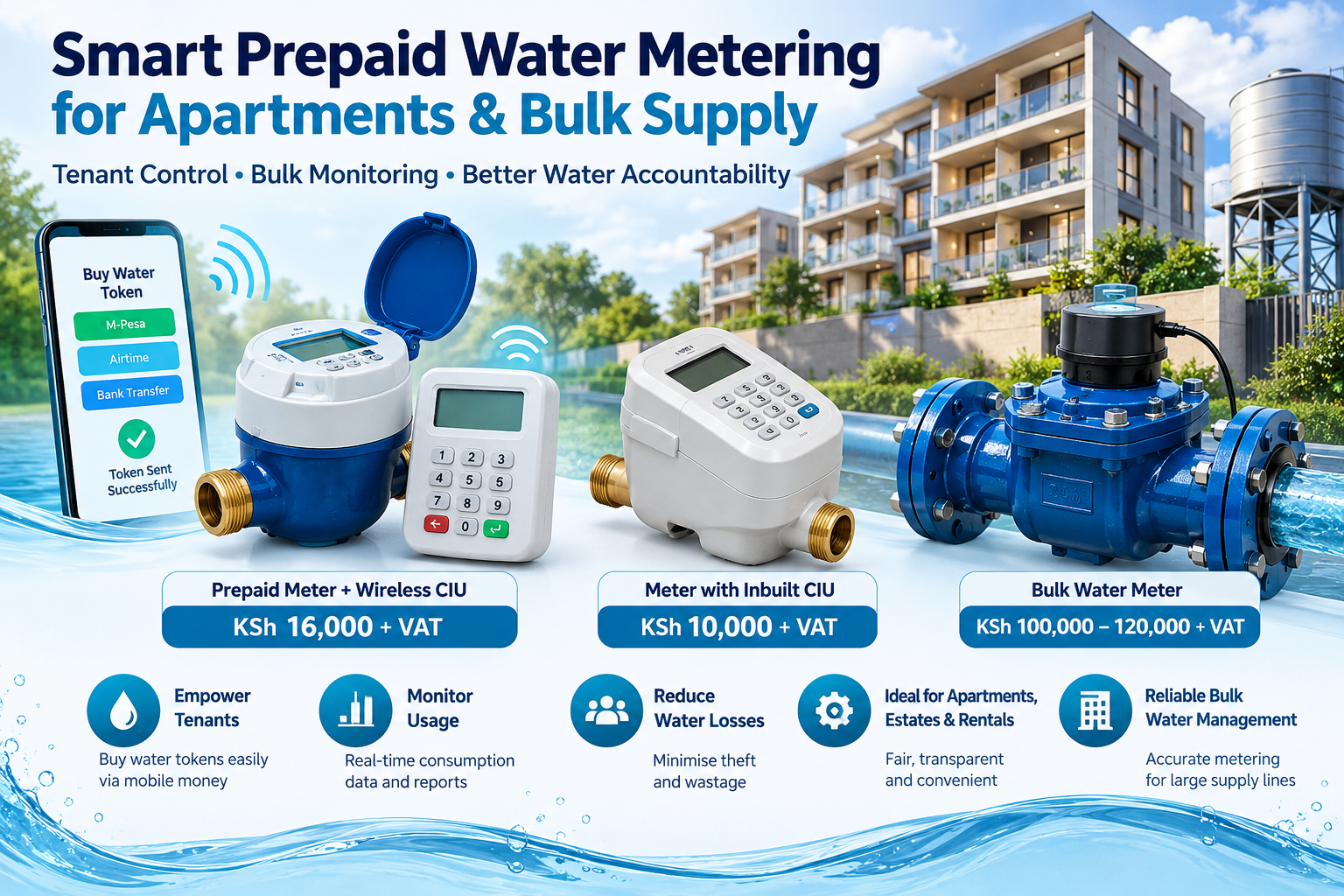
The Dotmobi prepaid water meter with wireless CIU is available at KSh 16,000 + VAT.
A wireless CIU is particularly useful where the main meter is installed outside the tenant’s house or inside a common meter chamber.
The tenant can interact with the prepaid system without requiring direct physical access to the main water meter.
This configuration is suitable for:
- apartments;
- rental flats;
- gated communities;
- hostels;
- multi-unit developments; and
- properties with centralized meter cabinets.
For apartment developers, the wireless CIU can make meter placement more flexible while keeping the user interface conveniently accessible to the tenant.
Dotmobi Prepaid Water Meter With Inbuilt CIU
Dotmobi also provides a prepaid water meter with an inbuilt CIU at KSh 10,000 + VAT.
This configuration can be suitable where the meter itself is easily and safely accessible to the tenant.
Potential applications include:
- individual rental houses;
- bedsitters;
- smaller apartment blocks;
- shops;
- offices; and
- small commercial premises.
The inbuilt CIU option provides a lower-cost entry point for landlords who want to introduce prepaid water management without requiring a separate wireless interface.
Dotmobi Bulk Water Meter for Larger Properties
For larger installations, Dotmobi bulk water meters are available at approximately KSh 100,000 to KSh 120,000 + VAT, depending on the required meter size, technical specification and installation requirements.
A bulk water meter can act as the main measurement point before water is distributed to individual prepaid meters.
This makes bulk metering particularly useful for property owners who want to compare:
Total water entering the property
against
Total water consumed by tenants
The difference can then be investigated.
For larger apartment developments, combining a bulk meter with prepaid water meters for apartments in Kenya can provide a clearer picture of both individual consumption and overall property water losses.
Why Combine a Bulk Meter With Individual Prepaid Meters?
A tenant prepaid meter answers:
How much water did this tenant consume?
A bulk meter answers:
How much water entered the property?
When the two measurements are compared, management can answer a third question:
How much water remains unexplained?
That can help property managers identify possible problems before they become expensive.
Detecting Hidden Water Leaks
Some water leaks are easy to see.
Others may continue underground, inside walls or along distribution pipes without being noticed.
For example, suppose tenants collectively consume about 30 cubic metres of water every day.
If the bulk meter consistently records 38 cubic metres entering the property, approximately 8 cubic metres per day requires investigation.
The cause may be:
- a leaking underground pipe;
- an overflowing storage tank;
- a faulty toilet cistern;
- an unmetered connection; or
- common-area consumption.
Without a bulk reference meter, the additional consumption may only become apparent after an unusually high water bill.
Better Management of Borehole Water
Bulk and prepaid water metering can also be useful where apartments are supplied from a private borehole.
Borehole water is not free simply because it comes from underground.
Property owners may still incur costs for:
- electricity;
- pumping;
- treatment;
- storage;
- maintenance;
- pumps;
- plumbing; and
- system repairs.
A bulk meter can measure the volume of water entering the property’s distribution network.
Individual prepaid meters can then record consumption for each tenant.
This gives management a clearer picture of how borehole water is being distributed and consumed.
For further information on prepaid metering for boreholes and other applications, see:
Why Prepaid Water Meters in Kenya Matter for Borehole and Water Projects
Reducing Water Billing Disputes
Shared water bills can be a major source of disputes within rental properties.
Tenants may ask:
- Why is my bill higher this month?
- Why am I paying the same amount as a larger household?
- How was my share calculated?
- Who pays for water lost through a leaking pipe?
- Why should I pay for someone else’s consumption?
Prepaid water metering can reduce many of these disputes because each tenant purchases water according to their own usage.
The landlord no longer needs to rely entirely on manually dividing a master bill among tenants.
This is one reason prepaid water meters for apartments in Kenya are increasingly relevant to landlords who want consumption and payment to be more closely connected.
Giving Tenants Greater Control
Prepaid water meters can also encourage households to monitor their own water consumption.
When tenants understand that excessive use affects how quickly their prepaid credit is consumed, they have a greater incentive to:
- repair leaking taps;
- avoid unnecessary water wastage;
- monitor unusual consumption;
- budget for water; and
- use water more responsibly.
This can benefit both tenants and property owners.
Prepaid Water Metering for Gated Communities
Prepaid water meters for apartments in Kenya are also suitable for gated communities and housing estates.
Each household can have its own prepaid water meter while a larger bulk meter monitors the total water entering the development.
This gives estate management a clearer picture of:
- total water supply;
- household consumption;
- common-area consumption;
- possible water losses; and
- overall system performance.
The same approach can also be used in developments supplied by boreholes or private water systems.
Prepaid Water Metering for Hostels
Student hostels and staff accommodation can also benefit from prepaid water management.
Shared billing can be difficult in environments where occupants frequently change.
Prepaid meters allow water charges to be linked more closely to actual consumption.
For hostels containing many individual rooms or units, prepaid water meters for apartments in Kenya can be adapted to help management separate user consumption and reduce dependence on estimated shared bills.
Prepaid Water Metering for Commercial Properties
The same technology can be used in commercial developments.
Examples include:
- shops;
- office blocks;
- workshops;
- markets;
- mixed-use buildings; and
- business parks.
Each unit can be metered independently while a bulk meter measures the total water entering the property.
This makes it easier to track consumption and identify unexplained losses.
Which Dotmobi Water Meter Should You Choose?
The right water meter depends on the type of property and the intended application.
For a smaller rental property where meters are easily accessible, the prepaid water meter with inbuilt CIU at KSh 10,000 + VAT may be suitable.
For apartments where meters are located outside tenant units or inside common meter chambers, the wireless CIU prepaid water meter at KSh 16,000 + VAT may offer greater convenience.
For larger properties that require monitoring of total incoming water, the bulk water meter at approximately KSh 100,000 to KSh 120,000 + VAT can be installed alongside individual prepaid meters.
For many larger developments, the most effective arrangement may therefore be a combination of:
one bulk water meter + individual prepaid tenant meters.
You can also read Dotmobi’s broader analysis of how prepaid and smart water-meter adoption is developing in Kenya:
Prepaid Water Meters in Kenya: Why Adoption Is Accelerating
From Water Billing to Water Accountability
The biggest advantage of modern water metering is not simply changing how tenants pay.
It is improving water accountability.
A well-designed system can help a property owner know:
How much water entered the property?
How much water did tenants consume?
How much water cannot immediately be accounted for?
Once those figures are available, water losses become easier to investigate.
This is especially valuable for apartments and estates where water expenses can represent a significant recurring cost.
Dotmobi Prepaid Water Meter Prices in Kenya
Dotmobi currently provides the following water-metering options:
- Prepaid water meter with wireless CIU — KSh 16,000 + VAT
- Prepaid water meter with inbuilt CIU — KSh 10,000 + VAT
- Bulk water meter — approximately KSh 100,000 to KSh 120,000 + VAT, depending on size and specification.
These solutions can be configured for apartments, rental properties, gated communities, institutions, commercial properties and private water-distribution systems.
For landlords comparing different prepaid water meters for apartments in Kenya, the choice should consider not only the meter price but also accessibility, CIU configuration, property size and whether bulk-water monitoring is required.
Frequently Asked Questions About Prepaid Water Meters for Apartments in Kenya
How much is a prepaid water meter in Kenya?
Dotmobi’s prepaid water meter with an inbuilt CIU costs KSh 10,000 + VAT, while the prepaid water meter with a separate wireless CIU costs KSh 16,000 + VAT.
How much does a bulk water meter cost in Kenya?
Dotmobi bulk water meters cost approximately KSh 100,000 to KSh 120,000 + VAT, depending on the meter size, specification and installation requirements.
Can prepaid water meters be installed in apartments?
Yes. Prepaid water meters for apartments in Kenya can be installed for individual tenant units so each tenant pays according to their own water consumption.
What is the advantage of a wireless CIU water meter?
A wireless CIU allows the tenant to interact with the prepaid system without needing direct physical access to the main water meter.
This can be useful where meters are installed outside the house or in common meter cabinets.
Why install a bulk meter together with tenant meters?
A bulk meter measures the total water entering a property, while individual prepaid meters measure tenant consumption.
Comparing the two readings can help identify unexplained water use, leaks and other losses.
Can prepaid water meters work with borehole water?
Yes. A bulk meter can measure water entering the distribution system from a borehole, while individual prepaid water meters can manage consumption for each tenant or household.
Are prepaid water meters suitable for landlords?
Yes. Prepaid water meters can help landlords reduce manual billing, unpaid water bills and disputes over shared consumption.
Can prepaid water meters be used in gated communities?
Yes. Individual prepaid meters can be installed for each household while a bulk meter monitors the total water entering the estate.
Get Prepaid Water Meters for Apartments in Kenya
If you manage apartments, rental houses, hostels, gated communities or commercial properties, installing prepaid water meters for apartments in Kenya can provide greater control over water consumption and billing.
For larger properties, combining individual prepaid water meters with a bulk water meter can provide an additional level of accountability by allowing management to compare total water supplied against total tenant consumption.
Dotmobi provides prepaid and bulk water-metering solutions for different property sizes and applications.
Prepaid meter with wireless CIU: KSh 16,000 + VAT
Prepaid meter with inbuilt CIU: KSh 10,000 + VAT
Bulk water meter: approximately KSh 100,000–120,000 + VAT
Contact Dotmobi to discuss the appropriate water-metering configuration for your apartments, rental properties, estate, institution or commercial development.