
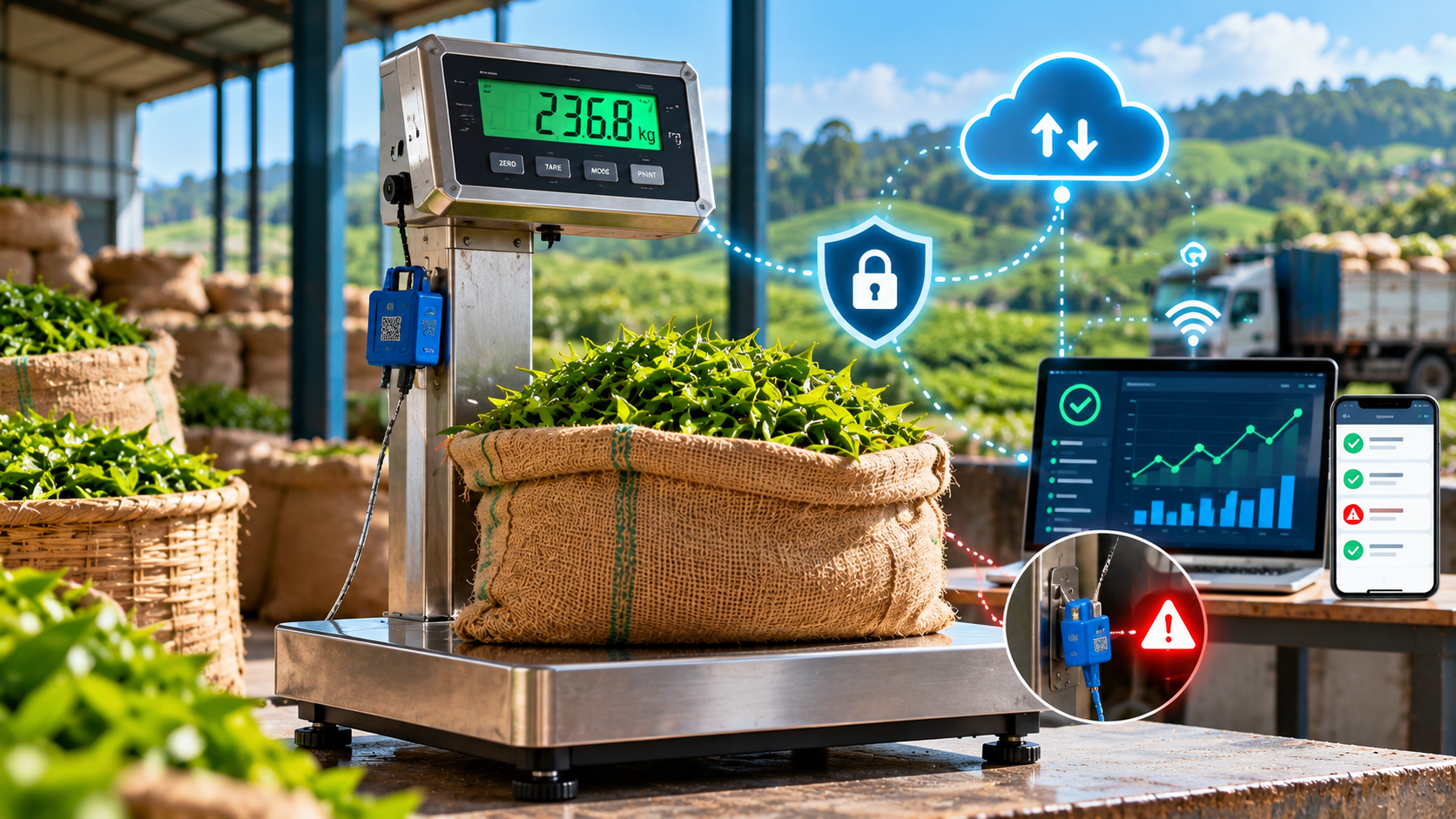
Scale tampering in Kenya has returned to national attention following enforcement operations in tea-growing areas where authorities investigated alleged manipulation of weighing equipment used to record farmers’ green leaf deliveries.
In August 2026, officials from the Tea Board of Kenya, the Department of Weights and Measures and security agencies carried out inspections at tea buying centres in Konoin, Bomet County following complaints from farmers.
The investigations reportedly uncovered suspected interference with weighing equipment, leading to arrests and prosecutions.
The enforcement later expanded into the South Rift. On 17 September 2026, further inspections were conducted in Bureti, Kericho County, where five clerks were arrested over allegations involving falsification of weighing scales. The allegations remain subject to investigation and due legal process.
The developments raise an important question for every farmer, factory, cooperative, warehouse and business that depends on weighing equipment:
Is calibration alone enough to protect a weighing scale from tampering?
The answer is no.
Calibration and statutory verification remain essential. However, they cannot continuously establish what happens to a weighing instrument after an inspector or technician leaves.
Where every kilogram affects money, inventory or supplier payments, weighing integrity requires continuous protection.
Recent Scale Tampering Cases in Kenya
The August 2026 enforcement operation in Konoin followed complaints that farmers were allegedly losing green leaf through manipulation of weighing equipment.
According to the Tea Board of Kenya, some digital weighing machines inspected during the crackdown were reportedly displaying weights approximately 1.7 kilograms below the actual weight of green leaf delivered by farmers.
TBK further stated that under the reported conditions, farmers could lose between one and two kilograms for every 10 kilograms delivered.
The potential cumulative losses are significant.
Nation reported that a truck transporting around 300 to 360 bags could represent roughly 300 kilograms of lost green leaf per trip under the alleged manipulation scenario. With several trips per day, the financial effect on farmers could become substantial.
The lesson extends beyond tea.
A weighing scale may be accurate when inspected but become unreliable later if somebody interferes with it.
That is why scale tampering in Kenya should increasingly be treated as both a legal-metrology problem and a continuous monitoring problem.
How Quickly Can Small Weight Differences Become Large Losses?
A discrepancy of one kilogram may appear insignificant when viewed as a single transaction.
But agricultural and industrial weighing involves hundreds or thousands of transactions.
Consider a simple example.
If a buying centre processes:
- 500 deliveries every day;
- each delivery is under-recorded by only 1 kg; and
- the centre operates for 26 days in a month;
the unexplained difference becomes:
500 kg × 26 days = 13,000 kg per month.
That equals 13 metric tonnes.
The financial impact depends on the commodity price, but the principle is clear.
Small weighing discrepancies repeated across large transaction volumes can create substantial losses.
For farmers, this can mean underpayment.
For factories and warehouses, it can mean inaccurate stock records.
For management, it can mean production and financial decisions being based on unreliable data.
What Kenya’s Weights and Measures Act Says About Tampering
Kenya already has a legal framework dealing directly with inaccurate and manipulated weighing instruments.
The Weights and Measures Act, Cap. 513 provides that a person who uses or possesses for trade a false or unjust weighing instrument commits an offence.
The Act also makes fraud involving weighing or measuring instruments an offence.
More importantly, the law specifically recognises that interference can happen after an instrument has already been verified and stamped.
Section 26 addresses conduct including:
- altering or defacing verification stamps;
- removing a stamp and inserting it into another instrument;
- altering an instrument after stamping so that it becomes false or unjust; and
- severing or tampering with wires, cords or other means by which a verification stamp is attached.
This point is extremely important.
A valid verification stamp confirms that an instrument satisfied the applicable requirements when it was inspected.
It does not mean that nobody can interfere with the instrument afterwards.
Calibration Does Not Equal Anti-Tampering Protection
One of the most common misconceptions about weighing equipment is that a recently calibrated scale cannot be tampered with.
Calibration and anti-tampering solve different problems.
What calibration does
Calibration checks whether a weighing instrument measures accurately against known reference standards.
It can identify problems such as:
- measurement drift;
- incorrect adjustment;
- load-cell problems;
- mechanical deterioration;
- electronic faults; and
- unacceptable measurement errors.
Calibration is therefore indispensable.
What calibration does not continuously establish
Calibration by itself does not continuously tell management:
- whether somebody later opened the scale;
- whether calibration settings were accessed without authority;
- whether another scale was substituted;
- whether communication connections were changed;
- whether an unauthorised device supplied weight data;
- whether the scale was moved;
- whether suspicious activity occurred between inspections; or
- whether the weight entered into software actually came from the authorised scale.
These risks require additional controls.
Why Scale Tampering Can Occur Between Inspections
Consider a weighing instrument that is officially tested and found accurate on Monday.
On Wednesday, somebody gains unauthorised access and changes its settings.
Later, the original settings are restored.
When the scale is inspected again, it may appear to be operating correctly.
The unanswered question is:
What happened between the two inspections?
This represents a monitoring gap.
Kenya’s Weights and Measures Act itself defines inspection partly around determining whether an instrument has been modified after verification and whether its stamp remains valid.
Modern anti-tampering systems can strengthen this protection by monitoring the weighing environment continuously rather than relying entirely on periodic checking.
Physical Seals Remain Important — But Digital Scales Create New Risks
Traditional weighing protection relies heavily on physical controls such as:
- verification stamps;
- sealing wires;
- physical seals;
- locks;
- restricted access; and
- periodic inspections.
These measures remain important.
However, modern weighing systems are increasingly electronic and interconnected.
A typical digital weighing environment may contain:
- Load cells.
- A weighing indicator.
- A mobile device or PDA.
- Bluetooth or cable communication.
- Operator identification.
- A local computer.
- Cloud software.
- A transaction database.
- A payment or accounting platform.
Protecting only the physical scale may therefore leave other parts of the weighing transaction exposed.
The security question is no longer simply:
“Has somebody physically opened the scale?”
It must also include:
“Can we prove that the recorded weight came from the correct authorised weighing instrument?”
Protecting the Complete Weighing Transaction
Modern weighing integrity should protect the complete chain:
Physical load → Scale → Authorised device → Transaction → Database → Payment or inventory record
This becomes particularly important when weighing systems are connected to cloud platforms and automated payments.
A genuine scale may produce a correct physical reading, but if an incorrect value enters the business system afterwards, the organisation still suffers a weighing-integrity failure.
Similarly, if another weighing instrument can be substituted without detection, the system may accept data that appears legitimate but originated from an unauthorised device.
Modern anti-tampering protection must therefore consider both:
the physical weighing instrument and the digital weight transaction.
Kenya’s Digital Green Leaf Payment System Raises the Stakes
The Government responded to concerns over farmer payments by directing KTDA to introduce a Digital Green Leaf Payment System.
The system is intended to link tea delivered at buying centres to digital payments so that farmers are paid according to the quantity delivered.
In August 2026, Agriculture Principal Secretary Dr. Paul Ronoh said the system was expected to be rolled out within three months and was intended to improve transparency while reducing manipulation of weighing records.
This is an important development.
However, digital payment does not automatically guarantee that the underlying weight is correct.
Consider the transaction chain:
Farmer → Scale → Recorded Weight → Digital Payment System → Farmer Payment
If the source weight is wrong, the payment system may simply process the wrong information more efficiently.
For this reason:
Digital payment needs trusted digital weight capture.
The weighing system should be capable of establishing that the weight entering the payment platform genuinely originated from the authorised scale.
Why Continuous Anti-Tampering Monitoring Matters
Continuous monitoring changes weighing security from periodic checking to ongoing supervision.
Instead of waiting for a farmer, auditor, inspector or manager to discover a discrepancy later, an IoT-based anti-tampering system can monitor predefined events as they occur.
Depending on system design, these events may include:
- unauthorised opening of protected equipment;
- unexpected calibration activity;
- scale substitution;
- changes in scale identity;
- unauthorised device connections;
- unexpected location changes;
- loss of communication with an approved scale;
- suspicious transaction behaviour; and
- attempts to interfere with protected weighing processes.
An alert does not automatically prove that fraud has occurred.
Instead, it gives management an event that can be investigated.
This is important because effective weighing security should provide visibility, evidence and accountability.
Test Weights Remain an Important First Line of Defence
A verified test weight remains one of the simplest practical methods of checking a weighing instrument.
For example, placing a verified 10 kg test weight on a suitable scale should produce the expected reading within the applicable permitted error.
This provides operators, supervisors and customers with an immediate indication of scale performance.
But a test weight provides only a point-in-time test.
If the scale is correct at 8:00 a.m., that does not by itself prove that the scale remains protected from interference throughout the rest of the day.
For high-risk weighing operations, the stronger approach is:
Test the scale. Verify the scale. Protect the scale. Monitor the scale. Protect the transaction.
Each control addresses a different risk.
Scale Tampering Is Becoming a Cyber-Physical Security Problem
Traditional scale fraud was primarily associated with physical interference.
Modern digital weighing changes this.
Electronic weighing systems combine physical measurement with communications, software and cloud platforms.
The physical weight originates from the scale, but software determines how that weight is transferred, recorded, stored and eventually used.
A secure weighing system should therefore help answer questions such as:
- Which scale produced this weight?
- Was the scale authorised?
- Which operator handled the transaction?
- Where did the weighing occur?
- Was the scale opened?
- Was calibration attempted?
- Was another scale substituted?
- Was communication interrupted?
- Did the recorded value originate from the expected hardware?
- Was the transaction later altered?
- Is there a time-stamped audit trail?
These questions are becoming increasingly important in preventing scale tampering in Kenya.
Why Digital Audit Trails Matter
An effective audit trail helps management reconstruct what happened during a weighing transaction.
A useful electronic record may include:
- transaction date;
- time;
- scale identity;
- connected device identity;
- operator;
- recorded weight;
- relevant security events;
- approved location where applicable; and
- alerts generated by the system.
The objective is not only to prevent manipulation.
It is also to make suspicious activity easier to investigate.
Without records, a weighing dispute can become one person’s word against another.
With a properly designed audit trail, management has evidence that can be reviewed.
Dotmobi WSTG and Continuous Weighing Protection
Dotmobi LLP developed the Weighing Scale Tampering Guard (WSTG) to add another protection layer to electronic weighing operations.
The technology is protected under Kenyan patent KE 1086 – Weighing Scale Tampering Guard.
WSTG is designed to complement—not replace—statutory verification, calibration and other approved weighing procedures.
The objective is to strengthen weighing integrity through electronic monitoring, alerts and auditability.
Depending on the deployment, a protected weighing environment can monitor predefined security conditions associated with the authorised scale and weighing process.
The underlying principle is simple:
Knowing that a scale was correct when inspected is important. Knowing what happens to it after inspection provides an additional layer of protection.
Where Anti-Tampering Protection Can Be Applied
Although recent enforcement has focused strongly on tea, weighing fraud is not exclusively a tea-sector problem.
Anti-tampering protection can be relevant anywhere weight determines money, stock or production.
Tea buying centres
Green leaf weight directly determines farmer payments.
Coffee and agricultural produce
Farmers depend on accurate weight when selling produce.
Grain and cereal collection
Small weighing discrepancies can become significant when multiplied across high volumes.
Warehouses
Receiving and dispatch weights directly affect stock reconciliation.
Manufacturing
Raw-material and finished-product weights influence production and inventory records.
Logistics and transport
Weighbridges determine vehicle and cargo weights.
Scrap-metal businesses
Payments are commonly calculated from measured weight.
Mining and quarry operations
Large transaction volumes can make small percentage discrepancies financially significant.
Where weight determines value, protecting the integrity of that measurement makes commercial sense.
Five Controls Businesses Should Use Against Scale Tampering
Businesses concerned about scale tampering in Kenya should consider a layered approach.
1. Maintain statutory verification
Ensure weighing instruments used for trade comply with applicable Weights and Measures requirements and carry the required valid verification status.
2. Conduct routine test-weight checks
Use appropriate verified test weights to conduct operational checks and maintain records of the results.
3. Restrict calibration access
Only authorised personnel should have access to calibration and configuration functions.
Where technically possible, such access should be logged.
4. Introduce continuous anti-tampering monitoring
High-value and high-volume weighing points should consider systems capable of monitoring suspicious events between statutory inspections.
5. Secure the complete digital weight transaction
Ensure that a recorded weight can be linked back to the approved scale that generated it.
The objective should be end-to-end weighing integrity.
Verification and Monitoring Work Better Together
Anti-tampering technology should not replace statutory verification.
The two controls solve different problems.
Verification asks:
Is this weighing instrument fit for use for trade?
Continuous monitoring asks:
Has something suspicious happened to the weighing system since verification?
Combined, they provide a stronger control environment.
For organisations handling valuable commodities or large transaction volumes, this layered approach can reduce financial, regulatory and reputational risk.
The Lesson From Kenya’s 2026 Tea Weighing Crackdown
The August and September 2026 enforcement operations offer an important lesson for Kenya’s wider weighing industry.
Accurate weighing should not depend entirely on occasional inspection.
Modern weighing systems operate continuously.
Their protection should increasingly do the same.
The objective needs to move from:
“The scale was checked.”
to:
“We can demonstrate that the weighing process remained trustworthy.”
That distinction is especially important where every kilogram determines somebody’s income.
Frequently Asked Questions About Scale Tampering in Kenya
What is scale tampering?
Scale tampering is unauthorised interference with a weighing instrument or weighing process that causes or attempts to cause an incorrect, misleading or unreliable weight.
Is scale tampering illegal in Kenya?
Yes. Kenya’s Weights and Measures Act contains offences relating to false or unjust weighing instruments, fraud involving weighing equipment, and alteration or interference with stamped instruments.
Can a calibrated scale still be tampered with?
Yes. Calibration confirms measurement performance at a particular point in time. It does not make a scale permanently immune from later physical or electronic interference.
Does a verification stamp guarantee that a scale cannot be altered?
No. The Weights and Measures Act itself specifically addresses alteration of an instrument after it has been stamped.
What is continuous weighing-scale monitoring?
Continuous monitoring uses electronic or IoT technology to monitor defined events associated with the weighing system and produce alerts or records when suspicious conditions occur.
Can anti-tampering technology replace verification?
No. Anti-tampering protection should complement statutory verification, calibration, test weights and proper operating procedures.
Why are audit trails important?
Audit trails help organisations establish when a transaction occurred, which equipment generated the weight, who handled the transaction and whether unusual events occurred.
What is Dotmobi WSTG?
The Dotmobi Weighing Scale Tampering Guard (WSTG) is an IoT-based anti-tampering technology designed to strengthen the integrity of electronic weighing operations through monitoring, alerts and auditability.
Protect Every Kilogram
Recent enforcement against alleged scale tampering in Kenya demonstrates why weighing integrity deserves serious attention.
For farmers, an incorrect kilogram can mean lost income.
For businesses, unreliable weighing can affect inventory, supplier payments, production records and customer confidence.
For regulators, it undermines trust in trade measurement.
Calibration remains essential.
Verification remains essential.
But modern weighing systems increasingly require another layer:
continuous anti-tampering monitoring and secure weight capture.
If your organisation depends on weighing scales for farmer payments, supplier settlements, inventory control, production or dispatch, Dotmobi LLP can help assess how weighing automation and anti-tampering monitoring can strengthen your operation.
Contact Dotmobi LLP for Weighing Scale Tampering Guard (WSTG), weighing automation and secure weight-monitoring solutions in Kenya.