
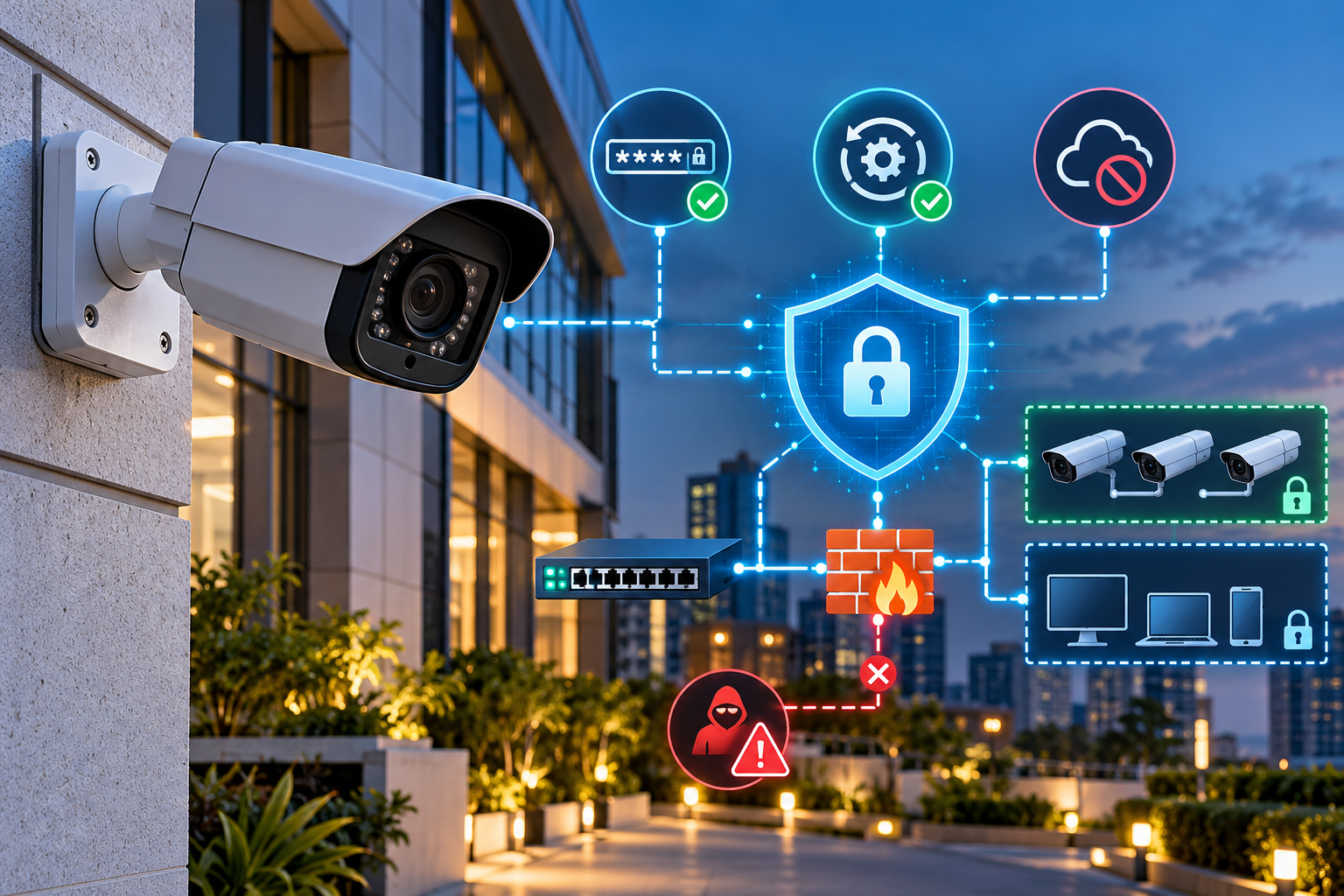
CCTV cybersecurity in Kenya is becoming increasingly important as homes, businesses, schools, apartments, warehouses, factories and institutions adopt internet-connected surveillance systems.
Modern CCTV systems no longer operate only as isolated cameras connected to a recorder. Many now include IP cameras, Network Video Recorders (NVRs), Digital Video Recorders (DVRs), mobile applications, cloud platforms, routers and remote-access services.
That creates an important question:
Who is protecting the security system itself?
A CCTV camera can protect a building physically while simultaneously becoming a cybersecurity weakness if it is poorly configured.
Weak passwords, outdated firmware, exposed remote access and poorly designed networks can all increase risk.
As more surveillance systems become internet-connected, CCTV cybersecurity in Kenya should therefore be considered during installation, operation and maintenance—not as an optional extra after the system has already been deployed.
Why CCTV Cybersecurity in Kenya Matters
Traditional CCTV systems were largely isolated.
A camera transmitted video to a recorder, and security personnel viewed the footage locally.
Modern surveillance systems are different.
A typical installation may include:
- IP cameras
- Network switches
- Routers
- NVRs
- Mobile applications
- Cloud services
- Remote monitoring
- Internet connections
- Laptops and smartphones used by administrators
Every connected component can increase the number of potential entry points into the surveillance environment.
The UK’s National Cyber Security Centre (NCSC) warns that internet-connected security cameras may be vulnerable where manufacturer default passwords remain unchanged. Its guidance recommends changing default passwords, keeping camera software updated and disabling remote viewing where it is unnecessary.
The same NCSC guidance also warns that router technologies such as UPnP and port forwarding can increase exposure if they are enabled unnecessarily.
This means CCTV installation should increasingly involve both physical security engineering and cybersecurity planning.
1. Default CCTV Passwords Are a Serious Security Risk
One of the simplest weaknesses in a surveillance system can also be one of the most dangerous:
Leaving the manufacturer’s default password unchanged.
Some devices may initially be configured using commonly known usernames or passwords.
Cybercriminals can automate attempts to locate internet-exposed devices and test common or previously known credentials.
The NCSC advises users to replace default passwords with secure credentials and recommends enabling two-step verification where available.
CISA also recommends changing manufacturer default passwords before hardware, software or firmware is placed onto an organisation’s network.
Better CCTV Password Practice
Businesses should therefore:
- Change default passwords during installation.
- Use strong, unique administrator passwords.
- Avoid sharing one administrator password among many employees.
- Remove accounts belonging to former staff.
- Limit administrator privileges.
- Enable multi-factor authentication where supported.
- Avoid reusing CCTV passwords on email, routers or other business systems.
A secure CCTV installation should never finish while factory-default credentials remain active.
Good password controls are one of the simplest ways to strengthen CCTV cybersecurity in Kenya.
2. Outdated Camera Firmware Can Create Vulnerabilities
Cameras and recorders contain embedded software known as firmware.
Like computer operating systems, firmware may occasionally contain security weaknesses.
Manufacturers may release updates to correct vulnerabilities, improve stability or add security controls.
But many CCTV installations operate for years without anyone checking whether the firmware has ever been updated.
The NCSC recommends keeping smart-device software and firmware current and, where possible, enabling automatic updates.
CISA similarly recommends timely software and firmware updates, particularly for internet-facing equipment.
CCTV Maintenance Should Therefore Include Cybersecurity
Routine CCTV servicing should check:
- Camera firmware versions
- NVR or DVR firmware
- Known security advisories
- Mobile application versions
- Router firmware
- Unsupported or end-of-life equipment
- Whether automatic updates are available
- Whether security patches have been applied
CCTV maintenance should no longer consist only of cleaning lenses and confirming that cameras are recording.
A modern maintenance programme should also verify whether the surveillance equipment is still receiving security support from the manufacturer.
3. Remote CCTV Viewing Must Be Carefully Secured
Remote CCTV viewing is extremely useful.
A business owner in Nairobi may monitor premises in another town using a smartphone.
A security manager may monitor several facilities from one control room.
However, remote access means that the CCTV system must communicate beyond the local premises.
This requires careful configuration.
The NCSC advises users who do not require internet-based remote viewing to consider disabling it.
Its guidance also notes that UPnP and port forwarding can potentially expose devices and recommends reviewing whether those functions are actually required.
Secure Remote CCTV Access May Include
- Encrypted connections
- VPN access
- Restricted administrator accounts
- Multi-factor authentication
- Manufacturer-supported secure remote services
- Logging of administrator activity
- Limiting access to approved devices
- Disabling unused remote-access services
Secure remote viewing is becoming an important part of CCTV cybersecurity in Kenya, especially for organisations managing multiple branches, schools, warehouses or residential properties.
Simply opening CCTV equipment directly to the public internet should not automatically be treated as good installation practice.
4. CCTV Cameras Should Ideally Be Separated From Business Networks
Consider a company where the same network contains:
- Employee computers
- Accounting systems
- Printers
- CCTV cameras
- Wi-Fi
- Servers
- NVR equipment
If every device can communicate freely with every other device, compromising one system could potentially increase exposure elsewhere.
Cybersecurity specialists therefore recommend network segmentation.
CISA recommends implementing network segmentation and organising connected assets into logical zones, with security controls limiting communication between those zones.
For CCTV environments, this can mean creating a dedicated surveillance network.
Example
Instead of:
Internet → Router → Cameras + Office PCs + Servers
a better architecture may resemble:
Internet → Firewall/Router
Then separately:
Business Network
and
CCTV Network → Cameras → NVR
Communication between the two networks can then be controlled using firewall rules or access-control policies.
Network separation is one of the most practical ways to strengthen CCTV cybersecurity in Kenya.
It can also reduce the chance that a compromised camera or recorder provides an easy route into other important business systems.
5. Unnecessary CCTV Services and Ports Should Be Disabled
Cameras and recorders may support multiple network services.
Some may be required.
Others may not.
Every unnecessary service increases the potential attack surface.
A professional CCTV security review should therefore identify:
- Which network ports are open
- Which remote services are enabled
- Whether unused protocols are active
- Whether administrator interfaces are internet-accessible
- Whether unnecessary cloud features are running
- Whether legacy services remain enabled
- Whether external access is restricted to authorised users
The principle is simple:
If a service is not required, there is usually little reason to leave it exposed.
Removing unnecessary services is a practical way of reducing the number of possible avenues through which a CCTV system could be attacked.
6. CCTV Systems Need Firewalls, Not Just Cameras
Businesses sometimes invest significantly in high-resolution cameras while paying little attention to the network infrastructure supporting them.
But an IP CCTV camera is effectively another computer connected to the network.
That means routers and firewalls matter.
A properly designed system can restrict which equipment is allowed to communicate with CCTV devices.
For example:
Camera → NVR: Allowed
Approved administrator → NVR: Allowed
Unknown internet device → Camera: Blocked
This creates another layer of protection.
Firewalls can also help organisations control remote access and reduce unnecessary exposure of management interfaces.
CISA guidance emphasises filtering traffic, separating network zones and controlling communications between connected systems.
For larger systems, firewall rules and logging should form part of the CCTV design—not an afterthought.
7. Protect CCTV Administrator Accounts
The administrator account often has extensive control over a surveillance system.
Depending on the equipment, an administrator may be able to:
- View live video
- Retrieve recordings
- Delete footage
- Add users
- Change network settings
- Alter camera configurations
- Enable remote access
- Reset passwords
- Change storage or recording policies
This makes administrator credentials particularly valuable.
Businesses should therefore distinguish between different user roles.
Security Guard
May view selected cameras.
Supervisor
May view cameras and retrieve recordings.
System Administrator
May configure cameras and network settings.
Not everybody who watches cameras needs full administrator rights.
This follows the principle of giving users only the access required for their duties.
Where the equipment supports it, administrators should also use multi-factor authentication and individual accounts rather than shared passwords.
8. CCTV Cybersecurity Also Protects Privacy
CCTV cybersecurity is not only about preventing hackers from controlling cameras.
It is also about protecting recorded personal information.
Video footage may contain:
- Customers
- Employees
- Visitors
- Vehicle registration numbers
- Children
- Identifiable behaviour
- Movement patterns
Kenya’s Office of the Data Protection Commissioner has found in a formal decision that CCTV collection, transmission and retention of identifiable images can amount to the processing of personal data.
ODPC guidance also stresses that CCTV surveillance, particularly involving children, should be proportionate, transparent and supported by appropriate safeguards.
Strong CCTV cybersecurity in Kenya therefore also helps organisations protect recorded personal data from unauthorised access.
Organisations should ask two important questions:
Who is authorised to watch the footage?
and
Who could gain unauthorised access to the footage?
Cybersecurity and privacy should therefore be treated as connected parts of CCTV management.
9. Cheap CCTV Equipment Can Become Expensive Later
When comparing CCTV quotations, customers frequently focus on:
- Megapixels
- Number of cameras
- Storage capacity
- Night vision
- Installation cost
Cybersecurity features are often overlooked.
But organisations should increasingly ask suppliers questions such as:
Does the manufacturer provide security updates?
How long will firmware support continue?
Can default passwords be changed?
Does the system support encrypted communication?
Can users be assigned different permission levels?
Can the equipment operate within a segmented network?
Does remote access support strong authentication?
Can unnecessary services be disabled?
Does the manufacturer publish security advisories?
The NCSC advises buyers to avoid smart devices that are already out of support or approaching the end of their manufacturer’s support period because unsupported devices may become easier to compromise over time.
The cheapest camera is therefore not necessarily the lowest-cost system if it creates cybersecurity problems later.
10. How Businesses Can Improve CCTV Cybersecurity in Kenya
Organisations do not necessarily need extremely complicated infrastructure.
A number of practical measures can significantly improve security.
CCTV Cybersecurity Checklist
✅ Change every default password.
✅ Use unique passwords for important CCTV accounts.
✅ Keep camera and recorder firmware updated.
✅ Enable multi-factor authentication where supported.
✅ Disable unnecessary remote-access functions.
✅ Avoid unnecessary internet exposure.
✅ Review UPnP and port-forwarding settings.
✅ Use firewalls.
✅ Separate CCTV equipment from critical business systems.
✅ Use encrypted remote access.
✅ Review administrator accounts regularly.
✅ Remove accounts belonging to former employees.
✅ Monitor unusual network activity.
✅ Maintain backups of important configuration information.
✅ Purchase equipment from manufacturers that continue providing security updates.
✅ Review security settings whenever cameras, routers or recorders are replaced.
For modern organisations, CCTV cybersecurity in Kenya should be treated as part of the overall security strategy rather than as an optional technical feature.
CCTV Security Must Protect Both the Building and the Network
A CCTV system can have excellent image quality and still have poor security.
Modern surveillance systems should therefore be evaluated from two perspectives.
Physical Security
Can the cameras:
- Capture important areas?
- Identify events?
- Provide usable recordings?
- Operate at night?
- Maintain adequate storage?
Cybersecurity
Can the system:
- Resist unauthorised login attempts?
- Restrict remote access?
- Receive firmware updates?
- Isolate cameras from important business systems?
- Protect recordings from unauthorised users?
- Log administrator activity?
- Restrict management access?
A truly secure CCTV installation needs both.
The Future of CCTV Installation in Kenya
As Kenya continues adopting:
- IP cameras
- Cloud surveillance
- AI video analytics
- Remote monitoring
- Smart access control
- Connected alarms
the separation between physical security and cybersecurity will continue disappearing.
The camera is increasingly becoming part of an organisation’s wider IT infrastructure.
Businesses should therefore start treating CCTV cybersecurity as an important part of procurement, installation and maintenance.
This is especially important where surveillance systems are integrated with access control, mobile applications, Wi-Fi networks, business servers or cloud services.
How Dotmobi Can Help
Dotmobi LLP provides CCTV and security solutions for businesses, institutions, schools, residential properties and other organisations.
Our CCTV solutions include features such as high-definition video, night vision, motion detection, alerts and remote viewing. You can view more information on the Dotmobi CCTV solutions page.
A properly designed surveillance project should consider more than simply the number of cameras required.
Important considerations include:
- Camera positioning
- Video quality
- Storage
- Remote monitoring
- Network architecture
- User permissions
- Equipment configuration
- System maintenance
- Cybersecurity
If you are installing a new CCTV system or reviewing an existing installation, Dotmobi can help evaluate both the physical surveillance requirements and the network infrastructure supporting the system.
Contact Dotmobi LLP for CCTV installation, upgrading and security-system assessment in Kenya.
Frequently Asked Questions
What is CCTV cybersecurity?
CCTV cybersecurity refers to protecting IP cameras, NVRs, DVRs, remote-access platforms and surveillance networks against unauthorised access, malware and other cyber threats.
Can CCTV cameras be hacked?
Internet-connected cameras can potentially be compromised when security weaknesses exist, including weak credentials, outdated firmware or unnecessarily exposed remote-access services.
Should CCTV cameras use the same network as office computers?
For many business environments, separating surveillance equipment from critical business systems through network segmentation can reduce cybersecurity risk.
Should CCTV firmware be updated?
Yes. Manufacturers may release firmware updates that improve functionality, correct faults and address security vulnerabilities.
Is remote CCTV viewing safe?
Remote CCTV monitoring can be secure when properly configured using strong authentication, encrypted connections and restricted network access.
Why should default CCTV passwords be changed?
Default credentials may be known, guessable or reused across devices. Cybersecurity authorities recommend replacing them before devices are placed into service.
Does CCTV involve personal data?
It can. Kenya’s Office of the Data Protection Commissioner has determined in a CCTV-related decision that the collection, transmission and storage of identifiable CCTV images constituted processing of personal data.
Conclusion
CCTV cybersecurity in Kenya is becoming increasingly important as surveillance systems move from isolated analogue equipment to internet-connected IP cameras, NVRs, cloud platforms and mobile applications.
Businesses should therefore look beyond camera resolution and storage capacity when investing in surveillance.
Strong passwords, firmware updates, network segmentation, controlled remote access, firewalls and proper user permissions can help ensure that the security system protecting your premises does not itself become a security weakness.
As CCTV becomes more connected, protecting the cameras, recorders and networks behind them will become just as important as choosing where the cameras are installed.
For organisations planning a new installation or reviewing an existing CCTV system, CCTV cybersecurity in Kenya should now be considered from the beginning of the design process.