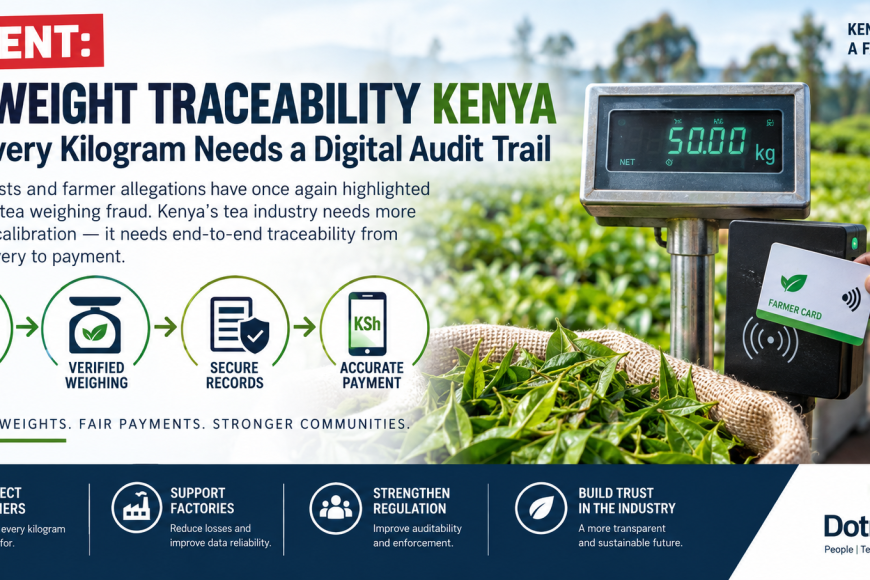
Recent enforcement action in Kenya’s tea-growing regions has again raised serious questions about the integrity of green-leaf weighing, recording and payment systems.
For tea weight traceability in Kenya to work effectively, protecting the weighing scale alone is not enough. The industry increasingly needs to answer a much bigger question:
Can every kilogram credited to a farmer be traced back to a genuine physical weighing event?
That question has become particularly important following recent investigations into alleged manipulation of tea weights at buying centres.
On 17 September 2026, at least five tea clerks were reported arrested during an impromptu operation in Bureti, Kericho County, following complaints by farmers over alleged manipulation of tea weights.
The operation involved the Tea Board of Kenya, the Department of Weights and Measures and other agencies. The allegations remain subject to investigation and due process.
The incident demonstrates why Kenya may need to move beyond periodic scale inspection towards continuous tea weight traceability from farmer delivery to payment.
Tea Weight Traceability Kenya: The Problem May Extend Beyond the Scale
Most discussions about tea weighing fraud focus on one problem:
A farmer delivers tea, but a manipulated weighing scale records less than the actual weight.
For example:
Physical tea delivered: 50 kg
Weight credited: 45 kg
Farmer’s potential loss: 5 kg
That is one possible form of manipulation.
But recent farmer discussions have raised another allegation: kilograms may potentially be allocated to accounts without a corresponding legitimate supply of green leaf.
Some farmers have informally referred to such alleged credits as “air kilograms.”
These allegations should not be treated as established fact without investigation.
However, they raise an important question for the entire tea industry:
Should a farmer account ever contain kilograms that cannot be traced back to an authenticated physical weighing transaction?
The answer should be no.
And that is where end-to-end tea weight traceability becomes important.
Three Potential Risks in Green-Leaf Weighing
There are at least three different integrity risks that a modern digital tea weighing system should be capable of identifying.
1. The Physical Weight Is Manipulated
A farmer physically supplies 50 kg.
The weighing system records 45 kg.
The farmer immediately loses 5 kg.
This is the conventional weighing-scale manipulation problem.
Kenya’s Weights and Measures Act prohibits the use of false or unjust weighing instruments and also provides offences relating to fraud involving weights, measures and weighing instruments.
Read Kenya’s Weights and Measures Act on Kenya Law
2. Genuine Kilograms Are Credited to the Wrong Account
A farmer supplies 50 kg.
The weighing transaction correctly captures 50 kg.
But the farmer’s account ultimately receives only 40 kg, while some or all of the balance appears elsewhere.
At factory level, the overall kilograms could still appear to balance.
The manipulation may therefore be difficult to discover through total-volume reconciliation alone.
3. Unsupported Kilograms Appear in an Account
A third risk arises where an account contains kilograms that cannot be matched to physical weighing transactions.
If such a discrepancy occurs, the system should be capable of identifying it before payment is finalised.
This is why tea weight traceability in Kenya must extend beyond calibration of the weighing scale.
Every kilogram needs an auditable digital history.
Every Kilogram Should Have a Verifiable Origin
A strong green-leaf integrity system should operate around one basic principle:
No kilogram should enter a farmer’s payable record unless it can be associated with a legitimate physical weighing event.
Similarly:
Every legitimate weighing event should reach the correct farmer’s record accurately and only once.
The objective is not to expose the internal design of the security technology.
The objective is to establish an independent chain of evidence connecting:
Farmer or picker → physical delivery → verified weighing event → secure transaction record → farmer account → payment
This creates two essential tests.
Weighing Event to Farmer Account
Every legitimate weighing transaction should appear correctly in the intended farmer’s record.
Farmer Account Back to Weighing Event
Every kilogram appearing in a farmer’s record should be traceable back to its legitimate source.
The second test is especially important where unexplained kilograms are suspected.
How Tea Weight Traceability Could Detect Unsupported Kilograms
Consider a simplified example.
A farmer’s account shows:
1,850 KG CREDITED
But the legitimate weighing records associated with that farmer total:
1,370 KG
The difference is:
480 KG
A properly designed integrity system should highlight that discrepancy for investigation.
The response should not be an automatic accusation of fraud.
Instead, the system might identify:
Account total: 1,850 kg
Verified transaction total: 1,370 kg
Unexplained variance: 480 kg
Status: Investigation required
There may be legitimate explanations.
But the discrepancy should not remain invisible.
That distinction is important.
Technology and AI should identify anomalies. Human investigation should determine their cause.
Secure Weighing Is the Foundation
Reliable traceability begins with confidence in the original weighing event.
If the physical weight entering the digital system cannot be trusted, every system downstream inherits the problem.
Dotmobi has been developing weighing-scale anti-tampering and weighing-integrity solutions aimed at strengthening the trustworthiness of weighing operations.
The purpose is to make unauthorised interference harder to conceal while creating stronger records for subsequent investigation.
For more information on Dotmobi’s approach to weighing protection, see:
Dotmobi Weighing Scale Tampering Guard
Dotmobi has also previously discussed the wider economic impact of weighing manipulation across African agricultural and commercial markets:
Weighing Scale Tampering in Africa: Who Pays the Price?
Securing the original weighing transaction, however, is only the beginning.
Secure Farmer Identification Strengthens Tea Weight Traceability
Once the physical weight has been captured reliably, the next challenge is ensuring that it reaches the correct farmer’s account.
A modern system should be capable of securely associating each delivery with the appropriate farmer or authorised supplier.
Without revealing the underlying security architecture, the objective is straightforward:
The farmer identity, weighing transaction and eventual payment record should remain consistently linked.
This makes it much harder for kilograms to disappear silently between weighing and payment.
It also makes investigation easier when records do not agree.
Instead of asking only:
“How many kilograms did the factory receive?”
management can ask:
“Where did each kilogram originate, and to whom was it credited?”
That is a much stronger integrity test.
AI Can Strengthen Tea Weight Traceability
Once trustworthy weighing records exist, AI can analyse transaction patterns across large volumes of data.
AI does not determine the physical weight.
The weighing system remains responsible for capturing the physical measurement.
AI’s role is different.
It can analyse historical and current transaction information and identify behaviour that appears unusual enough to require investigation.
For example, imagine a farmer normally supplies between approximately 20 kg and 50 kg during typical collection periods.
The same account suddenly begins showing repeated deliveries of 180 kg, 220 kg or 300 kg.
That does not automatically prove wrongdoing.
Harvesting conditions, additional labour or other legitimate factors could explain the change.
However, the change may justify review.
AI helps identify these exceptions quickly.
AI Can Identify Patterns That Are Difficult to See Manually
Tea factories and buying centres can generate thousands or millions of transaction records.
Examining every record manually is unrealistic.
AI-assisted analysis can examine relationships involving authorised information such as:
- farmer or supplier records;
- weight patterns;
- historical delivery behaviour;
- collection locations;
- transaction times;
- frequency of deliveries;
- weighing records;
- authorised users;
- amendments;
- duplicate or unusual transactions;
- factory receiving information; and
- payment records.
The purpose is not automatic enforcement.
It is risk identification and investigative intelligence.
Dotmobi has previously explained how AI can complement weighing-scale anti-tampering by identifying patterns that may not be visible when transactions are examined individually.
Read: AI in Weighing Scale Anti-Tampering — From Alerts to Behavioural Analysis
Detecting Kilograms Moved Between Farmer Accounts
Another important problem may not affect the factory’s overall kilogram total.
Consider this simplified example:
Actual legitimate transaction: 52.40 kg
The correct farmer eventually receives:
42.40 kg
Another account receives:
10.00 kg
Total accounted for:
52.40 kg
At factory level, everything appears to balance.
But the farmer has still lost 10 kg.
Total factory reconciliation alone may therefore fail to identify the problem.
Transaction-level tea weight traceability can provide a stronger test by comparing the final farmer record with the original verified weighing event.
The question becomes:
Did the farmer who generated the legitimate transaction receive the full kilograms associated with it?
AI Can Help Identify Possible Coordinated Patterns
One unusual transaction may have an innocent explanation.
Repeated relationships across many unusual transactions deserve closer attention.
For example, AI could assist authorised investigators in identifying patterns involving:
- unusual transactions concentrated at one location;
- repeated amendments to records;
- unexplained changes in farmer delivery patterns;
- unusually frequent corrections;
- repeated differences between source transactions and final account records;
- kilograms without corresponding legitimate source records; or
- similar anomalies involving connected operational variables.
Again, these patterns do not automatically establish fraud.
They tell management and investigators where to look first.
That can significantly improve the efficiency of investigations.
Tea Weight Traceability Should Continue Beyond the Buying Centre
A complete integrity system should not stop when the farmer leaves the buying centre.
The industry should increasingly be capable of reconciling the wider chain:
Farmer deliveries
↓
Buying-centre collection
↓
Dispatch
↓
Factory receipt
↓
Processing
↓
Made-tea output
This type of reconciliation can help identify where unexplained variances first appear.
It can also strengthen factory performance analysis.
Dotmobi has previously examined how inaccurate green-leaf weights could potentially distort tea factory outturn calculations:
Read: Tea Factory Outturn in Kenya — Can Weight Falsification Distort It?
The broader lesson is important:
A management report can only be as reliable as the data used to produce it.
Government Is Moving Towards Digital Green-Leaf Payments
Kenya is already moving towards greater digitalisation of farmer payment records.
On 22 August 2026, the Kenya News Agency reported that the Government had directed KTDA to introduce a Digital Green Leaf Payment System.
According to the report, the system is intended to link tea delivered at buying centres to digital payment records and help ensure farmers are paid according to the quantity delivered.
Read the Kenya News Agency report on automated green-leaf payments
This direction is important.
But digitising payments alone does not automatically guarantee integrity.
If incorrect or manipulated information enters a digital payment platform, the system may simply process incorrect data more efficiently.
The stronger approach is therefore:
Secure source data + transaction traceability + digital payment + continuous analysis
Digital Payments Need Trusted Source Data
The objective should not simply be to replace paper records with electronic records.
The industry needs confidence that the information entering the digital system represents what physically happened.
That means answering questions such as:
- Was there an actual tea delivery?
- Was it genuinely weighed?
- Was the weighing event legitimate?
- Was the correct farmer identified?
- Did the farmer receive the complete weight?
- Was the record subsequently altered?
- Does the payment correspond to the legitimate transaction?
- Can the transaction be independently audited?
If those questions can be answered consistently, digitalisation becomes much more powerful.
A Stronger Model: Secure Weighing + Traceability + Digital Payment + AI
The strongest approach does not depend on one technology.
It combines several layers of protection.
Secure Weighing
Establish confidence in the physical measurement at source.
Weighing Integrity Protection
Reduce opportunities for unauthorised interference with the weighing process.
Secure Farmer Identification
Associate legitimate deliveries with the correct farmer or supplier.
Transaction Traceability
Preserve an auditable relationship between the original weighing event and the eventual farmer record.
Digital Payment
Ensure payment is calculated from legitimate, traceable transactions.
AI-Assisted Analysis
Continuously examine transaction patterns and identify unusual behaviour requiring investigation.
The objective is not merely a digital weighing system.
It is a green-leaf transaction integrity system.
Protecting Farmers and Tea Factories
Farmers are the most obvious potential victims when legitimate kilograms disappear.
But unsupported or inaccurate kilograms can also harm factories.
If a factory becomes liable to pay for kilograms that were not genuinely received, somebody ultimately carries the financial cost.
Unexplained differences can affect:
- farmer payments;
- factory financial performance;
- production calculations;
- management information;
- reconciliation;
- director oversight; and
- confidence in the tea supply chain.
Tea weight traceability should therefore not be viewed as technology designed to monitor one group.
It protects everyone participating honestly in the system.
It can protect:
Farmers from losing legitimate kilograms.
Factories from unsupported liabilities.
Management from unreliable records.
Directors from making decisions based on questionable data.
Regulators by improving auditability.
The industry by strengthening trust.
Kenya’s Law Already Recognises the Importance of Honest Weighing
Kenya’s Weights and Measures Act already establishes legal controls around commercial weighing.
Among other provisions, the Act addresses false or unjust weighing instruments, fraud involving weighing instruments and unauthorised interference with verified equipment.
Recent enforcement activity shows that physical inspections and regulatory action remain important.
On 17 September 2026, authorities intensified weighing checks in Bureti following farmer complaints, resulting in arrests relating to alleged scale manipulation.
But inspections are necessarily periodic.
Digital traceability creates the possibility of strengthening oversight between inspections.
Regulation and technology should therefore complement each other rather than compete.
Every Kilogram Needs a Digital Story
The Kenyan tea industry should increasingly move beyond asking only:
“Is this scale calibrated?”
It should also be able to ask:
Who supplied these kilograms?
Did a genuine weighing event generate them?
Were they attributed to the correct farmer?
Did the farmer receive the complete recorded weight?
Were the records subsequently altered?
Does the payment correspond with the legitimate transaction?
Can the complete history be independently audited?
That is the essence of effective tea weight traceability in Kenya.
Dotmobi’s Position
Dotmobi LLP believes that stronger weighing integrity requires physical weighing, transaction traceability, secure farmer identification, payment integrity and intelligent analysis to work together.
Detailed implementation methods and security architecture should appropriately remain protected.
What matters to the farmer, factory and regulator is the outcome:
A genuine kilogram should be captured accurately, attributed correctly and remain traceable throughout the transaction chain.
Recent allegations and enforcement action demonstrate why the industry should increasingly move beyond reactive investigation towards continuous prevention, traceability and early identification of anomalies.
Inspection remains important.
Calibration remains important.
Enforcement remains important.
Human investigation remains important.
But technology can make integrity monitoring far more continuous.
Our objective is straightforward:
NO UNVERIFIABLE KILOGRAM.
NO UNTRACEABLE FARMER CREDIT.
NO SILENT MANIPULATION OF THE WEIGHING RECORD.
Every legitimate kilogram supplied by a farmer should be accurately captured, correctly attributed and ultimately paid to the person who supplied it.
Protect the kilogram.
Protect the farmer.
Protect the factory.
Protect the payment.
Dotmobi LLP
People | Technology | Fair Markets