
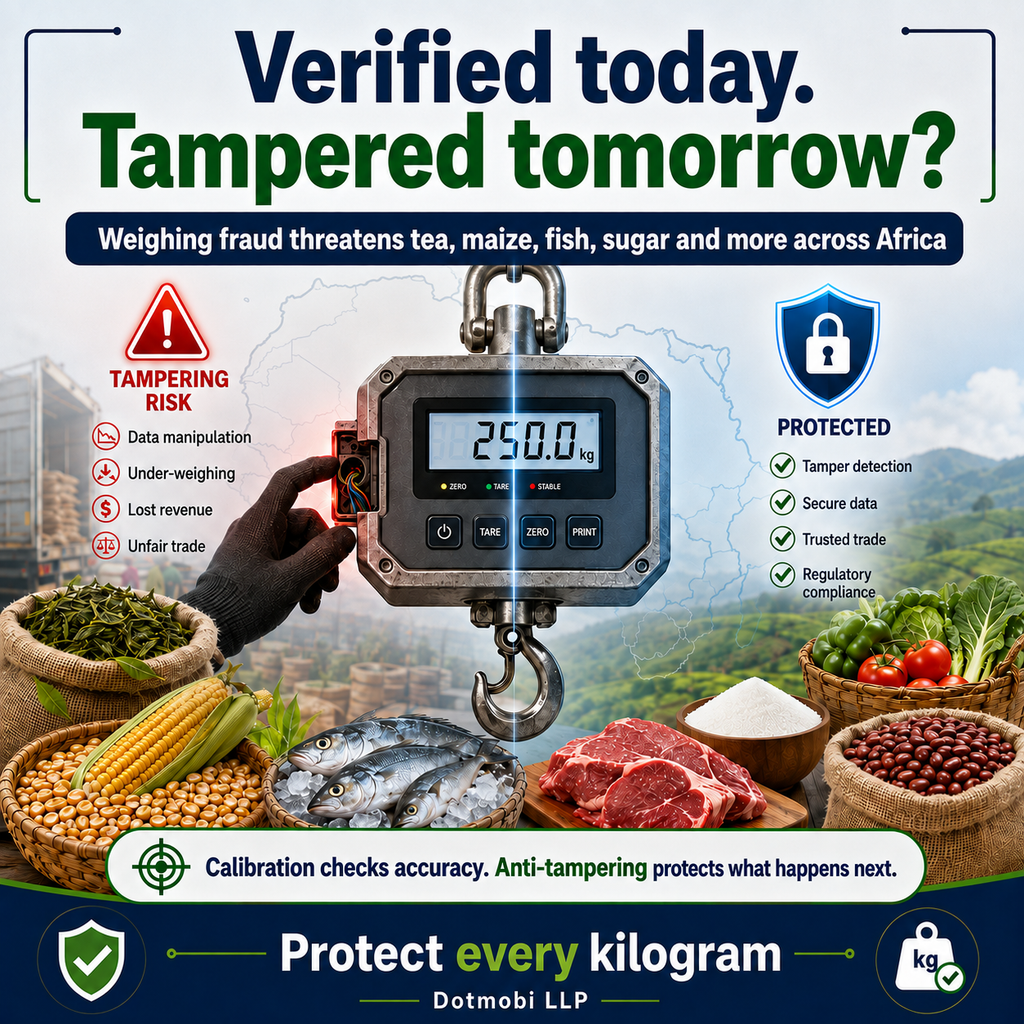
Across Africa, weighing scales play a critical role in determining how much farmers are paid, how much traders receive and whether consumers get the quantity they have paid for. Yet recent reports show that weighing scale tampering in Africa remains a serious concern alongside inaccurate weighing and the use of uncertified or non-compliant scales.
The products affected range from green tea leaf and maize to fish, meat, sugar, vegetables, beans and other agricultural commodities.
This makes weighing-scale integrity not simply a technical issue, but an important economic, agricultural and consumer-protection concern.
Kenya: Green Tea Leaf Weighing Under Scrutiny
In August 2026, authorities in Kenya investigated alleged manipulation of weighing equipment used in the tea sector in Konoin, Bomet County.
A multi-agency operation involving the Tea Board of Kenya, Weights and Measures Department and security officers followed complaints from farmers regarding alleged theft of green leaf and irregular weighing. Several tea factory clerks were arrested, and authorities reported uncovering cases of suspected tampering with weighing equipment at tea buying centres. (The Star)
Read the August 2026 Bomet tea weighing investigation
The product involved was green tea leaf, where farmer payments depend directly on the kilograms delivered.
Tea provides a particularly important example of the risks created by compromised weighing systems. A relatively small discrepancy during an individual transaction can become significant when multiplied across thousands of farmers and millions of kilograms of produce.
Kenya has previously responded to complaints about tea weighing by introducing additional controls and anti-tampering measures. However, continuing enforcement activity demonstrates that weighing-system integrity may require continuous protection rather than reliance only on periodic verification.
The Kenyan experience demonstrates why weighing scale tampering in Africa should increasingly be treated as both a measurement-integrity and revenue-protection issue.
This is particularly relevant because Kenya’s existing Weights and Measures Act, Cap. 513 expressly defines inspection as including checks intended to establish whether an instrument has been modified after verification. (Kenya Law)
Kenya Law – Weights and Measures Act, Cap. 513
Kenya is also considering a new Legal Metrology Bill, 2026, reflecting the continuing modernization of the country’s measurement-regulation framework. (Parliament of Kenya)
Kenyan Parliament – Legal Metrology Bill, 2026
Malawi: Maize, Soya Beans and Beans
In Malawi, farmers in Salima reported in May 2026 that some crop buyers were allegedly using tampered weighing scales while purchasing agricultural produce.
The products involved included:
- maize;
- soya beans; and
- beans.
Farmers also complained that some buyers were purchasing crops below prescribed minimum farm-gate prices. Malawi Broadcasting Corporation reported the farmers’ allegations as part of wider concerns over exploitation during crop marketing. (Malawi Broadcasting Corporation)
Read the Malawi report on farmers and alleged tampered scales
Where payment is determined by weight, manipulation of a scale can directly reduce a farmer’s income even when the apparent buying price seems acceptable.
Zambia: Maize and Grain Buying
Zambia has also faced concerns regarding weighing equipment used by private grain buyers.
In May 2025, the Zambia Metrology Agency (ZMA) urged farmers to trade only with buyers using verified and certified weighing scales.
The agency specifically warned that traders using non-compliant, altered or unverified scales could face regulatory action, including confiscation of equipment, financial penalties or legal proceedings. (Zambia Medicines Authority)
Zambia Metrology Agency – verified scales for grain marketing
The problem is particularly important in maize and grain purchasing, where large quantities are bought from smallholder farmers during harvesting seasons.
A compromised scale therefore has the potential to affect hundreds or thousands of transactions before the irregularity is detected.
Cameroon: Electronic Scale Manipulation
One of the most technically significant recent reports came from Cameroon.
A July 2026 investigation by Cameroon Tribune described questionable weighing practices in markets in Yaoundé, including electronic scales and the use of heavier containers during the weighing of fish.
Products mentioned included fish such as mackerel and sea bass, alongside broader concerns about measurement fraud in markets, bakeries and fuel stations. (Cameroon Tribune)
Read Cameroon Tribune’s investigation into fraudulent weighing
This highlights an important change in the nature of weighing fraud.
Traditional manipulation may involve mechanical interference. Electronic scales, however, introduce additional possible vulnerabilities involving:
- configuration;
- calibration settings;
- internal electronics;
- software parameters; and
- unauthorized access to protected functions.
Consequently, replacing mechanical scales with electronic scales does not automatically eliminate the possibility of manipulation.
Benin: Fish, Meat and Packaged Foods
Benin’s National Agency for Standardisation, Metrology and Quality Control (ANM) has conducted repeated inspections of commercial weighing equipment.
In April 2026, ANM carried out a surprise inspection at the Cotonou fishing port and seized nearly 20 non-certified weighing scales. The operation followed another inspection at a butchery where scales were also seized. (fr.anm.bj)
ANM Benin – enforcement against non-certified weighing scales
Products affected by these types of inspections include:
- fish;
- meat;
- rice;
- sugar;
- wheat flour; and
- other food products.
The enforcement demonstrates the importance African governments and regulators are increasingly placing on legal metrology, fair trade and consumer protection.
Madagascar: Market Food Weighing
Authorities in Madagascar also conducted inspections of market weighing equipment in 2026.
During an inspection exercise at Ambilobe market, 120 weighing scales were checked and 41 required repair because they were non-compliant.
The inspection particularly targeted sellers of meat and vegetables. Authorities emphasized that a correct scale is an important element of trust between a buyer and seller. (L’Express de Madagascar)
Read the Madagascar report on non-compliant market scales
Importantly, not every inaccurate scale is necessarily deliberately tampered with.
Some instruments may become inaccurate through:
- wear;
- poor maintenance;
- improper calibration;
- damage; or
- failure to undergo periodic verification.
However, consumers and farmers ultimately experience the same commercial consequence: an incorrect weight.
Gabon: Crackdown on Fraudulent Scales
In August 2026, Gabon’s standards authority, AGANOR, launched a campaign targeting commercial weighing scales suspected of being manipulated or falsified.
The operation began in the Grand Libreville area, including Owendo and Akanda, and was intended to expand across the country’s provinces.
AGANOR said its legal-metrology inspections were designed to ensure accurate weights, protect consumer purchasing power and identify weighing instruments that had been manipulated or falsified. (L’Union)
Read about Gabon’s 2026 weighing-scale enforcement campaign
The development provides further evidence that weighing integrity is becoming an important consumer-protection issue across Africa.
Uganda: Sugar and Sugarcane
Uganda has also experienced complaints concerning inaccurate weighing.
In one reported case, a consumer purchased what was represented as one kilogram of sugar, only to discover after re-weighing that the quantity was approximately 200 grams short. (Monitor)
Read Uganda’s report on consumer complaints over weighing scales
The country’s sugar industry has separately faced concerns regarding the weighing of sugarcane deliveries.
A Regulatory Impact Assessment reported concerns about inappropriate weighing of sugarcane and recommended clearer standards for weighbridges used within the sector. (Monitor)
Read the Uganda sugarcane weighbridge report
This illustrates that weighing-integrity problems can arise at both ends of the market — from relatively small retail scales to industrial weighbridges handling agricultural commodities.
The Products Most at Risk
Recent African reports show a clear concentration around products whose commercial value is determined directly by weight.
These include:
Green tea leaf, maize, grain, fish, meat, sugar, sugarcane, vegetables, soya beans and beans.
Reports of weighing scale tampering in Africa show that agricultural commodities are particularly vulnerable because transactions are frequent, volumes are high and payments are commonly calculated directly from weight.
For example, if a farmer loses only one kilogram during each transaction, the individual loss may initially appear small.
But when the same discrepancy occurs across hundreds of farmers, several buying centres and many months of deliveries, the cumulative financial impact can become substantial.
This is why protection should increasingly focus not only on the weighing instrument but also on the integrity of the individual weighing transaction.
Dotmobi has previously examined this principle in more detail in “The Farmer Creates the Value. Dotmobi Helps Protect It at the Weighing Point.” (DotMobi LLP)
Read: The Farmer Creates the Value – Dotmobi
Calibration Alone May Not Be Enough
Traditional legal metrology largely depends on:
- inspection;
- calibration;
- verification;
- stamping; and
- sealing of weighing instruments.
These controls remain essential.
However, verification primarily demonstrates that the weighing instrument met the required accuracy and legal requirements at the time it was inspected.
Kenya’s Weights and Measures Act is particularly instructive: its definition of inspection expressly includes checking that an instrument has not been modified after verification. (Kenya Law)
That distinction matters.
A weighing scale can potentially be interfered with after verification through:
- mechanical modification;
- unauthorized configuration changes;
- altered calibration;
- opening protected parts of the instrument;
- scale substitution; or
- other unauthorized interference.
This creates the need for an additional layer of protection:
continuous monitoring of the integrity of the weighing system itself.
Addressing weighing scale tampering in Africa therefore requires more than periodic calibration and verification. It also requires mechanisms capable of detecting unauthorized interference after a scale has been inspected and approved for trade use.
For businesses interested in this broader technology approach, the Dotmobi Cloud-Based IoT Platform provides centralized monitoring capabilities for connected operational systems. (DotMobi LLP)
Explore Dotmobi’s Cloud-Based IoT Platform
From Accurate Weighing to Secure Weighing
Africa’s challenge therefore goes beyond inaccurate weighing.
The deeper problem is measurement integrity.
A secure weighing environment should ideally provide confidence that:
- the authorized weighing scale is being used;
- calibration parameters have not been changed without authority;
- protected parts of the weighing system have not been interfered with;
- suspicious changes can be detected;
- weighing records can be traced;
- abnormal activity can trigger alerts; and
- responsible managers can respond promptly.
This approach shifts weighing protection from periodic inspection alone toward continuous assurance.
Dotmobi has discussed this distinction further in its article on why a patented, secure and integrated anti-tamper device matters in modern weighing systems. (DotMobi LLP)
Read Dotmobi’s guide to secure anti-tamper technology
Why Weighing Scale Tampering in Africa Matters
Agriculture supports millions of livelihoods across Africa.
When farmers sell tea, maize, grain, sugarcane and other produce, they depend heavily on the weighing instrument operated by the buyer.
They rarely have an independent weighing scale available to verify every transaction.
The weighing system therefore becomes an important point of trust between farmer and buyer.
Protecting that point of trust can help:
- protect farmer income;
- reduce commercial disputes;
- strengthen regulatory enforcement;
- improve transparency;
- protect consumers;
- improve confidence in agricultural value chains;
- strengthen auditability; and
- reduce opportunities for internal fraud.
Where money is calculated directly from kilograms, weighing integrity becomes revenue protection.
Dotmobi’s Approach to Weighing Integrity
Dotmobi LLP has developed the Weighing Scale Tampering Guard (WSTG), a patented IoT-based anti-tampering solution designed to strengthen protection of commercial weighing environments.
The solution is intended to detect suspicious or unauthorized interference and support real-time monitoring and tamper alerts. (DotMobi LLP)
Explore the Dotmobi Weighing Scale Tampering Guard (WSTG)
Rather than relying only on periodic inspection, the approach introduces an additional monitoring layer around the weighing process.
The objective is simple:
A verified weighing scale should remain trustworthy after the inspector leaves.
As African governments strengthen legal-metrology enforcement, technologies supporting continuous weighing integrity could become increasingly important in:
- agriculture;
- factories;
- cooperatives;
- retail;
- manufacturing;
- warehousing;
- logistics; and
- other industries where payments or inventory depend on weight.
Conclusion
Recent reports from Kenya, Malawi, Zambia, CaRecent reports from Kenya, Malawi, Zambia, Cameroon, Benin, Madagascar, Gabon and Uganda demonstrate that weighing scale tampering in Africa, together with inaccurate and non-compliant weighing systems, remains an important commercial and consumer-protection concern.
The products may differ, but the underlying commercial risk is similar.
Whenever money is calculated from kilograms, an inaccurate, altered or manipulated weighing instrument can transfer value unfairly from one party to another.
Africa therefore needs to move beyond asking:
“Was this scale calibrated?”
The more important question is increasingly:
“Has this scale remained secure and trustworthy since it was calibrated?”
That is the next frontier in protecting farmers, businesses and consumers from weighing fraud.
For Rank Math, this version now gives you both categories it was asking for:
External links: Kenya Law, Kenyan Parliament, The Star, MBC Malawi, Zambia Metrology Agency, Cameroon Tribune, ANM Benin, Madagascar, Gabon and Uganda sources.
Internal links: WSTG product page, Cloud-Based IoT Platform, the patented anti-tamper article and your farmer/value-protection article.
Keep these external links as ordinary links — do not enable nofollow, sponsored or UGC — so Rank Math recognizes them as DoFollow external resources.