Weighing scale fraud can cause substantial financial losses when inaccurate or unauthorized weight measurements are accepted into commercial transactions.
In Kenya, electronic weighing scales are widely used in tea buying centres, agricultural cooperatives, manufacturing facilities, warehouses, weighbridges, and retail businesses. In these operations, weight measurements often determine how much a farmer, supplier, transporter, or customer receives or pays.
But what happens when a weighing transaction is accepted before the reading stabilizes, when a scale has not returned to the required zero condition, or when an unauthorized device supplies the measurement?
These problems highlight an important weakness in some electronic weighing operations: a system may record a weight without adequately verifying the conditions under which it was captured.
International legal-metrology standards provide guidance on protecting measurement accuracy. Modern weighing automation can complement these requirements through additional transaction controls.
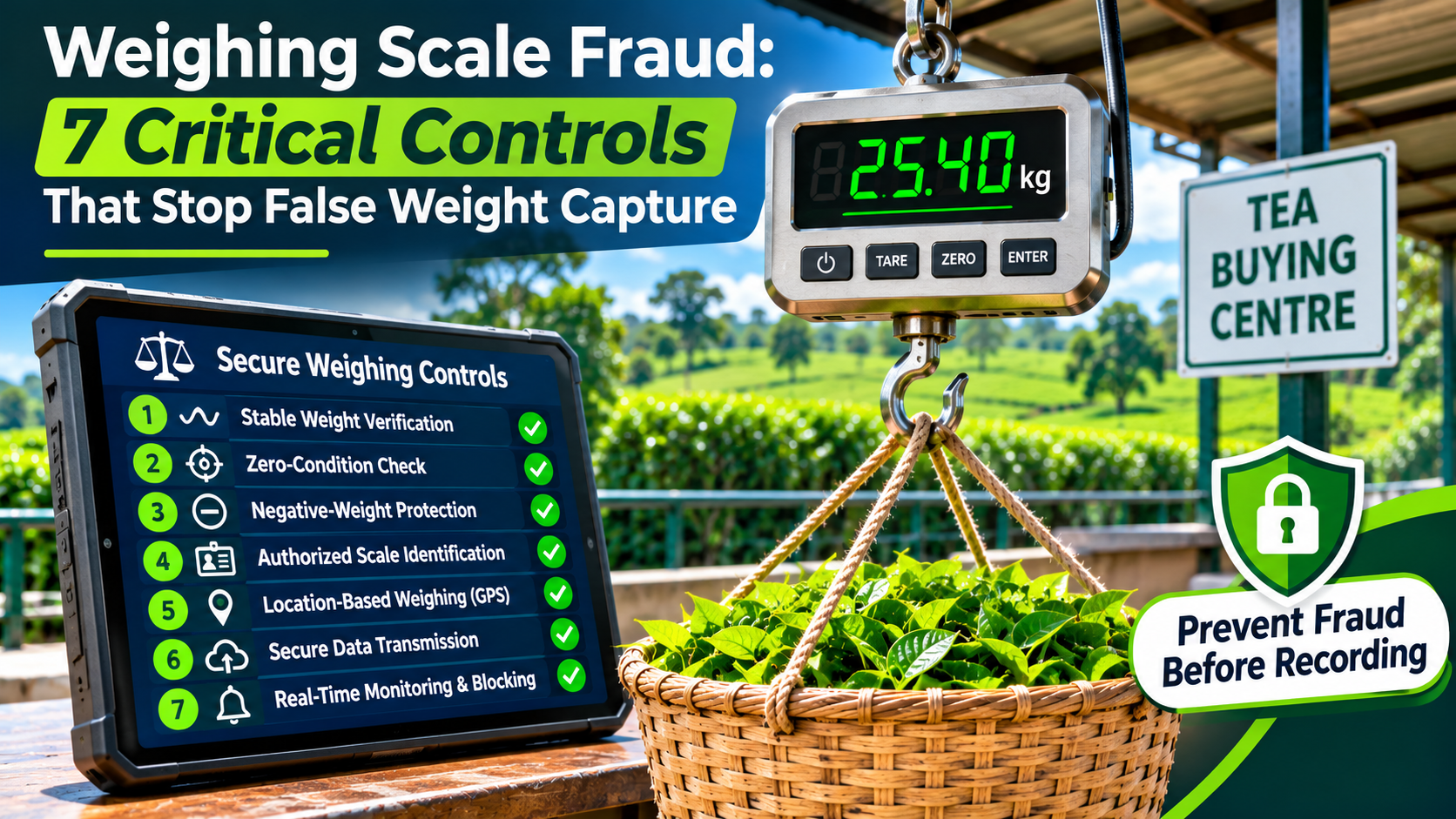
This article examines seven critical controls that can help prevent invalid weight capture before an incorrect measurement enters business records.
What Is Weighing Scale Fraud?
Weighing scale fraud involves deliberate interference with a weighing instrument or associated transaction system to produce or record misleading weight measurements for an unfair advantage.
Examples may include:
- Unauthorized manipulation of calibration settings.
- Deliberate interference with weighing equipment.
- Substitution of approved weighing instruments.
- Improper manipulation of zero or tare functions.
- Recording misleading weight measurements.
- Unauthorized alteration of electronically transmitted weight data.
- Deliberately exploiting weaknesses in weighing procedures.
However, not every inaccurate weighing transaction is fraudulent.
Incorrect readings may also result from equipment faults, unstable loads, operator mistakes, environmental conditions, or improper maintenance.
The objective of modern weighing security is therefore twofold: prevent invalid transactions and preserve enough information to distinguish equipment or operating problems from suspected deliberate interference.
Why Weighing Scale Fraud Prevention Matters in Kenya
Kenya’s agricultural and commercial sectors depend heavily on accurate measurements.
In tea buying centres, farmers are paid according to the recorded quantities of green leaf delivered.
In grain markets, weighing determines the value of produce purchased or sold.
Manufacturers use weighing records to control raw materials, production quantities, and finished goods.
Transport operators rely on weighbridges to determine vehicle and cargo weights.
Recent enforcement operations in Kenya’s tea industry have highlighted concerns about suspected manipulation of electronic weighing systems.
While investigations and regulatory enforcement are important, these incidents raise a broader operational question:
Can electronic weighing systems prevent certain irregular transactions before they are completed?
This is where preventive weighing controls become particularly valuable.
International Standards: Why Stable Weight Capture Is Essential
The International Organization of Legal Metrology (OIML) develops internationally recognized requirements and guidance for measuring instruments.
One particularly relevant publication is OIML R 76-1:2006 — Non-Automatic Weighing Instruments.
Section 4.4.2 addresses stable equilibrium in electronic weighing instruments.
The Recommendation requires applicable instruments to inhibit certain functions, including printing, data storage, zero-setting, and tare operations, when stable equilibrium has not been achieved.
Sections 4.4.5 and 4.4.6 provide further requirements concerning printing and storage of weight measurements under unstable conditions.
These requirements establish an important principle:
A displayed weight should not automatically become an accepted commercial transaction unless the relevant measurement conditions have been satisfied.
Consider a suspended weighing basket containing fresh tea leaves.
Immediately after lifting the basket, the displayed weight may fluctuate because of movement.
If the system captures a reading while the basket is swinging, the recorded measurement may be unreliable.
A properly configured weighing system should recognize the instability and prevent the relevant transaction function until the instrument satisfies the applicable stability criteria.
This is a metrological safeguard, not proof that every unstable reading represents fraud.
Research reference: OIML R 76-1:2006 — Non-Automatic Weighing Instruments
7 Critical Controls to Prevent Weighing Scale Fraud
The following seven controls address vulnerabilities associated with the initial measurement and its acceptance into a weighing transaction.
1. Stable Weight Verification Before Transaction Capture
One important requirement in reliable electronic weighing is ensuring that a measurement has stabilized before it is recorded.
A scale may display changing values while a load is moving, settling, or experiencing vibration.
Capturing a measurement during this period can lead to inaccurate transaction records.
Recommended prevention control:
Configure the weighing application to accept measurements only after the instrument satisfies the required stable-equilibrium criteria.
For example, a tea-buying application should not permit an operator to complete a weighing transaction while the hanging basket is still moving and the scale reports an unstable reading.
This reduces the risk of premature weight capture.
Importantly, an application should use a trustworthy stability indication or validated measurement criteria rather than relying solely on a short software delay.
2. Mandatory Zero Verification Before a New Weighing Cycle
The starting condition of a weighing instrument is critical to obtaining reliable measurements.
If a scale retains an unexpected weight reading after a previous load has been removed, a subsequent transaction could be affected.
Consider a weighing system that is supposed to begin each new transaction with an empty platform or unloaded hook.
If the instrument has not returned to its permitted zero condition, the operator should not be allowed to proceed without the required correction or investigation.
Recommended prevention control:
Before starting a new weighing cycle, verify that the instrument satisfies the prescribed zero condition.
Where the operating procedure requires an unloaded start, the application can prevent a new transaction until that condition is met.
This approach must respect authorized tare operations. A legitimate net-weight procedure may involve a container or other load, and should not be blocked simply because the gross load is non-zero.
Correctly implemented zero verification helps prevent errors associated with improper transaction starting conditions.
3. Negative-Weight Protection and Controlled Recovery
Unexpected negative readings may occur because of incorrect tare settings, equipment problems, operating mistakes, or possible manipulation.
For example, a scale may display a negative measurement after a load is removed while a previous tare value remains active.
Although negative readings are not necessarily fraudulent, accepting them without appropriate checks may create incorrect commercial transactions.
Recommended prevention control:
Configure the application to detect suspicious negative-weight conditions and restrict transaction capture when the reading violates the approved operating procedure.
Recovery should require the appropriate zero or tare conditions to be restored, where applicable.
The objective is not to prohibit every negative display, but to prevent invalid negative values from being accepted as commercial measurements.
4. Authorized Scale Identification and Authentication
Electronic weighing systems increasingly connect to mobile applications, personal digital assistants, computers, and remote management platforms.
If an application accepts measurements from any connected source, unauthorized instrument substitution may become possible.
For instance, an operator could attempt to connect an unapproved weighing device rather than the instrument assigned to a particular buying centre.
Recommended prevention control:
The transaction system should authenticate the approved weighing instrument before accepting measurement data.
The system may use device-specific identifiers combined with suitable authentication mechanisms.
Simple serial-number checks can help with identification, but identifiers alone may be copied or spoofed.
Proper authentication provides stronger protection.
The resulting transaction should identify the instrument from which the accepted measurement originated.
5. Location-Based Weighing Restrictions
Some commercial weighing activities are authorized only at designated facilities.
Tea buying centres, factory collection points, and mobile field-weighing operations may each have approved operating locations.
Location-based controls can help ensure that transactions are recorded from the intended site.
For example, a mobile weighing application can be configured to restrict the start of a transaction when the device is outside its approved operational location.
Recommended prevention control:
Use GPS or other appropriate location-verification mechanisms to restrict transactions to authorized sites where this is operationally necessary.
Location-based controls should be supported by scale authentication and other safeguards.
GPS is subject to positioning errors and possible spoofing, so it should not be treated as independent proof that a weight measurement is accurate.
6. Secure Weight Capture and Data Transmission
Even when a weighing scale produces an accurate reading, the data can become vulnerable if the connection between the instrument and the receiving application is insecure.
An electronic weighing system may transmit measurements to a mobile device, computer, printer, or server.
The security of this connection is therefore important.
The OIML publication D 31:2023 — General Requirements for Software Controlled Measuring Instruments provides guidance concerning legally relevant software, protection of measurement data, software identification, and secure interfaces.
Recommended prevention control:
Implement appropriate safeguards to protect measurement data from unauthorized modification during transmission and processing.
Depending on the equipment and architecture, such safeguards may include:
- Authenticated communication.
- Integrity-protected measurement messages.
- Secure application interfaces.
- Restricted software configuration access.
- Verification that incoming data originates from the approved instrument.
The objective is to ensure that the measurement accepted by the business application corresponds to the measurement produced by the authorized weighing system.
Research reference: OIML D 31:2023 — General Requirements for Software Controlled Measuring Instruments
7. Automatic Transaction Blocking When Validation Fails
The previous six controls become more effective when integrated into a clear transaction-acceptance process.
Instead of merely displaying an alert after something goes wrong, the system can refuse to complete a transaction until defined requirements have been satisfied.
For example, a weighing application may perform the following checks before enabling its transaction-save function:
- Confirm that the connected instrument is authorized.
- Verify the prescribed zero or tare starting condition.
- Confirm that the measurement satisfies the required stability criteria.
- Ensure the reading is valid for the applicable transaction type.
- Verify the authorized location where required.
- Validate the integrity of the received measurement data.
- Accept the measurement only if all applicable conditions have passed.
If a critical condition fails, the system should block the transaction and provide the operator with an appropriate indication.
Some failures may require supervisory intervention or technical investigation.
This is the central principle of prevention-oriented weighing automation: a questionable measurement should not be accepted simply because an operator presses the Save button.
How False Weight Capture Can Cause Financial Losses
Small measurement discrepancies can become financially significant when repeated across numerous transactions.
Consider a hypothetical agricultural buying centre handling 1,000 deliveries per day.
Suppose each delivery is recorded 0.5 kilograms below its actual weight.
| Measurement | Illustrative figure |
|---|---|
| Daily transactions | 1,000 |
| Average under-recording | 0.5 kg |
| Daily weight discrepancy | 500 kg |
| Illustrative commodity price | KES 25/kg |
| Daily financial difference | KES 12,500 |
| Financial difference over 26 working days | KES 325,000 |
These figures are illustrative and do not represent the results of an actual investigation.
They demonstrate why weighing accuracy is important even when discrepancies appear small.
However, prevention controls must be carefully implemented. They should improve measurement reliability without unnecessarily rejecting legitimate transactions or interfering with approved metrological functions.
Why Calibration Alone Cannot Prevent Every Invalid Transaction
Calibration and statutory verification are essential components of responsible weighing operations.
They establish important assurance about instrument performance under specified conditions.
However, a properly verified weighing instrument can still be operated incorrectly.
For example:
- A valid scale may be used while a load is unstable.
- An operator may begin a transaction without the required zero condition.
- An unauthorized connected device may attempt to submit weight data.
- Software may accept a measurement from an unexpected source.
- A valid instrument may be used outside the approved operational procedure.
These problems require operational safeguards in addition to appropriate verification and maintenance.
For a broader explanation of these risks, read Dotmobi’s related article:
Scale Tampering in Kenya: Why Calibration Is Not Enough
How Dotmobi’s Weighing Scale Tampering Guard Supports Prevention
Dotmobi LLP has developed the Weighing Scale Tampering Guard (WSTG), protected by Kenyan Patent No. KE 1086.
The patented technology is designed to strengthen weighing security through monitoring and protection against selected forms of unauthorized interference.
Dotmobi also develops integrated electronic weighing applications that can incorporate transaction-level safeguards.
Depending on the approved equipment, software integration, and deployment configuration, these solutions can support:
- Detection and reporting of selected tampering events.
- Stable-weight verification before transaction capture.
- Zero-condition checks.
- Protection against suspicious negative-weight transactions.
- Authorized weighing instrument identification.
- Location-controlled mobile weighing.
- Prevention of transactions that fail configured validation rules.
An important distinction is that the WSTG device and the wider integrated weighing application may perform different functions.
Their combined capabilities depend on the particular deployment and should not be assumed to be present in every installed device.
Dotmobi’s approach is to strengthen protection at the weighing point while supporting appropriate monitoring and accountability.
Learn more: Dotmobi Weighing Scale Tampering Guard (WSTG)
Weighing Fraud Prevention Versus Tea Weight Traceability
Preventing invalid weight capture is not the same as tracing a legitimate measurement through subsequent business processes.
These are related but different responsibilities.
Weighing fraud prevention focuses on validating the measurement before the transaction is accepted.
Tea weight traceability focuses on the subsequent relationship between an accepted weight, the delivery record, the farmer’s account, and the payment process.
For example, a properly captured weight may still be allocated incorrectly in a downstream records system.
Likewise, a transaction may be correctly allocated to a farmer but contain an inaccurate original measurement.
A complete weighing-integrity strategy should therefore address both stages.
This article focuses specifically on preventing inaccurate or unauthorized measurements at the point of capture.
For the subsequent record-management process, read:
Tea Weight Traceability Kenya: Why Every Kilogram Needs a Digital Audit Trail
Which Businesses Can Benefit from Preventive Weighing Controls?
Tea Factories and Agricultural Buying Centres
Stable-weight verification, approved instrument identification, and appropriate zero checks can help protect green-leaf weighing operations.
Weighbridge Operators
Validated transaction procedures can support secure first and second weighing, stable-load measurement, and proper equipment identification.
Manufacturing and Industrial Processing
Factories can strengthen the reliability of measurements used for raw material receipts, production monitoring, and dispatch.
Grain and Commodity Traders
Preventive controls can reduce the risk of questionable measurements being accepted into commercial buying and selling records.
Warehouses and Distribution Centres
Integrated weighing safeguards can help protect goods-receipt and dispatch transactions from operational errors and unauthorized interference.
Frequently Asked Questions About Weighing Scale Fraud
What causes false weight capture?
False weight capture may result from unstable loads, incorrect zero or tare conditions, faulty equipment, inappropriate procedures, or deliberate interference with a weighing system.
Can an electronic weighing application block an unstable reading?
Yes. A properly designed application can prevent transaction capture until the connected instrument satisfies the applicable stability requirements.
Why should a weighing scale return to zero?
For operations requiring an unloaded starting condition, returning to the permitted zero indication helps prevent residual readings from affecting the next transaction. Legitimate tare-based procedures must also be supported.
Is every negative weight reading evidence of fraud?
No. Negative readings may arise from normal tare operations, equipment faults, or operator mistakes. Unexplained readings should be assessed against the approved operating procedure.
Can GPS prevent weighing scale fraud?
GPS-based restrictions can help control where mobile weighing transactions are conducted. They cannot independently prove measurement accuracy or eliminate all forms of tampering.
What is the difference between fraud detection and prevention?
Detection identifies suspicious activity or irregularities. Prevention uses controls to stop specified invalid operations or transactions before they are accepted.
What is Dotmobi’s WSTG?
The Dotmobi Weighing Scale Tampering Guard is a patented anti-tampering technology designed to detect selected forms of interference and strengthen electronic weighing security.
Conclusion: Prevent False Weight Capture Before It Enters Business Records
Accurate weighing requires more than a functioning digital display.
A reliable transaction should originate from the authorized instrument, satisfy the required measurement conditions, and pass the relevant validation checks before being recorded.
International legal-metrology requirements provide an important foundation for this approach.
By combining stable-weight verification, zero-condition checks, instrument authentication, secure communication, and automatic transaction blocking, businesses can strengthen the reliability of their weighing operations.
The most effective time to stop an invalid weighing transaction is before it is accepted.
Protect Your Weighing Operations with Dotmobi LLP
Does your organization depend on accurate and secure commercial weighing?
Dotmobi LLP provides weighing automation, electronic measurement integration, and anti-tampering solutions for agricultural, industrial, and commercial applications.
Contact Dotmobi to discuss how the patented Weighing Scale Tampering Guard and appropriate preventive weighing controls can help strengthen your operations.
Telephone: +254 722 761 322
Email: info@dotmobi.co.ke
Website: https://dotmobi.co.ke/
Dotmobi LLP — Accurate Weights. Protected Transactions. Greater Accountability.