
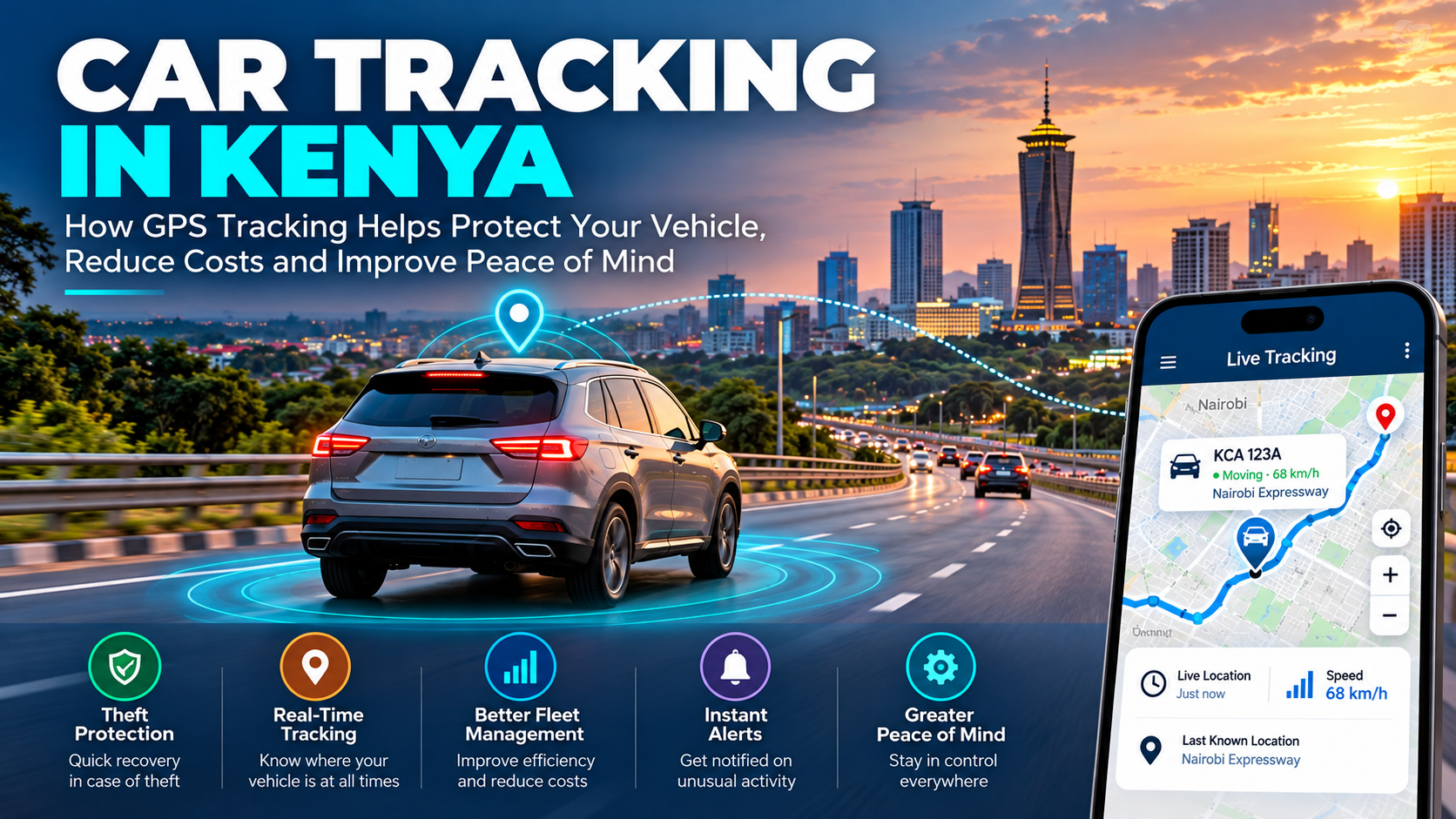
Car tracking in Kenya is becoming increasingly important as vehicle owners and businesses face risks ranging from ordinary theft to sophisticated vehicle-identity manipulation and organised cross-border crime.
A major Kenyan enforcement operation in October 2026 provides a timely reminder that vehicle security is no longer only about locking the doors, installing an alarm or parking in a secure location.
During Operation Carback II, Kenyan authorities carried out a nationwide crackdown targeting local and transnational motor vehicle theft networks. According to the Directorate of Criminal Investigations, detectives physically inspected more than 1,800 vehicles and checked over 260,000 vehicles against the INTERPOL database.
The exercise uncovered stolen vehicles as well as vehicles with suspicious registration and identification details.
For motorists and fleet operators, the lesson is clear:
Vehicle security should combine physical protection, proper vehicle identification and real-time digital monitoring.
The developments also reinforce why car tracking in Kenya should be considered before a vehicle disappears rather than after a theft has already occurred.
What Was Operation Carback II?
Operation Carback II was a week-long multi-agency crackdown that concluded on 16 October 2026.
It was spearheaded by the Directorate of Criminal Investigations through its INTERPOL National Central Bureau in Nairobi and Operations Directorate.
The operation also involved agencies including the National Transport and Safety Authority, Kenya Revenue Authority, Kenya Bureau of Standards and police services.
Kenya participated as part of an international initiative coordinated under INTERPOL’s Project Drive Out in collaboration with Europol.
The operation covered Nairobi, Eastern, Central, Nyanza, Western, Coast and Rift Valley regions.
Investigators targeted:
- motor vehicle yards;
- showrooms;
- garages;
- spare-parts businesses;
- vehicle bazaars; and
- highway checkpoints.
For motorists considering car tracking in Kenya, the operation demonstrates how quickly vehicle theft can develop into a wider identification, resale or cross-border problem.
A Vehicle Stolen in the UK Was Found in Nairobi
One of the most striking discoveries during Operation Carback II was a grey Land Rover Discovery found at a motor vehicle yard along Nairobi’s Northern Bypass.
Checks against the INTERPOL database established that the vehicle had been reported stolen in the United Kingdom.
It was subsequently impounded and taken to DCI Headquarters for further investigations.
The case demonstrates how modern motor vehicle theft can extend far beyond the location where a vehicle was originally stolen.
A stolen vehicle may potentially be:
- moved to another county;
- transported across international borders;
- fitted with different registration plates;
- repainted;
- dismantled for spare parts;
- hidden in a garage or vehicle yard; or
- introduced into the second-hand vehicle market.
This is why car tracking in Kenya should be considered one part of a wider vehicle-security strategy.
Tracking cannot prevent every form of vehicle crime, but it can provide valuable location and movement information while a tracker remains operational and communicating.
Vehicle Identity Can Also Be Manipulated
Operation Carback II also revealed suspicious identification discrepancies.
In Thika West, detectives found a Mercedes-Benz Kompressor carrying a registration number that official records associated with an orange Suzuki station wagon.
In Embakasi, investigators recovered a forklift whose displayed registration records reportedly belonged to a crawler. Its chassis number had also been obliterated, prompting further investigations.
Another DCI operation in Moyale on 8 October 2026 recovered a Toyota Prado whose chassis number did not correspond with registration information held by NTSA.
These cases show that vehicle security is not simply about preventing somebody from driving away with a car.
Vehicle identity itself can become part of the crime.
That is an important lesson for anyone investing in car tracking in Kenya: GPS monitoring should complement, rather than replace, proper vehicle documentation and identity verification.
A 2026 Recovery Shows Why Vehicle Tracking Matters
A separate Kenyan incident earlier in 2026 demonstrates the practical value of vehicle tracking.
In February, police recovered a high-end Mercedes-Benz that had disappeared from a garage in Nairobi’s Spring Valley area.
Reports indicated that detectives recovered the vehicle after it was tracked along Mombasa Road in Kajiado South Sub-County.
The case illustrates one of the most important benefits of car tracking in Kenya:
Location Information Can Help Narrow the Search Area
Without tracking, a vehicle owner may only know where a vehicle was last seen.
With an active GPS tracker, authorised users may be able to determine information such as:
- the vehicle’s latest reported location;
- previous routes;
- direction of travel;
- ignition events;
- stopping points; and
- movement outside an authorised area.
The exact information available depends on the tracking device, installation and platform being used.
A GPS tracker does not guarantee recovery, but it can give the owner and authorised responders information that would otherwise be unavailable.
7 Powerful Features to Consider in Car Tracking in Kenya
Modern car tracking in Kenya should provide much more than a dot moving across a map.
Before choosing a vehicle tracking solution, consider whether it provides the following capabilities.
1. Real-Time GPS Location
Real-time vehicle tracking allows an authorised user to see the latest reported position of the vehicle.
This can be useful for:
- private cars;
- motorcycles;
- delivery vehicles;
- school vehicles;
- company cars; and
- commercial fleets.
If a vehicle moves unexpectedly, the owner can quickly establish its latest reported location.
For vehicle owners comparing car tracking in Kenya, real-time location monitoring should therefore be one of the first capabilities considered.
2. Route History
Knowing where a vehicle is currently located is important.
Knowing where it has travelled can be equally valuable.
Route history can help vehicle owners and businesses:
- verify deliveries;
- review field visits;
- investigate unusual journeys;
- monitor vehicle utilisation;
- verify authorised routes; and
- resolve disputes regarding vehicle movements.
For businesses, route history transforms a GPS tracker from a simple security device into a useful fleet-management tool.
3. Geofencing
A geofence is a virtual boundary created around a particular geographical area.
The tracking platform can generate an alert when a vehicle enters or leaves that area.
For example, a business might establish a geofence around:
- company premises;
- a warehouse;
- a school;
- a customer’s site;
- a delivery zone; or
- an authorised operating area.
If the vehicle leaves the defined area unexpectedly, the event can be investigated.
Geofencing makes car tracking in Kenya particularly useful for organisations that operate vehicles within defined routes or geographical areas.
4. Ignition Monitoring
A vehicle’s ignition status provides useful information about how it is being used.
An ignition event occurring at an unexpected time may require attention.
For businesses, ignition monitoring can also help determine when vehicles start and stop operating.
Combined with location information, ignition monitoring can provide a clearer picture of vehicle activity.
5. Movement Alerts
A vehicle that begins moving when it is supposed to be parked may require immediate investigation.
Movement alerts can therefore provide an additional security layer.
They can be especially useful for vehicles parked:
- overnight;
- at construction sites;
- at company premises; or
- in remote locations.
This is another reason businesses increasingly consider car tracking in Kenya as both a security and fleet-accountability tool.
6. Power-Disconnection Alerts
A thief may attempt to interfere with a vehicle’s electronics or tracking equipment.
Some tracking devices can detect interruption of their normal external power supply and notify the monitoring platform.
This can provide an early warning that something unusual may be happening.
However, effectiveness depends on the tracker, installation method, backup battery and network connectivity.
7. Speed Monitoring
Speed monitoring can help fleet managers identify potentially unsafe driving.
Depending on the platform, alerts may be generated when a vehicle exceeds a predetermined speed.
This capability can help organisations improve:
- driver accountability;
- road safety;
- fleet management; and
- operating discipline.
For commercial users, this means car tracking in Kenya can contribute to vehicle security while also improving day-to-day fleet visibility.
Car Tracking Should Not Be the Only Security Measure
The recent DCI operations demonstrate an important limitation.
A GPS tracker cannot replace proper vehicle identification and documentation.
Vehicle owners — particularly people purchasing second-hand vehicles — should verify important information including:
- chassis or VIN details;
- registration information;
- ownership records;
- number plates; and
- applicable official documentation.
Tracking primarily provides visibility over vehicle location and movement.
Registration verification helps confirm vehicle identity.
Physical security protects access to the vehicle.
A stronger vehicle-security strategy combines all three.
Therefore, installing car tracking in Kenya should be regarded as an additional security layer, not a substitute for physical protection, proper documentation or official verification.
Why Car Tracking in Kenya Is Valuable for Businesses
For companies, GPS tracking is not only about recovering stolen vehicles.
It can also improve everyday fleet accountability.
Businesses can use vehicle tracking to monitor:
- delivery progress;
- authorised routes;
- driver movements;
- customer visits;
- excessive stops;
- vehicle utilisation;
- speed events;
- arrival times; and
- departure times.
This can be valuable for organisations such as:
- delivery companies;
- schools;
- NGOs;
- sales organisations;
- construction companies;
- transport businesses;
- field-service companies; and
- distribution businesses.
A company may therefore invest in car tracking in Kenya for security and at the same time gain better operational visibility over its vehicles.
For another practical example, read our article on why car tracking in Kenya can protect customer trust when delivery vehicles are delayed.
Dotmobi Car Tracking Solutions in Kenya
Dotmobi provides GPS motorcycle and vehicle trackers in Kenya for individual vehicle owners and organisations operating vehicle fleets.
Our tracking solutions are designed to help customers improve visibility over the location, movement and use of their vehicles.
Depending on the selected solution and customer requirements, functionality can include:
- real-time GPS monitoring;
- route history;
- movement monitoring;
- speed monitoring;
- security support;
- fleet reporting; and
- vehicle activity records.
For organisations managing cars, motorcycles, vans, pickups or other fleet vehicles, car tracking in Kenya can provide information that supports both security and operational accountability.
The objective is not simply to show where a vehicle is.
It is to help the owner understand what the vehicle is doing and identify unusual activity early.
What Can Vehicle Owners Learn From Operation Carback II?
Operation Carback II demonstrates that modern vehicle crime can involve far more than simply stealing a car.
Vehicles may move between regions or countries.
Registration plates can potentially be changed.
Vehicle identities may be manipulated.
Vehicles may also enter resale or spare-parts networks.
These findings make car tracking in Kenya increasingly relevant for owners who want an additional layer of visibility over valuable vehicles.
At the same time, tracking should work alongside:
- secure parking;
- alarms;
- immobilisation where appropriate;
- controlled access to keys;
- correct registration records; and
- verification of vehicle identification information.
The February 2026 Mercedes-Benz case also demonstrates how tracking information can contribute valuable location intelligence during a recovery effort.
The best time to install a tracker is therefore before an emergency happens.
Once an untracked vehicle disappears, an owner cannot go back in time and obtain its previous GPS route.
Frequently Asked Questions About Car Tracking in Kenya
Can Car Tracking in Kenya Help Recover a Stolen Vehicle?
Yes, it can assist.
A functioning GPS tracker may provide location and movement information that can help authorised persons and law-enforcement officers narrow down a search area.
However, vehicle recovery cannot be guaranteed because effectiveness depends on factors including tracker installation, device condition, network coverage and whether criminals interfere with the tracker.
Can I Monitor My Vehicle From My Phone?
Many modern vehicle-tracking systems allow authorised users to monitor vehicles using a smartphone or web-based tracking platform.
This makes car tracking in Kenya useful even when the owner is far away from the vehicle.
Can a Tracker Show Where My Car Travelled Previously?
Yes, if route-history functionality is available and the relevant data has been retained.
The owner can normally review previous vehicle journeys for the historical period supported by the tracking platform.
Is Car Tracking Useful for Businesses?
Yes.
Businesses can use vehicle tracking for both security and operational management.
It can assist with deliveries, field visits, fleet utilisation, route monitoring and driver accountability.
Can GPS Tracking Prevent Vehicle Theft?
GPS tracking does not physically prevent every vehicle theft.
Its main value is providing location, movement and activity information.
For stronger protection, car tracking in Kenya should be combined with other security measures such as secure parking, alarms, immobilisation where appropriate and good access-control procedures.
Protect the Vehicle Before You Need to Find It
A motor vehicle can represent years of savings, an essential family asset or an important source of business income.
Recent Kenyan enforcement operations show that vehicle theft can involve organised and increasingly sophisticated networks.
Installing reliable car tracking in Kenya gives vehicle owners another important layer of visibility.
The lesson from Operation Carback II is that vehicle security should not begin after something goes wrong.
Do not wait until the vehicle disappears to start wondering where it went.
Need Car Tracking in Kenya?
Dotmobi LLP provides GPS vehicle and motorcycle tracking solutions for individuals, businesses and fleet operators.
Whether you need to monitor a single personal vehicle, delivery motorcycles or a company fleet, Dotmobi can advise on a suitable tracking solution.
View Dotmobi GPS motorcycle and vehicle trackers
Call: +254 722 761 322
Email: info@dotmobi.co.ke
Website: dotmobi.co.ke
Track the vehicle. Monitor the journey. Protect the asset.