
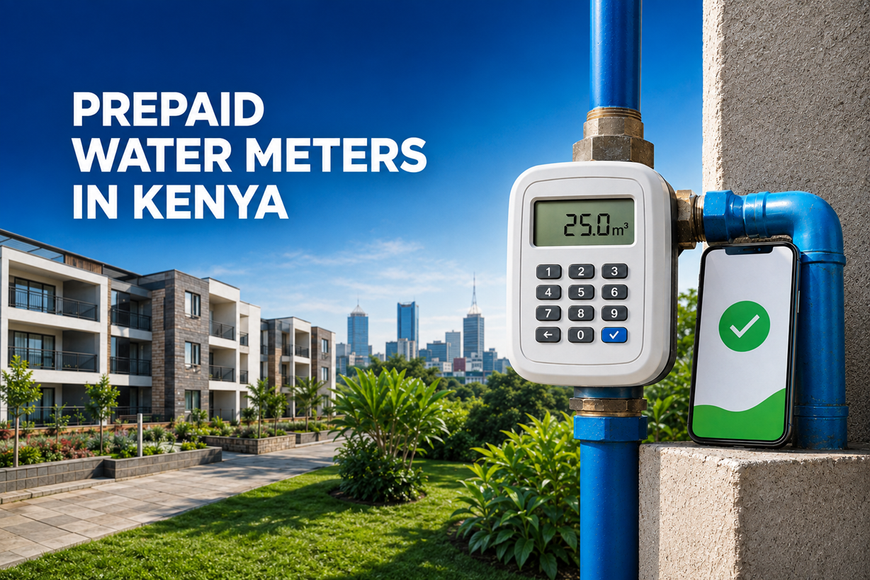
Kenya is accelerating the adoption of prepaid and smart water meters to improve billing, accountability and water-loss control.
For years, prepaid water meters in Kenya were mainly associated with rental properties, borehole projects and community water points. Today, the situation is changing.
Prepaid and smart water metering is increasingly appearing in county water programmes, regulated utility investment plans, apartment developments, gated communities and institutional water systems.
The driving forces are clear: Kenya must reduce water losses, improve billing accuracy, protect revenue and give consumers better control over what they use and pay for.
Kenya’s Water-Loss Problem Has Become Urgent
The latest WASREB IMPACT 18 Water Services Sector Performance Report, covering the 2024/2025 financial year, reported:
- Water coverage within regulated service areas of approximately 72%
- A national metering ratio of 97%
- Revenue-collection efficiency of 94%
- Non-revenue water of 48%, up from 44% in the previous reporting period
Non-revenue water is water that is produced but does not generate revenue because of leaks, illegal connections, inaccurate meters, meter-reading errors or weaknesses in billing systems.
The figures reveal an important lesson: installing an ordinary meter is not enough. Kenya needs accurate meters connected to dependable payment, monitoring and water-loss-control systems.
A prepaid water meter addresses the commercial side of this problem by connecting actual consumption to payment. When combined with bulk meters, leak monitoring and proper network maintenance, it can become part of a much stronger water-management system.
Nairobi Has Approved a Major Prepaid and Smart-Metering Programme
One of the strongest signs of Kenya’s transition appears in Nairobi.
The official Kenya Gazette notice of 27 February 2026 approved an extensive metering and non-revenue-water reduction programme for Nairobi City Water and Sewerage Company.
The approved investments include:
- 40,000 prepaid ultrasonic customer water meters
- 300 prepaid water dispensers
- Smart meters for high-volume consumers
- Bulk and distribution-line ultrasonic meters
- Smart meters at production points, reservoirs and transmission offtakes
- Replacement of tens of thousands of ageing or malfunctioning meters
- Real-time water-data capture, transmission and analysis
The overall metering programme is valued at approximately KES 2.58 billion. The 40,000 prepaid ultrasonic meters alone have an approved allocation of about KES 1.02 billion for implementation between the 2026/2027 and 2028/2029 financial years.
Nairobi Water is also expected to reduce non-revenue water from 54% to 39% by 2028/2029 while maintaining a 100% metering ratio.
This does not mean that every Nairobi connection will immediately become prepaid. It does, however, confirm that prepaid water metering has entered mainstream utility planning in Kenya.
Counties Are Also Adopting Prepaid Water Technology
The transition is not limited to Nairobi.
The County Government of Makueni reported installing smart meters at 31 water points. Consumers use prepaid cards or mobile-money wallets to pay for the exact volume of water drawn.
The county also secured KES 39 million to support smart-meter installations through its three water service providers.
In northern Kenya, prepaid water dispensers—commonly called water ATMs—have been used in community water projects. A 2025 study of prepaid smart metering in Marsabit County found that meter efficiency, reliability and billing accuracy significantly influenced the performance of community water projects.
Taken together, these developments show that Kenya’s prepaid-meter market is growing through several channels:
- Regulated water utilities
- County water projects
- Community boreholes and water kiosks
- Apartments and rental houses
- Gated communities
- Schools, hospitals and institutions
- Factories and commercial premises
Smart Water Meter and Prepaid Water Meter: What Is the Difference?
The terms “smart” and “prepaid” are sometimes used as though they mean the same thing, but there is an important difference.
A smart water meter can automatically record and transmit consumption data. It may still operate under postpaid billing.
A prepaid water meter requires the user to purchase water credit before consumption. The meter deducts the volume used from the available credit and, depending on its configuration, can control the water supply when the credit is exhausted.
A meter can be both smart and prepaid when it combines advance payment, automated control and remote data communication.
For landlords and water projects primarily concerned about arrears, a prepaid meter may be the priority. For utilities trying to identify leaks and monitor an entire distribution network, smart bulk and customer meters must work together.
Why Prepaid Water Meters Make Sense in Kenya
1. They reduce unpaid water bills
Users purchase water credit before consumption. Landlords, institutions and water projects do not have to pursue large accumulated bills after the water has already been used.
2. They improve billing fairness
Each household, tenant or user pays according to measured consumption instead of relying on estimated bills or dividing one shared bill among several users.
3. They give consumers more control
A consumer can monitor the remaining balance, adjust usage and top up according to the household budget.
4. They strengthen revenue collection
Payments can be linked to individual meters, creating a clearer transaction record and reducing dependence on manual cash collection.
5. They encourage responsible consumption
When consumers can see the relationship between usage and the remaining credit, they are more likely to notice unusual consumption, leaking taps or unnecessary wastage.
6. They simplify tenant handovers
When a tenant moves out, the property owner is less likely to inherit a large unpaid water bill because the water was paid for before use.
How an M-Pesa Prepaid Water Meter Works
A properly integrated prepaid system can make water purchasing as convenient as buying prepaid electricity.
The typical process is:
- The consumer pays for water credit using M-Pesa.
- The water-management platform confirms the payment.
- A secure token is generated for the customer’s meter.
- The consumer enters the token through the meter interface or Customer Interface Unit.
- The purchased water credit is loaded.
- The meter deducts credit as water is consumed.
- The consumer tops up when the balance becomes low.
Dotmobi has developed a locally supported prepaid water-management platform that can integrate M-Pesa payments with token generation for compatible meters.
Prepaid Meters Should Be Integrated With Bulk Metering
A prepaid meter at each apartment or water point can improve individual accountability, but it cannot identify every upstream loss.
For stronger water-loss control, a bulk meter should measure all water entering the property or distribution network. The combined readings from the individual prepaid meters can then be compared with the bulk-meter reading.
A significant difference may point to:
- A leaking underground pipe
- An overflowing storage tank
- An illegal connection
- A bypassed or damaged meter
- Unmetered consumption
- Meter-reading or data errors
Dotmobi’s approach to integrating bulk meters with individual prepaid water meters helps property managers and water projects detect losses before they become large financial problems.
What to Check Before Buying a Prepaid Water Meter in Kenya
Before selecting a system, consider more than the purchase price.
Confirm:
- The required meter size and expected flow rate
- Water pressure and installation conditions
- Token security and STS compatibility
- Availability of M-Pesa vending
- Whether a Customer Interface Unit is required
- Availability of consumption and transaction reports
- Local installation and technical support
- Availability of spare parts
- Bulk-meter and platform-integration capability
- Procedures for low balances, faults and emergency access
- Applicable approval and verification requirements
Where water is sold by measured volume, the buyer should confirm the relevant legal-metrology requirements. Kenya’s Weights and Measures Department is responsible for type approval and verification of measuring instruments used in trade.
Public water-service tariffs must also follow the rates approved by WASREB. Prepaid technology should improve billing and collection, not be used to impose unexplained or unauthorised charges.
Dotmobi Prepaid Water Meter Solutions
Dotmobi STS prepaid water meters are suitable for:
- Apartments and rental houses
- Gated communities
- Borehole water projects
- Community water schemes
- Schools and colleges
- Hospitals and churches
- Factories and staff housing
- Commercial buildings
- Water kiosks and vending points
Dotmobi can assist with meter selection, installation planning, STS token management, M-Pesa integration, bulk-meter integration and consumption monitoring.
The Future of Prepaid Water Metering in Kenya
Kenya has not yet moved every water consumer to prepaid metering. However, the direction is becoming clear.
With non-revenue water at 48%, utilities and property managers cannot continue relying only on manual meter reading, estimated bills and delayed collections. Nairobi’s approved investment in 40,000 prepaid meters, together with county and community deployments, indicates that prepaid and smart metering will play an increasingly important role in Kenya’s water sector.
The strongest results will come from treating the meter as one part of a complete system—combining accurate measurement, secure payment, bulk-meter reconciliation, leak detection, transparent tariffs and dependable technical support.
For a prepaid water meter quotation or installation assessment, contact Dotmobi LLP:
Call: +254 722 761 322
Email: info@dotmobi.co.ke
Website: www.dotmobi.co.ke
Frequently Asked Questions
Are prepaid water meters legal in Kenya?
Yes, prepaid water meters can be used in Kenya. Where water is sold by measured volume, applicable metrology, consumer-protection and tariff requirements should be observed.
Can a prepaid water meter use M-Pesa?
Yes. A compatible prepaid-meter platform can connect M-Pesa payment confirmation to secure water-token generation.
How much does a prepaid water meter cost in Kenya?
The cost depends on the meter size, communication technology, Customer Interface Unit, installation requirements, vending platform and number of meters required. A site assessment provides a more reliable quotation than the meter price alone.
Do prepaid water meters automatically stop water?
Many models contain a control valve that restricts supply when the available credit is exhausted. The exact operation depends on the meter and its configuration.
Are prepaid water meters suitable for apartments?
Yes. They allow individual tenants to pay for their actual consumption and reduce disputes arising from shared or estimated water bills.
Can prepaid meters reduce non-revenue water?
They can reduce commercial losses associated with unpaid consumption, inaccurate manual billing and weak collection controls. Physical losses from leaking pipes require bulk metering, leak detection, pressure management and timely repairs.